
You Ran the Cap Rate Numbers on a Cleveland Duplex. They Look Spectacular. Nobody Told You That the City Will Tax Your Rental Income at 2.5%, the House Needs a Lead Safe Certificate Every Two Years, and Accepting $50 of Late Rent From Your Tenant Will Destroy Your Entire Eviction Case.
You found a double on the West Side — an over-under two-family with separate meters, listed at a price that would barely buy a parking spot in your home state. You plugged the gross rents and the asking price into your spreadsheet, subtracted 8% for management, estimated insurance and taxes from the county auditor's website, and the projected cap rate came back at 11.2%. You may have also looked at Columbus properties after reading about Intel's $28 billion semiconductor campus, or Dayton rentals near Wright-Patterson Air Force Base where military tenants pay with government BAH checks.
Then Ohio happened. Your spreadsheet didn't include the 2.5% municipal income tax that Cleveland levies on your net rental profits through the Central Collection Agency. It didn't include the $300 to $900 biennial Lead Safe Certification fee that every pre-1978 rental must pay or face $200-per-violation fines. It didn't include the $500+ annual cost of a Local Agent in Charge that the Residents First ordinance requires because you live outside Cuyahoga County. It didn't include the property management attorney retainer you need because Cleveland Housing Court does not allow your LLC to self-represent in eviction proceedings. It didn't include the three months of lost rent from the eviction that failed because you accepted a partial payment of $50 after serving the three-day notice, voiding the entire legal process. Your 11.2% cap rate is now 6.8%, and that's before the tenant whose security deposit you returned four days late sues you for double damages plus attorney fees under ORC 5321.16.
Here's what no single free resource explains: Ohio layers a municipal income tax system administered by RITA and the CCA — where your rental property's city claims 1.8% to 2.5% of your net rental profits and the penalties for non-filing compound at 15% of unpaid tax plus $25 per month plus 9% to 10% annual interest with a six-year lookback — against a mandatory Lead Safe Certification regime in Cleveland and Toledo where pre-1978 rentals face recurring $300-$900 assessments or $50-per-day fines — against an absentee-owner registration system with criminal misdemeanor penalties and joint civil liability for your appointed local agent — against a judicial foreclosure process that traps distressed-note capital for 12 to 18 months — against an eviction procedure where the exact statutory language of a single warning paragraph determines whether your case survives or is dismissed at the first hearing — and the 2026 HB 186 property tax reform just eliminated the Non-Business Property Tax Credit for every non-owner-occupied residential property in the state. Each of these has bankrupted real Ohio investors because the information existed — scattered across CCA filing instructions, Cleveland Housing Court local rules, CMHA voucher payment standards, county auditor records, BiggerPockets cautionary tales, and ORC sections 1923.04 and 5321.16 — but nobody assembled it into a single operational manual calibrated to how Ohio rental investing actually works.
The Ohio Investment Property Guide is an Ohio Landlord Compliance System — not a motivational overview of Midwest cap rates, but a structured reference that maps every Ohio-specific municipal tax, lead paint mandate, LAIC registration, eviction procedure, DSCR financing mechanic, and market-by-market yield analysis into a process you work through before your earnest money is at risk. It replaces months of cross-referencing CCA tax forms, Cleveland Building and Housing certification requirements, Housing Court local rules, CMHA inspection checklists, and county conveyance fee schedules with a single guide that tells you exactly what to budget, exactly what to file, and exactly where deals go wrong in this state.
What's Inside the Ohio Landlord Compliance System
A comprehensive 65-page guide, a quick-start checklist, and 8 standalone printable tools (10 PDFs) — covering every stage from entity formation through exit strategy, built specifically for the tax structures, compliance mandates, and legal procedures that make Ohio different from every other state:
Municipal Income Tax Filing System
Ohio's municipal income tax is the single most financially destructive blind spot for out-of-state investors. Cleveland, Columbus, and Toledo each levy 2.5% on net rental profits. Cincinnati charges 1.8%. These taxes are administered by the Central Collection Agency (CCA) or the Regional Income Tax Agency (RITA), depending on which municipality your property sits in. The guide explains the filing thresholds ($125 gross monthly rent under CCA, $250 under RITA), walks through the exact Schedule E deductions that reduce your taxable base, calculates how the municipal tax compresses your effective cap rate by 40 to 60 basis points, and maps the penalty structure that catches non-filers: 15% of unpaid tax, $25 per month the return stays unfiled, 9% to 10% annual interest, and a statutory six-year lookback that permits the taxing authority to audit years of unfiled returns retroactively. It covers the specific trap where out-of-state investors who also reside in an Ohio municipality may owe taxes to both their residence city and the city where the property is located — and explains the credit system that may or may not offset the overlap.
Four-Market Yield and Appreciation Analysis
Ohio is not one real estate market. Cleveland delivers 8.8% to 8.9% multifamily cap rates and single-family gross yields above 10% — but vacancy runs 8.5% to 9.5% and the West Side and East Side are functionally different economies. Columbus operates on a 2.0-month housing supply with cap rates compressing to 5.75% to 7.0%, anchored by Intel's semiconductor campus that has shifted from a speculative frenzy (2022) to a patient five-year position trade (operational timeline pushed to 2030-2031). Cincinnati offers $1,560 average rent, 3.8% vacancy, and recently eliminated single-family-only zoning to encourage density. Dayton delivers stable cash flow anchored by Wright-Patterson Air Force Base's 30,000 jobs, $1,093 average rent, and BAH-backed military tenants. The guide includes average rents, cap rate ranges, vacancy rates, rent growth percentages, and the specific economic drivers that determine which strategy works in each market — so you match your investment thesis to the right city instead of deploying capital blindly.
DSCR Loan Underwriting Breakdown
Debt Service Coverage Ratio loans are the dominant financing vehicle for scalable Ohio investment. The guide explains how rates are mathematically calculated from the 2-Year Treasury Yield plus a lender-specific risk premium based on FICO score, loan-to-value ratio, property type, and DSCR ratio. It covers the 1.00 minimum DSCR threshold, the 1.15+ sweet spot for best pricing, and the $150,000 minimum loan amount that many DSCR lenders enforce in depressed Cleveland and Dayton submarkets — which means sub-$100,000 properties often require cash acquisition or portfolio lender financing. It walks through sub-1.00 DSCR programs for transitional assets, the impact of Ohio's judicial foreclosure timeline on hard money risk premiums, and the Ohio statutory protection that limits prepayment penalties on residential mortgage loans below approximately $116,536 — critical flexibility for investors refinancing stabilized Rust Belt assets.
Cleveland Lead Safe Certification Decision Matrix
Every residential rental in Cleveland built before 1978 must hold a valid Lead Safe Certification. The standard 2-Year Certification requires dust wipe sampling by a state-certified Lead Risk Assessor ($300 to $900 per assessment cycle), creates a permanent recurring operational expense, and poses a continuous risk of clearance exam failure that triggers mandatory remediation by RRP-certified contractors. The alternative is the 20-Year Combined LIRA Exemption: a higher upfront cost ($850+ for XRF analyzer inspection alongside the risk assessment) but eliminates biennial re-testing entirely. The guide runs the break-even analysis between the two paths, explains how the 20-year exemption dramatically increases resale value and FHA eligibility for fix-and-flip operators, and covers Toledo's parallel TMC 1760 ordinance that imposes $50-per-day fines up to $10,000 per year per dwelling unit. It includes the Shaker House LLC appellate precedent where the Ohio Court of Appeals ruled that Cleveland Housing Court cannot require Lead Safe Certification as a precondition for filing an eviction — a ruling that defines the current legal boundary between compliance enforcement and landlord property rights.
Residents First Ordinance and LAIC Compliance
Cleveland's Residents First legislation requires any rental property owner residing outside Cuyahoga County or its contiguous counties (Medina, Summit, Portage, Geauga, Lake, Lorain) to appoint a Local Agent in Charge — a human being living within those boundaries who shares joint legal and financial liability for the property's physical condition. If your tenant creates a code violation and you fail to fix it from out of state, the City of Cleveland holds your LAIC personally responsible — and can assess civil fines directly. Failure to register a LAIC prevents the issuance of a rental occupancy certificate and triggers criminal misdemeanor charges against the property owner. The guide explains the registration process, the indemnification amendments that theoretically protect LAICs but create practical reluctance among property managers, the $500+ annual cost of specialized compliance firms willing to serve as registered agents, and the strategic implications for portfolio structuring and property management contracts.
Section 8 and CMHA Voucher Operations Manual
A dedicated breakdown of Housing Choice Voucher investing through the Cuyahoga Metropolitan Housing Authority. Includes the 2026 CMHA payment standards table (1-bedroom $1,005 through 5-bedroom $1,910), the arbitrage mechanics that make voucher rents systematically exceed market rents in Class C Cleveland neighborhoods, and the Housing Quality Standards inspection requirements that determine whether your unit qualifies. The guide exposes the abatement paradox: when a tenant causes damage that constitutes an HQS violation and fails to repair it within the allotted timeframe, CMHA abates (withholds) the entire housing assistance payment from the landlord — forcing you to self-fund repairs for tenant-caused damage simply to restore your government-backed rent. It covers the screening standard that separates profitable Section 8 operators from those who lose money (require independent income at 3x the tenant's portion of rent), the utility inclusion strategy that can boost your rent determination by absorbing specific utility costs, and the bureaucratic timeline for scheduling inspections and rent determinations.
Ohio Eviction Procedure: The Complete ORC 1923.04 Walkthrough
The eviction process in Ohio is rapid when executed correctly (four to eight weeks) and catastrophically slow when executed incorrectly (months of resets). The guide reproduces the exact statutory warning paragraph that must appear verbatim and conspicuously on every three-day notice — because omitting or altering a single phrase results in immediate case dismissal. It covers the day calculation (excludes the day of service, weekends, and state holidays), the three service methods (certified mail, personal hand delivery, conspicuous posting), and the partial rent trap that catches more out-of-state landlords than any other procedural error: accepting any payment after serving the notice legally waives the entire eviction, forces the housing court to dismiss the case, and requires you to draft and serve an entirely new notice after the next default. For Cleveland properties, the guide details Housing Court Local Rule 3.011 (LLCs must be represented by a licensed attorney — no pro se representation for organizational owners), Local Rule 3.012 (proof of current ownership via deed or auditor record must accompany the complaint), and the Corporate Docket that halts all proceedings until full compliance is achieved.
Security Deposit Rules and Double Damages Liability
ORC 5321.16 imposes a strict 30-day deadline for returning the security deposit or providing an itemized deduction statement after the tenant vacates. The guide explains the double damages penalty: fail to meet the deadline, and the tenant recovers the wrongfully withheld amount plus twice that amount in statutory penalties plus their reasonable attorney fees. A $1,000 deposit returned one week late exposes you to $2,000 in penalties plus legal costs. The guide also covers the 5% annual interest requirement on deposits exceeding one month's rent when the tenant remains in possession for six months or more — a provision almost universally ignored by out-of-state operators until it surfaces as a counterclaim during eviction proceedings.
2026 Property Tax Reform Impact Analysis
Two pieces of legislation enacted in 2025-2026 directly alter the tax burden on Ohio rental investors. HB 186 eliminated the Non-Business Property Tax Credit for all non-owner-occupied residential properties — including single-family rentals, multifamily buildings, and investor-owned condominiums — effectively shifting a larger share of the municipal tax burden onto real estate investors and compressing Net Operating Income. HB 335 provides a partial counterbalance by capping inside millage collections during reappraisal years to the GDP deflator growth over the preceding three years, preventing county governments from reaping automatic windfall revenue from rapidly appreciating property values. The guide includes the county-by-county conveyance fee table for Ohio's primary investment markets (Cuyahoga $4 per $1,000, Franklin $3, Hamilton $3, Montgomery $3), the state's transition to a flat 2.75% income tax in 2026, and the critical distinction between individual investors (exempt from municipal tax on sale proceeds) and entity investors (exposed to Section 1250 depreciation recapture municipal taxation).
Entity Formation and Portfolio Structuring
Ohio's LLC formation is among the most cost-effective in the nation: $99 one-time filing fee, no annual report requirement, no franchise fee, no publication requirement. The guide covers the Articles of Organization filing, registered agent requirements (must maintain a physical Ohio address), and the multi-entity strategy that allows investors to compartmentalize risk across individual assets or property portfolios. It explicitly addresses the Cleveland Housing Court attorney mandate for organizational owners — an ongoing operational cost that must be budgeted from the first acquisition.
Distressed Asset and Tax Lien Acquisition
Ohio's judicial foreclosure system forces all foreclosures through the county Court of Common Pleas, trapping investor capital for 12 to 18 months from complaint to possession. The guide maps the entire timeline: the 28-day answer period (default judgment possible in 31 days if no answer is filed), the appraisal and sheriff's sale advertising requirements, the right of redemption that allows the former homeowner to reclaim the property by paying the outstanding debt before court confirmation (up to 30 days post-auction), and the federal 90-day tenant notice requirement that delays rehabilitation of occupied properties. It covers the Assignment of Rents rider for collecting rent during pending foreclosure litigation, and the HB 493 legislative changes that introduced a right of first refusal for existing lienholders and a 2027 owner consent requirement for residential tax certificate sales — fundamentally altering the tax lien acquisition strategy.
Fix-and-Flip Regulatory Navigation
Ohio splits contractor licensing between state and municipal jurisdictions. The Ohio Construction Industry Licensing Board governs specialized trades (electrical, plumbing, HVAC — requiring five years of experience, a technical exam, and a $25 licensing fee). General contractor licensing is entirely municipal: Columbus requires a Home Improvement Contractor license backed by a $25,000 surety bond. The guide covers the physical challenges of Ohio's pre-1930 housing stock (knob-and-tube wiring that DSCR lenders and insurers refuse to underwrite, sandstone foundations damaged by decades of freeze-thaw cycles), and positions lead paint abatement as a strategic value-add — completing full abatement during renovation secures the 20-year Lead Safe exemption, dramatically increases After Repair Value, and enables FHA buyer financing that would otherwise be blocked by defective paint surfaces.
Exit Strategy and 1031 Exchange Planning
The guide maps Ohio's favorable exit environment: a flat 2.75% state income tax on capital gains (2026), individual investors' exemption from municipal income tax on sale proceeds, and conveyance fees of $3 to $4 per $1,000. It covers the 1031 exchange strategy that institutional and sophisticated retail investors commonly execute in Ohio — incubating capital in high-yield Cleveland or Dayton assets, then rolling accumulated equity into newer, low-maintenance Class A inventory in the rapidly appreciating Columbus tech corridor. It warns entity investors about Section 1250 depreciation recapture municipal taxation and the CPA coordination required to shield reversion yield from local tax drag.
Who This Guide Is For
- Out-of-state investors targeting Cleveland cap rates, Columbus appreciation, or Dayton military housing who need to understand the hidden operating costs before they destroy their spreadsheet projections with municipal taxes, lead certifications, and LAIC compliance fees they didn't budget for
- First-time Ohio landlords who need the exact ORC statutory language for eviction notices, the 30-day security deposit return deadline, and the Cleveland Housing Court rules that apply specifically to LLC-owned properties before their first tenant stops paying
- Section 8 and CMHA investors who want to maximize voucher rent determinations, navigate the abatement paradox, and screen voucher applicants using the income standards that separate profitable operators from those subsidizing tenant negligence
- Fix-and-flip operators who need the lead certification strategy that adds resale value, the municipal licensing requirements that vary by city, and the physical infrastructure challenges specific to pre-1930 Ohio housing stock
- Note and tax lien investors who need to model the judicial foreclosure timeline into their holding cost projections and understand the 2027 legislative changes that fundamentally alter the tax certificate strategy
Why Free Tools Won't Save You
The free information exists — scattered across BiggerPockets forum threads where veteran Cleveland landlords warn newcomers about RITA, CCA filing pages buried three levels deep on municipal websites, Cleveland Housing Court local rules published as PDFs that contradict the simplified explanations on real estate blogs, and CMHA policy manuals that no turnkey provider includes in their marketing materials.
The problem is not that the information is hidden. The problem is that it's fragmented across dozens of sources that don't reference each other, written in legal and bureaucratic language that obscures the financial impact, and organized by issuing authority rather than by the investor's actual decision sequence. You need to know your municipal tax obligation before you make an offer — not three years later when the CCA sends a compliance letter. You need the Lead Safe Certification cost in your underwriting model at the acquisition stage — not after closing when Cleveland Building and Housing issues the first $200 fine. You need the exact eviction notice language before your first tenant defaults — not the morning of the hearing when the magistrate dismisses your case because the warning paragraph was paraphrased instead of quoted verbatim.
The Ohio Investment Property Guide compresses the regulatory research, the tax calculations, the compliance checklists, and the legal procedures into a single reference organized around your investment timeline — from entity formation through exit. Every chapter exists because a real investor lost real money by not knowing what was in it.
100% Satisfaction Guarantee
If the guide doesn't give you a clearer picture of Ohio's municipal tax obligations, compliance costs, and legal procedures within the first 30 minutes of reading, email [email protected] for a full refund. No questions, no friction.
Get the Free Checklist — or Get the Full Guide
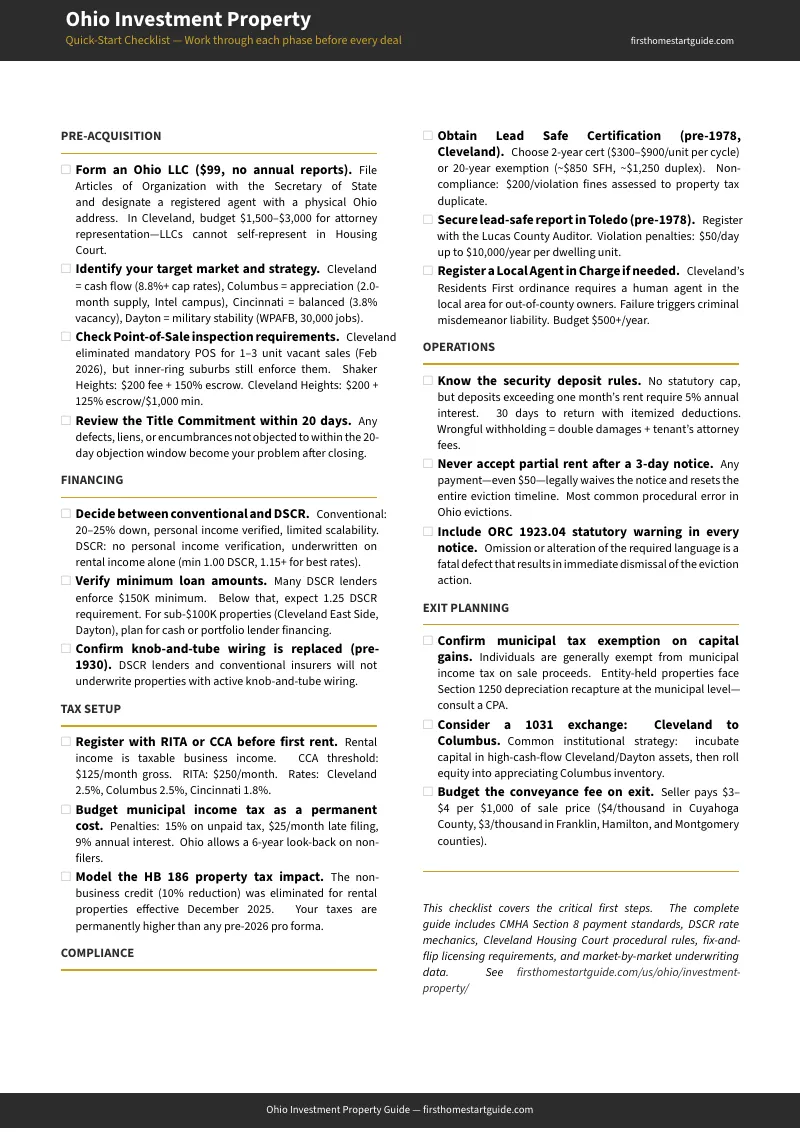
Download the Ohio Investment Property Quick-Start Checklist for free — 20 items covering entity setup, financing decisions, tax registration, compliance requirements, and operations essentials. It tells you what to do.
The full Ohio Investment Property Guide tells you how — with the exact statutory citations, worked financial examples, market-by-market yield data, and compliance procedures that turn the checklist items into executed results. For less than the cost of a single Lead Risk Assessment phone call, you get the operational manual that protects your investment from Ohio's regulatory traps.
Frequently Asked Questions
What if the rules change after I buy?
We update the guide when the rules change. Email us any time, even years later, and we'll send you the current edition free.