
You Have Googled Oregon Property Taxes Six Times and Still Cannot Explain Why Two $450,000 Homes Carry Tax Bills That Differ by $3,000
You found a 1920s bungalow in inner NE Portland listed at $450,000 with a property tax bill of $2,800 per year. Down the street, a newer townhome at the same price shows $5,900. You assumed the seller's low tax bill would carry over. You assumed a sale resets the assessed value. You asked on r/Portland and got three conflicting answers about "Measure 50" and a "3% cap" and something called a "Changed Property Ratio" that nobody fully explained.
Then you looked at the down payment assistance landscape. OHCS Flex Lending offers 4% to 5% of the loan. The DPA Grant covers up to $60,000. Portland's DPAL goes to $100,000 at 0% interest. USDA covers 99% of Oregon's land mass with zero down. Each has different income limits, different credit thresholds, different forgiveness terms. The OHCS website gives you tables and PDFs. None of them tell you which combination of programs yields the best financial outcome for your income level — or whether stacking two programs together is even allowed.
And if you are looking at an older Portland home, nobody has mentioned the crawlspace. Pre-1978 houses in Portland sit unbolted on their concrete foundations — gravity alone holds them in place. When the Cascadia Subduction Zone produces the magnitude 7.1+ earthquake that seismologists project at 37% probability in the next 50 years, an unbolted sill plate slides off the foundation and an unbraced cripple wall collapses. A bolt-and-brace retrofit costs $3,500 to $7,000. Not budgeting for it means not budgeting for your home's structural survival.
The problem is not a lack of information. The problem is that Oregon layers a constitutionally unique property tax system (Measure 5 and 50), an Urban Growth Boundary that constrains housing supply, seismic risks that national guides ignore, and overlapping state and local assistance programs with different eligibility rules — and no single resource maps all of them into a decision framework you can actually work through.
The Oregon First-Time Home Buyer Guide is an Oregon Buyer Decision System — a structured walkthrough of every Oregon-specific financial trap, structural risk, legal protection, and assistance program that determines whether your purchase works or falls apart. It replaces months of cross-referencing the Multnomah County Assessor's FAQ, the OHCS website, Portland seismic retrofit guides, USDA eligibility maps, and Reddit threads with a single reference that tells you exactly what to verify, exactly what the numbers should look like, and exactly where Oregon transactions go wrong.
What's Inside the Oregon Buyer Decision System
A comprehensive guide, a quick-start checklist, and 8 standalone worksheets and reference cards — 10 printable PDFs covering every stage from financial preparation through post-purchase setup, built specifically for the regulatory structures and market dynamics that make Oregon different from every other state:
Oregon's Dual-Value Property Tax System Decoded
Every Oregon property carries two values: the Real Market Value (RMV) and the Maximum Assessed Value (MAV), capped at 3% annual growth from a 1997 baseline established by Measure 50. A sale does not reset the tax base. The guide walks you through how the MAV compounds from the 1997 starting point, what the Changed Property Ratio (CPR) is and how it adjusts your taxes when you renovate, the Exception Events that bypass the 3% cap (additions over $18,700, subdivisions, unpermitted work discovered by the assessor), and worked examples showing how two homes at the same purchase price produce tax bills that differ by thousands of dollars — so you know your actual annual liability before you make an offer, not after you receive your first tax statement.
Seismic Risk Assessment and Retrofit Budgeting
The Cascadia Subduction Zone runs 600 miles offshore. Pre-1978 Portland homes were built before modern seismic codes — the sill plate sits on the foundation by gravity, and cripple walls lack structural bracing. The guide covers what to look for during a crawlspace inspection, the standard bolt-and-brace retrofit ($3,500 to $7,000), soft-story condo risks ($10,000 to $80,000), Portland's free prescriptive engineering plans and permit fee waivers for residential seismic work, and how earthquake insurance works as a separate policy from your standard homeowner's coverage. You will know what a structurally vulnerable home looks like before your inspector arrives — and what it costs to fix.
Down Payment Assistance Stacking Strategy
Oregon's DPA programs are among the most generous in the country, but each one has different income limits, credit thresholds, and repayment terms. The guide lays out OHCS Flex Lending (4% to 5% as a deferred second lien), the DPA Grant (up to $60,000 for buyers at or below 100% AMI), Portland's DPAL (up to $100,000 at 0% interest, forgiven over 30 years), and the OHCS Bond Residential Loan (below-market rate plus a 3% cash grant). It shows you which programs you qualify for based on your income, which combinations are stackable, and worked dollar-amount comparisons so you can see the total out-of-pocket difference between your options — not just the program descriptions.
USDA Zero-Down Financing for 99% of Oregon
Because Oregon's population is concentrated in a handful of metro areas, 99% of the state's land mass qualifies for USDA Section 502 financing with zero down payment. The guide covers the 2026 income limits ($119,850 standard; $142,750 for Portland MSA; $135,550 for Corvallis; $131,450 for Bend-Redmond), property eligibility requirements, how USDA's annual guarantee fee compares to conventional PMI and FHA MIP, and why USDA often delivers lower total monthly costs than FHA even when both are available.
The First-Time Home Buyer Savings Account (FTHBSA)
Oregon's FTHBSA lets you deduct up to $6,285 (single) or $12,570 (joint) from your Oregon taxable income annually while saving for a home. The guide covers the 10-year contribution window, lifetime caps, income phase-outs, what qualifies as an eligible expense, and the 5% penalty for non-qualifying withdrawals — so you can start reducing your state tax bill now while building your down payment.
Urban Growth Boundary Trade-Off Analysis
Oregon's UGB constrains where development can occur. Inside the Portland Metro boundary, single-family homes with yards are a fixed and shrinking supply — the population has grown 70% since 1980 while the boundary expanded by less than 15%. The guide evaluates the scarcity premium for homes inside the boundary against the commuting costs, well water requirements, and septic system considerations of buying outside it, so you can make an informed decision based on your budget and lifestyle rather than discovering the trade-offs after you have committed.
The 5-Day Right of Revocation (ORS 105.475)
Oregon gives buyers a powerful unilateral escape clause. Once the seller delivers the Property Disclosure Statement, you have exactly 5 business days to revoke your offer for any reason — or no reason. The guide explains how to exercise it in writing, why the seller's failure to provide the disclosure keeps this right active until closing day, and how this protection compares to standard inspection contingencies. This is the single most important consumer protection Oregon offers buyers, and most people find out about it from their agent after they have already waived it.
The Full 30-to-45-Day Transaction Timeline
Oregon is an escrow state — title and escrow companies handle closings, not attorneys. The guide walks through pre-approval, offer submission using OREF or Oregon Association of Realtors forms (with the critical difference in how financing-failure contingencies work between the two), earnest money protocols, the 10-business-day inspection window, appraisal and title review, underwriting, and the separate signing and recording process. It includes Oregon-specific inspections: sewer scope ($200 to $300) for Portland's aging clay and Orangeburg pipes, radon testing ($150 to $200) for NE/SE Portland and the northern Willamette Valley, mandatory well water testing under ORS 448.271, and septic inspections for rural properties.
Regional Market Analysis
Six distinct Oregon markets with current pricing, supply dynamics, and financing strategies: Portland Metro (UGB constraints, Silicon Forest employment base, DPAL access), Eugene-Springfield (university-driven market, limited detached inventory), Salem-Keizer (government-job stability, relative affordability), Central Oregon (Bend's $800,000 median, out-of-state cash competition), Southern Oregon (ACCESS HOAP program in Jackson and Josephine counties), and Eastern Oregon and the Coast (USDA-dominant financing, tsunami and erosion zones, wildfire defensible space requirements).
Who This Guide Is For
- Portland Metro buyers earning $60,000 to $120,000 who qualify for multiple DPA programs but cannot determine whether OHCS Flex Lending, the DPA Grant, or Portland DPAL gives them the best financial outcome — and want worked dollar-amount comparisons before committing to a program
- Buyers considering a pre-1978 home in Portland who need to evaluate seismic risk, understand what a crawlspace inspection should reveal, budget for a bolt-and-brace retrofit, and know about Portland's free prescriptive plans and permit fee waivers before they close
- First-time buyers confused by Oregon property taxes who do not understand why the seller's current tax bill has nothing to do with their future liability, how the dual RMV/MAV system works, or what renovations will trigger an Exception Event that bypasses the 3% annual cap
- Bend, Redmond, or Central Oregon buyers competing against out-of-state cash offers in a market approaching $800,000 median and looking for financing strategies and DPA programs that give them a realistic path to ownership
- Rural Oregon buyers in the Willamette Valley, Southern Oregon, or Eastern Oregon who qualify for USDA zero-down financing and want a clear breakdown of income limits, property requirements, and how to stack USDA with state grants
- Out-of-state transplants from California, Washington, or other states accustomed to different disclosure frameworks, transfer tax structures, and property tax reassessment rules who need to understand Oregon's distinct legal and financial landscape before making the most expensive purchase of their lives
Why Not Free Tools and Forums?
Free information on buying a home in Oregon exists. Here is what it actually delivers:
- The OHCS website gives you income limit tables, program descriptions, and a list of participating lenders. It does not tell you which program combination yields the best financial outcome for your income level, whether you can stack the DPA Grant with Flex Lending, or how to compare the total cost of a forgivable second lien versus a deeper rate discount over a 30-year loan. You get the eligibility inputs without the decision framework.
- Reddit threads (r/Portland, r/FirstTimeHomeBuyer, r/Bend) contain genuine warnings about Oregon property taxes, but mixed with advice that conflates Measure 5 and Measure 50, confuses the CPR with the tax rate, and was posted before the 2024 Exception Event threshold indexing changes. Sorting current from outdated takes longer than reading a guide that already did it.
- Zillow and Rocket Mortgage estimate your monthly payment using national formulas. They do not account for Oregon's 9.9% top marginal income tax rate reducing your effective borrowing power, the dual-value property tax system producing tax bills that bear no fixed relationship to the purchase price, or the DPA programs that could drop your out-of-pocket closing costs by tens of thousands of dollars.
- Real estate agent blogs focus on neighbourhood overviews and "5 steps to buying a home" posts designed to capture search traffic and generate leads. They do not explain cripple wall mechanics, the CPR formula, the OREF versus Oregon Association of Realtors financing-failure contingency difference, or the specific dollar cost of a sewer scope versus a radon test versus a seismic retrofit. You get marketing content, not analytical tools.
This guide fills the Oregon-specific gap — the space between knowing how to buy a home in general and knowing how to buy one in a state where a constitutional property tax formula from 1997, a land-use boundary from 1973, a subduction zone earthquake threat, and five overlapping assistance programs each independently determine whether your purchase makes financial sense. It is the analysis that would take an Oregon real estate attorney, a property tax consultant, a structural engineer, and a housing counselor to assemble — structured as a reference you own permanently.
— Less Than One Sewer Scope Inspection
A single sewer scope inspection in Portland runs $200 to $300. A pre-1978 home that needs a seismic bolt-and-brace retrofit you did not budget for costs $3,500 to $7,000. An unpermitted remodel discovered by the county assessor after closing can trigger a retroactive tax reassessment adding hundreds to your annual tax bill permanently. Choosing the wrong DPA program — or not knowing you qualified for one at all — can mean leaving $60,000 to $100,000 in assistance on the table.
This guide does not replace your real estate agent, your lender, or your home inspector. But it gives you the property tax analysis, seismic assessment framework, DPA stacking strategy, and transaction walkthrough that ensure you identify every Oregon-specific risk and opportunity before you are contractually committed — instead of discovering them on your first tax statement, your first earthquake, or your first conversation with a housing counselor who tells you about a program you missed.
If it catches a single property tax miscalculation, prevents a single unbudgeted structural expense, or connects you with a single DPA program you did not know you qualified for, it pays for itself before you have finished reading it.
Money-back guarantee, no time limit. If the guide does not sharpen your Oregon home buying analysis and protect your down payment, you pay nothing.
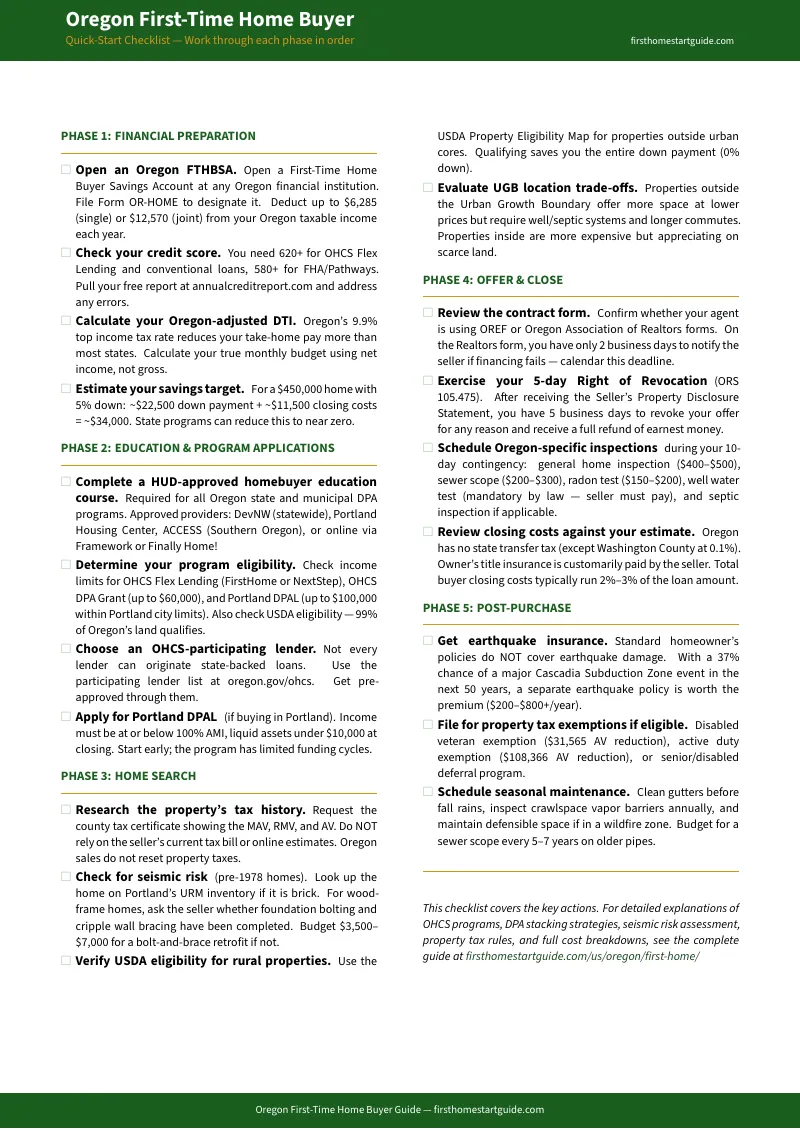
Download the free Oregon Quick-Start Home Buying Checklist to see the step-by-step framework covering financial preparation, program eligibility, property due diligence, offer and close, and post-purchase essentials. When you are ready for the full property tax decoder worksheet, seismic inspection checklist, DPA comparison card, closing cost worksheet, and the complete guide with market-by-market analysis, the full 10-PDF toolkit is here.
Oregon rewards buyers who understand how it works. This guide makes sure you do.