
The Fundamentals Are Strong. The Regulations Will Destroy You.
You found a Portland duplex in a tight Urban Growth Boundary market where vacancy runs below 5% and long-term appreciation outpaces national averages because the government literally restricts new supply. Or a Bend single-family rental where remote workers with six-figure incomes are competing for a housing stock constrained by federal land on three sides. Or a Eugene fourplex near the University of Oregon where 42,500 students create structural demand for off-campus housing every academic cycle. Or a Cannon Beach cottage where peak-season nightly rates hit $350 and the Oregon Coast draws visitors year-round. The acquisition math works. The supply thesis is real. You are ready to wire earnest money.
Then you run the real numbers. You discover that Oregon enacted the nation's first statewide rent control in 2019 and your annual rent increases are capped at 9.5% for 2026 under SB 608 — and violating the cap exposes you to a penalty of three months' rent plus actual damages. You plan to end a month-to-month lease after 13 months to renovate or sell vacant — but SB 608 abolished no-cause evictions after 12 months of occupancy, and now you need a qualifying landlord reason, a 90-day notice, and a relocation payment of one month's rent just to regain possession. You raise rent in Portland by exactly 10% — and the tenant exercises their right under City Code 30.01.085 to demand $4,500 in mandatory relocation assistance, wiping out years of income growth in a single payment. You sell a $600,000 property with a $300,000 gain and discover Oregon taxes capital gains at 9.9% as ordinary income — then you 1031 exchange into a Texas property, and Oregon tracks the deferred gain indefinitely under ORS 316.738 and claws it back when you eventually cash out.
Here is what no single resource explains: Oregon layers the nation's first statewide rent control (SB 608, capped at 7% + CPI with a 10% ceiling) on top of an absolute prohibition on no-cause evictions after 12 months, Portland's FAIR ordinance that mandates first-come-first-served tenant processing and forces acceptance of credit scores as low as 500, Portland's Schedule R registration at $70 per unit per year, mandatory relocation payments of $2,900 to $4,500 per unit triggered by lease terminations or rent increases of 10% or more, Eugene's own relocation mandate of two months' rent, a 9.9% capital gains tax with no preferential long-term rate, a 1031 exchange clawback provision that tracks deferred gains out of state indefinitely, coastal STR moratoria in Cannon Beach (14-day annual limit for new permits) and Lincoln City (caps reached in both R1-RE and R1-5 zones), and Measure 50's property tax exception events that increase your assessed value when renovations exceed $18,700 in a single year — into an operating environment that rewards investors who understand every Oregon-specific statute and punishes everyone who assumes this state works like Texas, Florida, or even neighboring Washington. Every one of these has cost real investors five figures because the information existed — scattered across ORS Chapter 90, Portland Housing Bureau forms, DAS rate publications, county assessor databases, and coastal municipal zoning codes — but nobody had assembled it into a single investment framework.
The Oregon Investment Property Guide is a Regulatory Defense System — not a motivational overview of Pacific Northwest real estate, but a structured compliance and due diligence framework that maps every Oregon-specific rent control mechanic, eviction pathway, municipal overlay, tax obligation, and regional market opportunity into a process you work through before you deploy capital. It replaces months of cross-referencing the Oregon Department of Administrative Services, Portland Housing Bureau relocation forms, Eugene Rental Housing Code, coastal planning departments, and county assessor records with a single reference that tells you exactly what the numbers should look like, exactly what the legal requirements are, and exactly where deals go wrong when generic assumptions meet Oregon law.
What's Inside the Regulatory Defense System
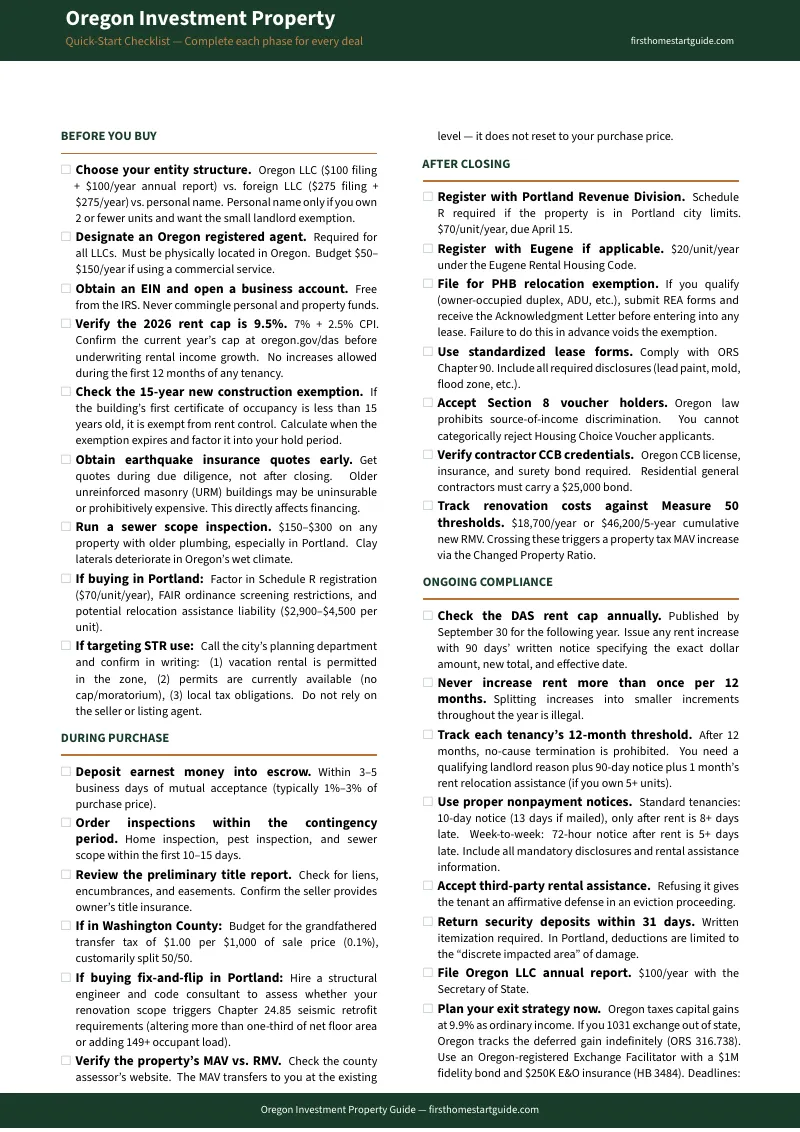
A 16-chapter guide, a quick-start compliance checklist, and 10 standalone printable tools — covering every stage from entity formation through exit strategy, built specifically for the regulatory complexity and regional market dynamics that make Oregon a fundamentally different investment jurisdiction:
SB 608 Rent Control Mechanics: The Cap, The Exceptions, The Penalties
Oregon's statewide rent cap for 2026 is 9.5% (7% + 2.5% CPI), published annually by the Department of Administrative Services. You get one increase per rolling 12-month period with 90 days' written notice specifying the exact dollar amount, new total, and effective date. No increases are permitted during the first 12 months of any tenancy. The penalty for exceeding the cap is three months' rent plus actual damages. But the guide also maps the exceptions that sophisticated investors use: the rolling 15-year new construction exemption (buildings with a certificate of occupancy less than 15 years old are completely exempt), the small landlord exemption (two or fewer single-family homes or condos held in personal name), and the substantial renovation exemption. Each exception requires specific documentation in the notice — the guide provides the exact compliance language.
Portland Deep Dive: FAIR Ordinance, Schedule R, and $4,500 Relocation
Portland layers the densest municipal regulatory overlay in the state on top of SB 608. The FAIR ordinance mandates first-come-first-served application processing — you must accept the first qualified applicant, not the best one. Low-barrier screening criteria force acceptance of credit scores as low as 500 and prohibit denials based on criminal history or evictions older than 3 years. Screening fees are capped at 125% of your actual cost. Security deposits cannot exceed one month's rent (50% if you collect last month's rent), and you cannot deduct for interior painting unless you prove damage beyond normal wear and tear. Schedule R registration costs $70 per unit per year, due April 15. And the relocation assistance mandate under City Code 30.01.085 requires payments of $2,900 (studio) to $4,500 (3+ bedroom) for no-cause terminations, non-renewals, qualifying landlord reason terminations, or rent increases of 10% or more. The guide walks through all 12 exemptions, the REA forms required, the 2-3 week Portland Housing Bureau processing timeline, and the exact sequence you must follow — because delivering a termination notice before receiving the PHB Acknowledgment Letter voids the exemption entirely and triggers the full payment plus penalties of up to three times monthly rent.
Regional Markets: Portland, Salem, Eugene, Bend, and the Coast
Oregon is five distinct investment markets with radically different risk-return profiles. Portland Metro delivers appreciation through UGB supply constraints but compresses cap rates to 4.5%-5.5% for Class B/C multifamily and layers the highest compliance overhead in the state. Salem offers recession-resistant cash flow backed by state government employment without Portland's municipal overlays. Eugene produces student housing yields near 42,500-student University of Oregon enrollment but imposes its own Rental Housing Code with $20/unit registration, first-come-first-served screening, and relocation assistance of two months' rent. Bend commands premium rents in a lifestyle market constrained by federal land, but STR Type II permits require a 500-foot radial separation buffer. The Oregon Coast is a patchwork of jurisdiction-specific STR regulations where Cannon Beach limits new permits to 14 rental days per year, Lincoln City's residential zone caps are fully reached with no waitlist, and Newport requires Transient Guest Facility approval with $500-$1,000 registration fees and owner-occupancy requirements. The guide maps each market's price points, demand drivers, regulatory burden, and the specific strategy that works there.
Measure 50 Property Tax: The Two-Value System That Rewards Holders
Oregon's property tax system is unlike any other state. Every property carries two values: Real Market Value (RMV) and Maximum Assessed Value (MAV), which is constitutionally capped at 3% annual growth under Measure 50. Because Oregon real estate has appreciated far faster than 3% over three decades, most established properties have an MAV dramatically lower than their RMV — a Portland duplex with a $650,000 RMV might be taxed on a $280,000 MAV. The critical advantage: the MAV does not reset to your purchase price. You inherit the seller's artificially low tax basis. But the protection disappears when renovations add more than $18,700 of new RMV in a single assessment year or $46,200 over a rolling 5-year period. The guide shows how to model the Changed Property Ratio, phase improvements across assessment cycles, and structure rehab budgets to preserve the Measure 50 advantage.
The 9.9% Capital Gains Tax, 1031 Exchanges, and the Clawback
Oregon treats all capital gains as ordinary income with no preferential long-term rate. A $300,000 gain on a property sale pushes you into the 9.9% top bracket, adding $29,700 in state tax on top of federal capital gains, depreciation recapture, and the Net Investment Income Tax — producing a combined effective rate approaching 29%. The 1031 exchange defers the gain, but Oregon's clawback provision (ORS 316.738) tracks any gain that originated in Oregon indefinitely. If you exchange into an out-of-state property and eventually cash out, Oregon recaptures its tax on the original deferred gain. The only permanent elimination is a step-up in basis at death. The guide covers Exchange Facilitator selection (Oregon requires a $1 million fidelity bond and $250,000 E&O insurance under HB 3484), the 45-day identification and 180-day closing deadlines, the annual reporting requirement for out-of-state replacement properties, and the multigenerational exchange strategies that sophisticated investors use to eliminate the liability entirely.
Fix-and-Flip Execution: CCB Licensing, Seismic Triggers, and Climate Risk
Oregon strictly prohibits unlicensed contracting. Managing subcontractors or performing substantial work yourself requires a Construction Contractors Board license — 16-hour pre-license training, a surety bond ($15,000-$25,000 for residential), and general liability insurance. In Portland, Chapter 24.85 of the building code triggers mandatory seismic retrofits to ASCE 41-BPOE standards if your renovation alters more than one-third of net floor area or adds an occupant load exceeding 149 people. These forced retrofits can cost hundreds of thousands and destroy a flip proforma. Oregon's wet climate adds mold remediation, deteriorated clay sewer laterals ($150-$300 sewer scope inspections are mandatory), and roof condition as standard rehab concerns. The guide covers the complete CCB licensing process, the seismic trigger thresholds, and the climate-specific due diligence checklist for every flip.
Short-Term Rental Jurisdiction Breakdown
Oregon has no unified STR framework — every city sets its own rules, and many have moved to outright prohibition or hard caps. Portland requires 270-day owner residency and caps unhosted nights at 95 per year. Bend requires a 500-foot radial separation buffer for non-owner-occupied Type II permits and $500,000 in liability insurance. Cannon Beach banned new full-time STR permits entirely — new buyers receive only a 14-Day Permit, revoked on sale. Lincoln City caps residential zone licenses at 91 (R1-RE) and 194 (R1-5), both reached with moratoria in effect. Newport confines STRs to specific commercial and tourist zones with $500-$1,000 registration fees and multi-department review. All jurisdictions layer the 1.5% state Transient Lodging Tax on top of local levies ranging from 6% to 10.4%. The guide provides the complete jurisdiction-by-jurisdiction decision framework so you verify license availability before you make an offer — not after.
Oregon vs. Washington: The Cross-Border Decision
Clark County, Washington (Vancouver, WA) sits directly across the Columbia River from Portland and competes for the same tenant base. Washington has no state income tax — an investor earning $200,000 in rental income and selling for a $400,000 gain pays approximately $59,400 in Oregon state taxes versus functionally $0 in Washington. Washington adopted its own rent control in 2026 (HB 1217, capped at 7% + CPI, max 10% — virtually identical to Oregon), but it sunsets in 2040 while Oregon's is permanent. Washington's 7% capital gains tax largely exempts real estate transactions. The trade-off is Washington's Real Estate Excise Tax of 1.1%-3.0% on every sale versus Oregon's near-zero transfer tax. The guide provides the full side-by-side comparison across taxation, rent control mechanics, eviction rules, and enforcement — so you can model both sides of the river before choosing where to deploy capital.
Standalone Printable Tools (included with the full guide)
- Investment Due Diligence Worksheet — 6-stage fillable checklist covering property identification, legal and title review, physical inspection, financial underwriting, regulatory compliance (Portland FAIR, seismic triggers, Eugene code, STR), and entity and insurance setup. Fill in per property before making an offer.
- Oregon Statutes Reference Card — Every key statute, bill, and municipal code on a single page. ORS Chapter 90, SB 608, HB 2001, HB 3484, Measure 50, Portland City Code 30.01.085, FAIR Ordinance, and Eugene Rental Housing Code. Keep at your desk for quick reference.
- Dollar Amounts and Deadlines Cheat Sheet — All critical numbers on one page: LLC fees, rent cap percentages, notice periods, penalty amounts, relocation costs (state, Portland, and Eugene), eviction timelines, 1031 deadlines, tax rates, exception event thresholds, and CCB bond amounts.
- Portland Compliance Card — Portland-specific reference covering Schedule R ($70/unit, April 15 deadline), FAIR ordinance screening rules, security deposit caps by scenario, relocation assistance amounts by unit size, the 3-step PHB exemption process, and STR rules.
- Eviction Process Timeline — Step-by-step FED process with day counts for both standard (10-day notice) and week-to-week (72-hour notice) tracks. Includes the HB 2001 right-to-cure rule and common procedural pitfalls that void your case.
- Closing Costs Worksheet — Fillable buyer and seller cost tables with Oregon-specific items including sewer scope, Washington County transfer tax, escrow fee split, and the Measure 79 no-transfer-tax advantage.
- STR Jurisdiction Breakdown — One-page table showing vacation rental viability, key restrictions, and license fees for Portland, Bend, Cannon Beach, Lincoln City, Newport, Seaside, Hood River, and rural areas.
- Oregon vs. Washington Comparison — Side-by-side analysis of income tax, capital gains, rent cap, duration, enforcement, and transfer tax. Includes the worked tax arbitrage example showing the $59,400 difference on identical portfolio income.
- Measure 50 Renovation Worksheet — Model the exception event thresholds ($18,700 annual, $46,200 cumulative), calculate the Changed Property Ratio impact, and estimate your post-renovation property tax increase before committing capital.
- 1031 Exchange and Clawback Tracker — Critical deadlines (Day 0, Day 45, Day 180), Exchange Facilitator requirements under HB 3484, the ORS 316.738 clawback rules, and the three exit strategy options with their tax consequences.
Who This Guide Is For
This guide is for real estate investors targeting the Oregon market who:
- Are an out-of-state investor attracted to Oregon's UGB supply constraints and strong appreciation fundamentals but need to understand the complete regulatory framework before deploying capital — SB 608 rent control, just cause eviction after 12 months, Portland's FAIR ordinance and relocation mandates, the 9.9% capital gains tax, and the 1031 clawback that follows your deferred gain to any state
- Are a California equity refugee migrating capital northward and assuming Oregon is a cheaper, less regulated West Coast alternative — only to discover that Oregon enacted statewide rent control before California did, that just cause eviction protections are nearly identical, and that the 9.9% income tax applies to all rental income and capital gains with no preferential long-term rate
- Are a Portland landlord who already owns rental property and needs to understand the FAIR ordinance screening requirements, the Schedule R registration process, the relocation assistance triggers and exemption sequence, and how to calculate maximum rent increases without triggering the $4,500 payment
- Are evaluating Bend or Central Oregon for a lifestyle-market rental and need the STR licensing rules (500-foot buffer, $500,000 insurance), the SB 608 impact on long-term holds, and the cap rate reality in a high-acquisition-cost market
- Are targeting Oregon Coast vacation rentals and need to verify — before making an offer — whether STR permits are actually available in your target zone, or whether you are about to buy a property you cannot legally rent
- Are comparing Oregon versus Washington for Pacific Northwest investment and need the tax-adjusted analysis — because the difference between Oregon's 9.9% income tax and Washington's 0% income tax, combined with the permanent versus sunsetting rent control and the clawback versus clean exit, can each independently determine whether a deal creates wealth or destroys it
Why Not Free Tools and Forums?
Free information on Oregon real estate investment exists across dozens of sources. Here is what it actually delivers:
- Oregon state government sites and the Portland Housing Bureau publish statutory text, DAS rate calculations, PHB forms, and Schedule R instructions in dense bureaucratic language. They tell you what ORS 90.323 says, not how to model the rent cap against your proforma. They provide the REA exemption forms, not the sequence you must follow to avoid voiding the exemption. An investor must already know the precise form number, the correct bureau, and the relevant ORS section to find anything — and a first-time Oregon investor will miss the interplay between SB 608, the FAIR ordinance, Measure 50 exception events, and the 1031 clawback entirely.
- BiggerPockets and Reddit forums are where frustrated Portland landlords debate selling their properties, out-of-state investors ask whether Oregon is "still worth it," and everyone argues about whether the FAIR ordinance has reduced the rental supply. Forum posts from 2022 reference rent caps that no longer match the current DAS calculation. Tax threads recommend 1031 exchanges without mentioning the clawback provision. Someone posts that Oregon has "no transfer tax" without noting Washington County's grandfathered 0.1% rate. Sorting current from obsolete, accurate from incomplete, takes longer than reading a guide that has already done it.
- National real estate courses teach cap rate analysis, BRRRR mechanics, and portfolio scaling that assume you can raise rents to market, terminate leases freely, and exit without state-level tax complications. They do not cover SB 608's 12-month threshold, Portland's $4,500 relocation payments, Cannon Beach's 14-day permit limit, the Measure 50 two-value system, or the clawback provision that follows your deferred gains across state lines. Applying generic frameworks to Oregon-specific regulatory friction is how investors lose five figures on their first deal.
- Local real estate agents and property managers know their submarkets but cover one piece of the puzzle — market pricing, not tax strategy; tenant placement, not coastal zoning caps; listing data, not 1031 exchange facilitator regulations. No single local professional has the cross-disciplinary view spanning rent control mechanics, municipal ordinance compliance, multi-market STR regulation, capital gains planning, and seismic risk assessment.
This guide fills the Oregon-specific gap — the space between knowing how to analyze a rental property in general and knowing how to underwrite one in a jurisdiction where a 9.5% rent cap, a 12-month no-cause eviction prohibition, a $4,500 municipal relocation mandate, a 9.9% capital gains tax with no long-term preference, a clawback provision that tracks deferred gains indefinitely, and coastal STR moratoria with no waitlist can each independently determine whether a deal creates wealth or destroys it. It is the analysis that would take an Oregon real estate attorney, a CPA with multi-state tax expertise, a Portland property manager, and a coastal planning consultant to assemble — structured as a reference you own permanently.
— Less Than One Compliance Mistake
A single rent increase that exceeds the DAS-published cap exposes you to a penalty of three months' rent plus actual damages. A Portland rent hike of 10% or more triggers mandatory relocation assistance of $2,900 to $4,500 — regardless of whether you intended to push the tenant out. A renovation that crosses Measure 50's $18,700 exception event threshold permanently increases your assessed value through the Changed Property Ratio. A Cannon Beach property purchased without verifying the 14-day permit limit produces a home you cannot legally rent for more than two weeks per year. A 1031 exchange executed without understanding the clawback provision creates a false sense of tax freedom that Oregon recaptures years or decades later.
This guide does not replace your Oregon real estate attorney, your CPA, or your property manager. But it gives you the rent control mechanics, eviction pathways, municipal compliance sequences, regional market data, tax modeling, STR jurisdiction rules, and exit strategy frameworks that ensure you identify every Oregon-specific risk and opportunity before you are contractually committed — instead of discovering them on your first DAS rate notice, your first PHB relocation demand, or your first Oregon tax return.
If it catches a single rent cap violation, prevents a single unlicensable coastal purchase, surfaces the clawback provision before your 1031 exchange closes, or identifies the Portland relocation exemption sequence before you serve the wrong notice, it pays for itself before you have finished reading it.
Money-back guarantee, no time limit. If the guide does not sharpen your underwriting and protect your capital in Oregon's regulatory environment, you pay nothing.
Download the free Oregon Quick-Start Home Buying Checklist to see the compliance framework covering entity selection, rent cap verification, municipal registration, and exit planning. When you are ready for the full 16-chapter guide with SB 608 mechanics, Portland's FAIR ordinance deep dive, regional market intelligence, and 1031 clawback strategies, the complete guide is here.
The supply thesis is real. This guide tells you which returns survive Oregon law.