
The Spreadsheet Says Cash Flow. Philadelphia's Tax Office Says Otherwise.
You found a duplex in Kensington throwing off 8% gross yield. Or a rowhouse flip in Fishtown where the ARV comps support a $60,000 spread. Or a rental portfolio in Pittsburgh's Lawrenceville where three units at $1,400/month each pencil to a 1.35 DSCR. The numbers work. The comps are solid. You're ready to wire earnest money.
Then you run the real numbers. The Kensington duplex sits in Philadelphia, where the transfer tax is 4.578% — not the 2% you modeled from reading about Pennsylvania's "1% state plus 1% local" framework. On a $250,000 property, that's $11,445 at closing instead of $5,000. Your rental income triggers the Business Income and Receipts Tax, and as of 2025 the $100,000 gross receipts exemption is gone — every dollar of rent is taxable from dollar one. The Net Profits Tax takes another 3.74% of your net income. The Fishtown flip sits on a block where the city's Licenses and Inspections department has been issuing $300/day vacant property fines and $2,000-per-unit lead paint violations that don't show up in the seller's disclosure. The Pittsburgh portfolio is in a county where the property sits above abandoned coal mines — and your standard homeowner's policy explicitly excludes mine subsidence damage.
Here's what no single resource explains: Pennsylvania layers a uniquely punitive Philadelphia tax regime (BIRT + NPT + wage tax + transfer tax + Use and Occupancy tax), a mine subsidence risk covering 43 of the state's 67 counties, lead paint enforcement with $2,000-per-violation penalties and mandatory six-month compliance windows, and an eviction system where Philadelphia Municipal Court cases routinely take six months or longer — into a regulatory environment that punishes investors who apply national assumptions to Pennsylvania-specific problems. Every one of these has cost real investors five to six figures because the information existed — scattered across the Philadelphia Department of Revenue's website, DEP coal mine maps, L&I enforcement records, and landlord forums from 2022 — but nobody had assembled it into a single underwriting system.
The Pennsylvania Investment Property Guide is a Pennsylvania Investor Compliance Navigator — not a motivational overview of real estate investing, but a structured due diligence framework that maps every Pennsylvania-specific financial trap, regulatory restriction, and environmental risk into a process you work through before you wire earnest money. It replaces months of cross-referencing Philadelphia tax forms, DEP mine subsidence maps, L&I violation databases, and county court eviction timelines with a single reference that tells you exactly what to verify, exactly what the numbers should look like, and exactly where deals go wrong.
What's Inside the Pennsylvania Investor Compliance Navigator
A 14-chapter guide, a standalone 20-item due diligence checklist, and 8 printable worksheets and reference cards — covering every stage from market selection through post-purchase setup, built specifically for the financial traps and regulatory complexity that make Pennsylvania different from every other state:
Philadelphia Tax Burden Analysis
The single most misunderstood cost structure in Pennsylvania real estate investing. Philadelphia stacks five taxes on rental property investors that don't exist — or exist at far lower rates — anywhere else in the state. The Business Income and Receipts Tax (BIRT) now applies from dollar one after the 2025 elimination of the $100,000 gross receipts exemption — meaning a landlord collecting $36,000/year in rent pays BIRT on the full amount, not just the amount above $100,000. The Net Profits Tax (NPT) takes 3.74% of your net income. The wage tax applies to any active management income at 3.74% for residents or 3.43% for non-residents. The transfer tax is 4.578% — more than double the state standard and among the highest in the nation. The Use and Occupancy tax adds another layer for commercial or mixed-use properties. The guide models the combined tax burden across all five taxes for rental portfolios at different income levels, shows you exactly which taxes you can reduce through entity structuring, and walks through the annual filing calendar so you never miss a deadline that triggers penalties. Without this analysis, your Philadelphia pro forma understates annual carrying costs by thousands of dollars.
Mine Subsidence Risk Assessment
Forty-three of Pennsylvania's 67 counties have documented underground coal mine workings — and standard homeowner's insurance policies explicitly exclude mine subsidence damage. Foundation cracking, wall displacement, and ground settlement from abandoned mine collapse can cause $50,000 to $200,000 in structural damage that your policy won't cover. The guide walks through how to use the DEP GIS portal and the Pennsylvania Mine Subsidence Insurance Fund to identify whether your target property sits above abandoned workings, how to interpret mine map overlays, when MSIF coverage ($150,000 maximum dwelling, $50,000 contents) is adequate and when it falls short for higher-value properties, and the specific due diligence steps for properties in Allegheny, Westmoreland, Lackawanna, Luzerne, and Schuylkill counties where mine density is highest. Buying a rental property above abandoned coal mines without MSIF coverage is how investors discover a $150,000 foundation repair bill that no insurance will pay.
Lead Paint Compliance Framework
Pennsylvania's pre-1978 housing stock is among the oldest in the nation, and Philadelphia's Department of Licenses and Inspections enforces lead paint violations aggressively. A single violation carries up to $2,000 in fines per unit — and a property with multiple units and multiple violations can generate five-figure penalty exposure before you've collected your first rent check. The guide covers the federal EPA RRP Rule, Pennsylvania's Act 93 lead notification requirements, Philadelphia's specific Lead Disclosure and Certification Ordinance, the six-month compliance window for identified hazards, and the certified lead abatement contractor requirements that determine whether your remediation work actually satisfies the inspection. For investors buying pre-1978 properties in Philadelphia — which is most of the rental housing stock — lead compliance isn't optional, and the cost of non-compliance is $2,000 per violation plus potential tenant relocation expenses.
Eviction Timeline and Court System Analysis
Pennsylvania operates two parallel court systems for landlord-tenant disputes, and the one that applies to your property determines whether an eviction takes six weeks or six months. Outside Philadelphia, evictions go through Magisterial District Court with a complaint-to-lockout timeline of 4 to 8 weeks. Inside Philadelphia, evictions go through Municipal Court, where the complaint-to-trial timeline alone runs 60 to 90 days, appeals add another 30 days, and the full process from filing to writ of possession execution routinely takes six months or longer. The guide maps the complete procedural timeline for both court systems, covers the specific grounds for eviction under Pennsylvania's Landlord and Tenant Act, explains the Philadelphia Good Cause Eviction Ordinance that restricts non-renewal of month-to-month leases, and calculates the holding cost impact of extended vacancy. If you're underwriting a Philadelphia rental with one month of vacancy reserve, you're underfunded by five months.
Transfer Tax and Closing Cost Mechanics
Pennsylvania's transfer tax framework varies dramatically by municipality. The base is 1% state plus 1% local — but Philadelphia adds its own 3.278% on top, bringing the total to 4.578%. Pittsburgh's total is 3%. Some rural counties sit at the 2% minimum. The guide breaks down transfer tax rates by county and municipality, covers the exemptions that apply to certain entity structures and intrafamily transfers, walks through the attorney-state closing process (Pennsylvania does not use title companies in all regions), and calculates true closing costs for each major market. Modeling your Philadelphia acquisition with a 2% transfer tax assumption means your closing cost estimate is $6,000 to $15,000 short before you've even factored in lender fees.
Market-by-Market Investment Analysis
Six metro markets dissected with median listing prices, median rents, gross yields, vacancy trends, and demand drivers: Philadelphia ($265k median, 5.4% yield, highest regulatory burden but deepest tenant pool), Pittsburgh ($220k, 5.8% yield, lowest entry point among major metros with mine subsidence as the primary risk), Allentown-Bethlehem ($290k, 4.8% yield, Lehigh Valley warehouse economy), Lancaster ($310k, 4.5% yield, tourism plus healthcare demand), Scranton-Wilkes-Barre ($165k, 6.7% yield, highest gross yield but coal country risk), and the Philadelphia suburbs ($425k, 3.8% yield, appreciation play with lower regulatory friction). Know which game you're playing before you deploy capital.
Financing, Tax Strategy, and Entity Structuring
Conventional, DSCR, second-home, FHA house hack, and hard money financing compared by down payment, rate, and qualification method. Pennsylvania-specific entity structuring for Philadelphia tax optimization — how LLC vs. S-Corp election affects your BIRT and NPT liability. Cost segregation and bonus depreciation strategies. The Section 8 Housing Choice Voucher pathway in Philadelphia (one of the largest Section 8 markets in the country). 1031 exchange mechanics. Pennsylvania LLC formation through the Department of State, registered agent requirements, and the annual reporting obligations that keep your entity in good standing for eviction filings.
Who This Guide Is For
This guide is for real estate investors targeting Pennsylvania markets who:
- Are analyzing a Philadelphia property and need to model the real tax burden — BIRT, NPT, wage tax, transfer tax, and Use and Occupancy — not the generic "property tax plus insurance" projections that work in landlord-friendly states like Texas or Florida
- Are buying rental property outside Philadelphia in coal country — Pittsburgh, Scranton, Wilkes-Barre, or any of the 43 mine-affected counties — and need to verify mine subsidence risk, understand MSIF coverage limits, and know when supplemental coverage is necessary
- Are under contract on a pre-1978 property and need to understand the full lead paint compliance framework — federal EPA RRP, Pennsylvania Act 93, Philadelphia's Lead Disclosure Ordinance — before your inspection contingency expires and the violations become your problem
- Are a Philadelphia landlord dealing with the post-2025 BIRT changes and need to restructure your entity or filing strategy to minimize the tax impact of losing the $100,000 gross receipts exemption
- Plan to operate Section 8 rentals in Philadelphia and want to understand the Housing Authority inspection standards, voucher payment schedules, and the operational differences from market-rate tenancies
- Are an out-of-state investor evaluating Pennsylvania markets for the first time and want every state-specific regulation, tax calculation, and due diligence requirement in one reference — instead of assembling it from the Philadelphia Department of Revenue, DEP mine maps, L&I databases, and Reddit threads that may have been accurate two legislative sessions ago
Why Not Free Tools and Forums?
Free information on Pennsylvania real estate investing exists across dozens of sources. Here's what it actually delivers:
- BiggerPockets forums are where someone in a 2022 thread says the BIRT $100,000 exemption protects small landlords, someone in 2024 says it was being phased down, and nobody has posted since the 2025 elimination. You'll find genuinely useful experience reports mixed with advice predating the exemption removal, the Good Cause Eviction Ordinance, and the latest L&I enforcement campaigns. Sorting current from outdated takes longer than reading a guide that has already done it.
- The DEP mine subsidence maps show you the GIS overlay of documented mine workings. They don't tell you how to interpret the data for investment purposes, don't explain the $150,000 MSIF coverage cap and when it's inadequate, don't flag which counties have the highest density of unmapped workings, and don't walk through the due diligence protocol for getting a mine subsidence risk assessment before closing. You get the map without the analysis.
- National investing books and courses teach cap rate, DSCR, and 1031 mechanics that apply everywhere. They don't mention BIRT, NPT, the 4.578% Philadelphia transfer tax, mine subsidence insurance, Philadelphia Municipal Court eviction timelines, or lead paint enforcement under Philadelphia's specific ordinance. Applying national frameworks to Pennsylvania-specific problems is how investors lose five figures on their first deal.
- Philadelphia Department of Revenue website has the tax rates and filing forms. It doesn't model the combined burden across all five taxes, doesn't compare entity structures for tax optimization, doesn't explain which taxes a non-resident investor owes versus a resident, and doesn't connect the tax obligations to your cash flow model. You get compliance requirements without the investment analysis that determines whether the deal works after taxes.
This guide fills the Pennsylvania-specific gap — the space between knowing how to analyze a rental property in general and knowing how to underwrite one in a state where Philadelphia's stacked tax regime, mine subsidence risk across 43 counties, aggressive lead paint enforcement, and a six-month eviction timeline can each independently turn a profitable deal into a losing one. It's the analysis that would take a Philadelphia tax attorney, a environmental consultant, and a landlord-tenant lawyer to assemble — structured as a reference you own permanently.
— Less Than One BIRT Filing Surprise
A single BIRT filing you didn't anticipate after the 2025 exemption elimination adds hundreds to thousands in annual tax liability depending on your gross receipts — every year you own the property. A Philadelphia transfer tax modeled at 2% instead of 4.578% understates your closing costs by $6,000 to $15,000. A mine subsidence event on an uninsured property in Allegheny County creates $50,000 to $200,000 in structural damage no standard policy will cover. A lead paint violation at $2,000 per unit across a four-unit building generates $8,000 in fines before remediation costs. A Philadelphia eviction that takes six months instead of the six weeks you budgeted adds five months of lost rent and carrying costs to your bottom line.
This guide doesn't replace your real estate attorney or your CPA. But it gives you the Philadelphia tax burden analysis, mine subsidence risk assessment, lead paint compliance framework, and eviction timeline model that ensure you identify every Pennsylvania-specific risk before you're contractually committed — instead of discovering them on your first BIRT filing, your first foundation crack, or your first L&I inspection.
If it catches a single tax liability you didn't model, prevents a single mine subsidence coverage gap, or saves you from underestimating a single Philadelphia eviction timeline, it pays for itself before you've finished reading it.
Money-back guarantee, no time limit. If the guide doesn't sharpen your underwriting and protect your capital in Pennsylvania's regulatory environment, you pay nothing.
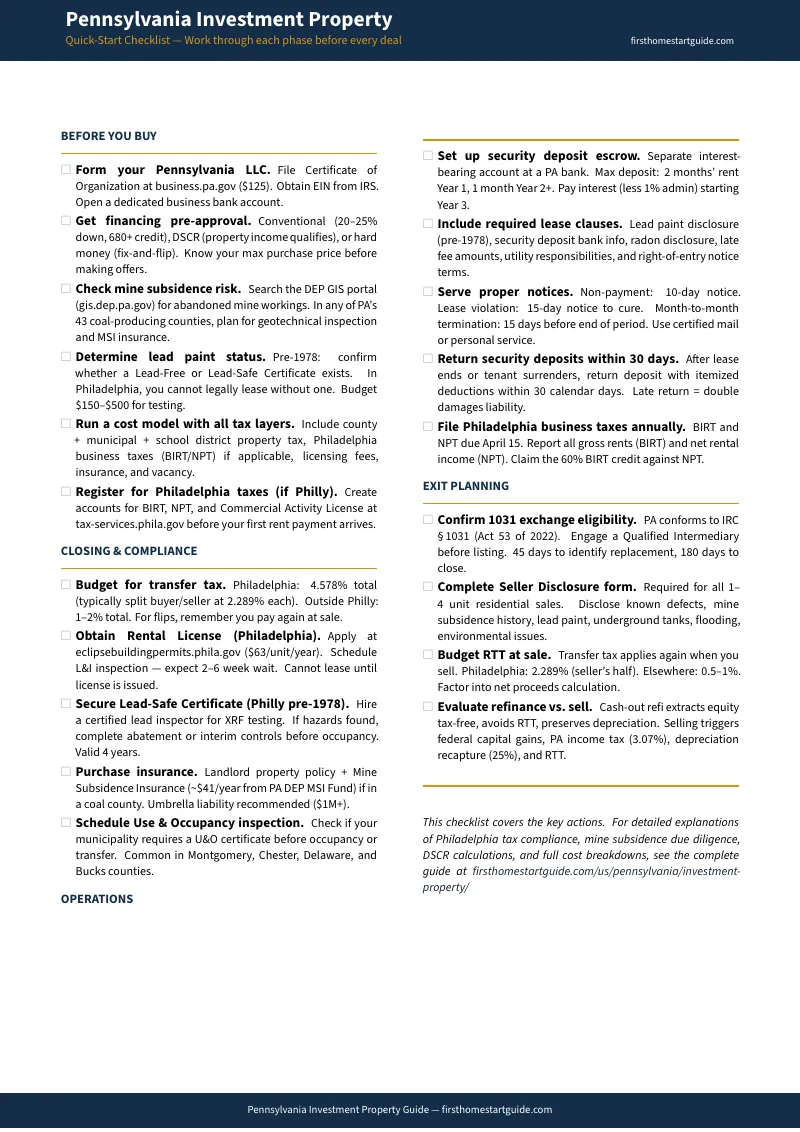
Download the free Pennsylvania Quick-Start Checklist to see the 20-item due diligence framework covering pre-purchase research, financial analysis, under-contract inspections, closing, and post-purchase setup. When you're ready for the full Philadelphia tax burden analysis, mine subsidence risk assessment, lead paint compliance framework, and 12-chapter investment system, the complete guide is here.
The deal looks good on the spreadsheet. This guide tells you whether Pennsylvania agrees.