
You Have Read the SC Housing Website, Googled "Do I Need a Lawyer to Close in South Carolina," and Asked Your Agent About Property Taxes. You Still Cannot Figure Out How to Stack Palmetto Home Advantage With an FHA Loan, Whether the Seller Is Hiding Termite Damage Behind Caveat Emptor, or Why Your First Tax Bill Is Triple What the Previous Owner Paid.
You have been pre-approved for a mortgage and started looking at ranch homes in Summerville, townhomes in Greenville, or new construction in Fort Mill. You may have found the SC Housing website and spent thirty minutes clicking through program descriptions before closing the tab without understanding whether you qualify for the Bond program, Palmetto Home Advantage, or both — or how the income limits work differently for each one. Or you relocated to Charleston for work, discovered South Carolina requires a licensed attorney to conduct your closing instead of the title company you used in Ohio, and now you are trying to figure out who pays for what and why your closing costs include a $1,110 deed recording fee nobody mentioned. Or you closed on your first home in September, nobody warned you about the Assessable Transfer of Interest, and you just opened a letter from your mortgage servicer explaining that your monthly payment is jumping $150 because the property was reassessed from the previous owner's capped value to your purchase price — and you still have not filed the Legal Residence Application that would have dropped your assessment ratio from 6% to 4% and exempted you from school operating taxes entirely.
The problem is not a shortage of information. SC Housing publishes income limits and participating lender lists. HUD counseling agencies explain FHA basics. Reddit threads in r/Charleston and r/Charlotte debate which credit union has the best rates. But no single resource explains how Palmetto Home Advantage's 4% forgivable DPA stacks with an FHA first mortgage in a USDA-eligible suburb outside Greenville — where they combine, where they conflict, and which combination produces the lowest cash-to-close for your specific income bracket. Nobody explains that South Carolina is a caveat emptor state where the seller has no legal obligation to investigate or disclose defects they do not have actual knowledge of, and that your due diligence period is not a formality but your only legal defense. Nobody walks you through the 30-day expiration window on the CL-100 Wood Infestation Report — or explains how a delayed closing forces a second inspection that cascades into appraisal problems and jeopardizes your loan commitment. And nobody warns you that the previous owner's property tax bill was artificially capped by the 15% reassessment limit, that the ATI permanently removes that cap when you buy, and that you have until January 15 to file a Legal Residence Application or you will be billed at the 6% assessment ratio with full school operating taxes — potentially tripling your annual property tax bill with no automatic correction coming.
The South Carolina First-Time Home Buyer Guide is a South Carolina Transaction Protocol — a single, structured reference that maps every assistance program, tax optimization, legal requirement, and environmental liability into a step-by-step process you work through before you make an offer, before you sign at the closing table, and before you miss a single filing deadline. It replaces weeks of cross-referencing the SC Housing portal, parsing Reddit anecdotes from out-of-state commenters, guessing at CL-100 timing, and hoping your agent mentions the Legal Residence Application before January.
What's Inside the South Carolina Transaction Protocol
A comprehensive guide, a quick-start checklist, and standalone worksheets — covering every stage from calculating your true borrowing power through to filing your Legal Residence Application, built specifically for the programs, legal structures, environmental risks, and tax mechanics that make buying in South Carolina different from every other state:
The SC Housing Program-Stacking Strategy — Bond + Palmetto Home Advantage + Federal Loans in One Purchase
Palmetto Home Advantage provides forgivable DPA of 0%, 3%, or 4% of the loan amount — with no first-time buyer requirement, no sales price limits, and a $135,750 income limit based solely on the borrower's income (not household income, not dependent on family size). The Bond program offers $10,000 in forgivable DPA at 0% interest over 15 years, with county-specific income limits and a $450,000 statewide price cap. Palmetto Heroes delivers $10,000 for eligible public servants but exhausts its funding within weeks — the 2026 cycle closed in a single month with 272 loans consuming $72 million. The County First Initiative provides enhanced rates in 29 rural counties. The guide provides worked cash-to-close calculations showing exactly how these programs combine with FHA, VA, USDA, and conventional financing at three price points — $200,000, $275,000, and $350,000 — so you know exactly what you need in the bank on closing day, not just a list of programs you might qualify for.
The Attorney Close Mandate Survival Guide — What Your Closing Attorney Does, What It Costs, and Why You Choose
The South Carolina Supreme Court has ruled that conducting a real estate closing constitutes the practice of law — making attorney supervision mandatory for every transaction, cash or financed. Your closing attorney conducts a 40-to-60-year title search, prepares the deed, manages funds in a regulated IOLTA escrow account, explains your Closing Disclosure, supervises the signing, and records the deed at the county Register of Deeds. Typical total fees run $1,000 to $1,500. Under SC Code Section 37-10-102, you have the absolute legal right to choose your own attorney — if a lender or agent tries to override this, they are violating state consumer protection law. The guide explains the attorney's role at each phase, the typical cost breakdown, how to evaluate residential closing specialists, and why South Carolina's race-notice recording jurisdiction makes prompt recording critical to protecting your ownership.
The Caveat Emptor Inspection Protocol — Your Due Diligence Period Is Your Only Legal Defense
South Carolina follows the doctrine of caveat emptor — "let the buyer beware." Sellers must complete a Residential Property Condition Disclosure Statement, but they are only required to disclose defects of which they have actual, contemporary knowledge. There is no obligation to investigate the property before selling. The "No Representation" option on the disclosure form is a legal liability shield, not an admission of hidden problems. Foreclosures, bank-owned properties, and estate sales are entirely exempt from the disclosure statute — you will receive no disclosure form at all. And an "As-Is" addendum removes the seller's repair obligation but does not erase the statutory duty to disclose known defects. The guide covers how to structure your due diligence under the SCR311 addendum, which specialist inspections to order beyond the general inspection, the critical distinction between earnest money and the termination fee, and how to use the SCR525 Repair Request to negotiate without killing the deal.
The CL-100 Wood Infestation Report — Timing, Cost, and What Happens When It Expires
South Carolina's subtropical climate makes subterranean termite pressure among the highest in the nation. The CL-100 documents the presence or absence of termites, powderpost beetles, wood-decaying fungi, and moisture damage to structural wood. It costs $75 to $160 and is mandatory for VA loans (the VA will not issue a Notice of Value without a clear CL-100 for previously occupied homes) and required by most FHA and conventional lenders. The critical constraint: a CL-100 is valid for only 30 days. If your closing is delayed beyond that window, a new inspection must be ordered — cascading into further delays and jeopardizing your loan commitment. The guide provides a timing strategy that aligns the 30-day validity window with your anticipated closing date, explains what happens when structural damage or active infestations are found, and covers negotiation tactics for seller-funded treatments and repairs.
The 4% vs. 6% Property Tax System and the ATI Reassessment Trap
South Carolina rewards owner-occupants with a 4% assessment ratio and full exemption from school operating taxes under Act 388. Investment and second homes are assessed at 6% with full school taxes. On a $350,000 home, the difference is $1,500 to $1,900 per year — $125 to $158 per month added to your mortgage payment. But the 4% rate is not automatic. You must file a Legal Residence Application with your county assessor before January 15, providing your SC driver's license, vehicle registration, and voter registration matching the property address. Miss the deadline and you are billed at 6% with full school operating taxes — no automatic correction. The Assessable Transfer of Interest (ATI) compounds the problem: the previous owner's tax bill reflects a value capped at 15% growth over five years. When you buy, that cap is permanently removed and the property is reassessed to your purchase price. Buyers who base their budget on the previous owner's tax bill face severe escrow shortages the following year. The guide walks through the exact math, the filing protocol, and how to ask your lender to escrow based on the ATI-adjusted value.
Regional Market Breakdowns — Charleston, Greenville, Columbia, Fort Mill, Myrtle Beach, and Bluffton
South Carolina is not one housing market — it is six distinct regional economies with different price points, competitive dynamics, insurance costs, and environmental risks. Charleston metro features intense competition and coastal insurance premiums driven by Risk Rating 2.0 flood costs that have jumped from $450 to over $1,400 annually. Greenville-Spartanburg is a high-growth corridor with radon risk in EPA Zone 1 counties. Columbia offers the most buyer leverage and affordable entry points. Fort Mill and Rock Hill function as Charlotte suburbs with geographic arbitrage on property taxes and school districts. Myrtle Beach demands flood zone vigilance and HOA fee awareness. Bluffton and Hilton Head carry the highest insurance costs and most punitive 6% tax exposure in the state. The guide provides specific strategies, risk factors, and USDA eligibility boundaries for each region so you compare real numbers and real trade-offs.
Flood Insurance, Hurricane Coverage, and the Coastal Insurance Reality
For buyers targeting the Lowcountry or Grand Strand, insurance is the variable that determines whether your DTI qualifies you for the mortgage. FEMA's Risk Rating 2.0 has moved pricing from simple flood zone maps to individualized assessments based on elevation, distance to water, and foundation type. Standard homeowners policies exclude flood damage entirely. Coastal policies frequently carry percentage-based windstorm deductibles of 2% to 5% of insured value — not flat-dollar amounts. Major insurers have begun restricting new policy writing in coastal South Carolina. The guide explains how to obtain an Elevation Certificate during due diligence, how to compare NFIP and private market flood insurance quotes, and how to identify properties where insurance costs make the purchase unsustainable before you submit an offer.
Environmental Risk Protocols — Radon, Septic Systems, and Well Water
The Upstate sits on bedrock geology that produces indoor radon levels regularly exceeding the EPA's 4.0 pCi/L action threshold. Greenville, Spartanburg, Pickens, and Oconee counties are all classified EPA Zone 1 — highest potential. Radon testing costs $150 to $250 and mitigation (sub-slab depressurization) runs $800 to $1,500. Outside municipal grids, rural South Carolina relies heavily on septic systems regulated by SCDES under Regulation 61-56. Replacing a failing system costs $5,000 to $20,000 depending on soil conditions and system type — a $300 inspection can prevent a catastrophic surprise. The guide covers when to order each specialist inspection and how to negotiate seller-funded remediation during due diligence.
6 Standalone Printable PDFs
Closing cost calculator with SC Housing DPA assistance and deed recording fee formulas. SC Housing program eligibility self-assessment for Bond, Palmetto Home Advantage, and Palmetto Heroes. Inspection checklist built for caveat emptor states — general, specialist, and direct inquiry questions for the due diligence period. CL-100 timing and termite protection worksheet. Legal Residence Application filing tracker with required documents, county assessor contacts, and deadline tracking. Monthly cost projection with 4% assessment formula, ATI adjustment, DTI calculations, and flood insurance budgeting. Print the ones you need and bring them to your lender, attorney, or inspection.
Who This Guide Is For
- Out-of-state professionals relocating to Charleston or Greenville who need a crash course on attorney closings, caveat emptor, CL-100 timing, and the SC Housing programs they never heard of in their previous state
- Military families at Fort Jackson, Shaw AFB, or Beaufort Marine bases who are buying under PCS time pressure and need to understand VA loan CL-100 requirements, attorney closing costs, and how to secure the 4% tax rate before January 15
- Charlotte commuters considering Fort Mill, Rock Hill, or Indian Land who need a full cost-of-living comparison that goes beyond house prices to include property tax arbitrage, commute costs, income tax differences, and school district premiums
- First-generation home buyers with no family real estate experience who need every step explained from credit check through post-closing filings, including the programs designed specifically to bridge the down payment gap
- Renters in Columbia or the Midlands whose lease renewal now costs more than a mortgage and who need to know which suburbs offer USDA eligibility, County First enhanced rates, and Made It Home new construction under $200,000
- Anyone earning under $135,750 who has not been told about Palmetto Home Advantage — forgivable DPA with no first-time buyer requirement and no sales price cap, available to a far wider income range than most buyers assume
Why Not Free Resources?
Free information on buying your first home in South Carolina exists across government websites, agent blogs, and Reddit threads. Here is what it actually delivers:
- The SC Housing website publishes program parameters, income limits, and a list of participating lenders. It does not provide worked cash-to-close calculations, explain how Palmetto Home Advantage's 4% forgivable DPA interacts with your FHA or VA first mortgage at specific price points, or model the escrow impact of the ATI reassessment on your monthly payment. You get the program catalog without the financial planning that makes the programs actionable.
- Real estate agents will walk you through the offer and closing process. Most will not proactively explain the ATI reassessment trap, the January 15 Legal Residence deadline, or the fact that South Carolina's caveat emptor doctrine means the seller is not required to disclose defects they did not have actual knowledge of. Their business model rewards closing speed, not buyer education on post-closing tax shocks.
- Reddit threads in r/Charleston, r/Charlotte, and r/FirstTimeHomeBuyer contain genuine buyer experiences — but a 2023 thread about USDA eligibility boundaries may not reflect 2026 maps, termite advice from a commenter in Ohio tells you to "rely on the title company" when South Carolina uses closing attorneys, and "just get a good inspector" does not tell you which specialist inspections to order in a caveat emptor state or how to time a CL-100 so it does not expire before closing. Sorting current from outdated and South Carolina-specific from generic takes longer than reading a guide that has already done it.
This guide fills the South Carolina-specific gap — the space between knowing you want to buy a first home and knowing how to navigate a state where the seller does not have to tell you about the foundation crack, the closing attorney is mandatory, the CL-100 expires in 30 days, the Legal Residence Application has an invisible deadline, and the most flexible down payment assistance program in the Southeast has a $135,750 income limit that your lender may never mention.
— Less Than a Single Home Inspection
A home inspection costs $400 to $600. A CL-100 termite inspection runs $75 to $160. Failing to file your Legal Residence Application before January 15 costs you $1,500 to $1,900 every year you remain at the 6% assessment rate — with full school operating taxes that the 4% classification would have eliminated entirely. Being blindsided by the ATI reassessment means an escrow shortage that inflates your monthly mortgage payment by $100 to $150 with no warning. Missing Palmetto Home Advantage means bringing thousands more to closing that you did not need to.
This guide does not replace your closing attorney. But it gives you the program-stacking strategy, the caveat emptor inspection protocol, the CL-100 timing framework, the Legal Residence filing checklist, and the regional market breakdowns that ensure you identify every South Carolina-specific risk and capture every South Carolina-specific advantage before you sign a purchase agreement — not when the tax bill arrives, the CL-100 expires, or your attorney asks why you did not file the Legal Residence Application nine months ago.
If it saves you from a single missed filing deadline, a single expired CL-100, or a single undisclosed defect you would not have caught without the right inspection protocol, it pays for itself before you finish reading it.
Money-back guarantee, no time limit. If the guide does not sharpen your due diligence and protect your investment in South Carolina's housing market, you pay nothing.
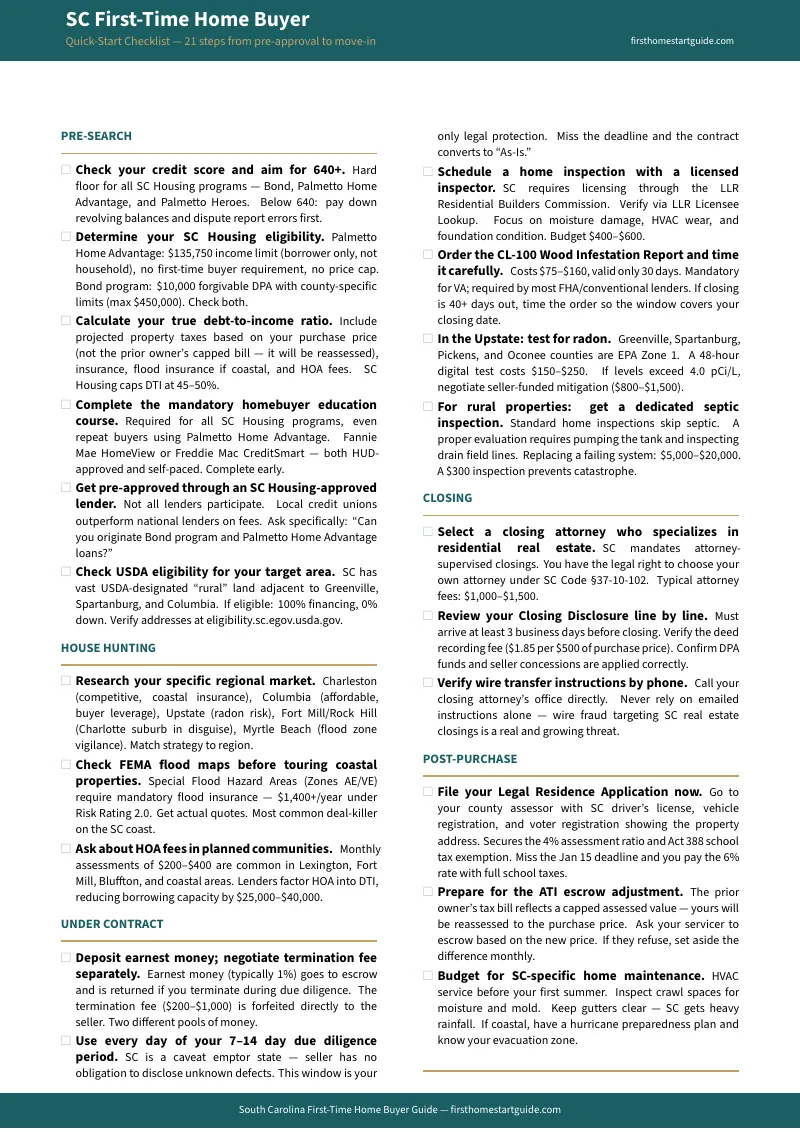
Download the free South Carolina Quick-Start Home Buying Checklist to see the step-by-step framework covering pre-approval, house hunting, inspections, and closing. When you are ready for the full program-stacking strategy, caveat emptor survival guide, CL-100 timing protocol, and complete cost breakdowns, the complete guide is here.
The programs are generous. The traps are hidden. This guide makes sure you claim the first without falling into the second.
Frequently Asked Questions
What if the rules change after I buy?
We update the guide when the rules change. Email us any time, even years later, and we'll send you the current edition free.