The Cash Flow Works. Act 388 School Millage, Non-Transferable STR Licenses, and Legal Residence Audits Will Make Sure It Doesn't.
You found a duplex in Greenville projecting 10% cash-on-cash in the BMW corridor with mid-90% occupancy. Or a beachfront cottage in Folly Beach listed at $650,000 with an active Airbnb pulling $45,000 in gross revenue. Or a $180,000 single-family near Fort Jackson where the listing shows property taxes of $1,800 per year and Section 8 will cover 100% of the mortgage. The DSCR clears. The cap rate works. You're ready to wire earnest money.
Then you discover the Greenville duplex triggers an Assessable Transfer of Interest that resets the tax basis from the previous owner's capped value to your purchase price, the classification flips from 4% to 6%, school operating millage gets added back in, and the $2,000 tax bill on the listing becomes $5,400 — destroying $3,400 of annual cash flow you already underwrote. The Folly Beach cottage has an active ISTR license, but it's non-transferable — the license is permanently extinguished at closing, no new investor licenses are being issued, the waitlist is closed, and you just bought a $650,000 property that cannot legally operate as a short-term rental. The Fort Jackson house was owner-occupied by a military family who PCS'd without notifying the county assessor, and now Dorchester County's TransUnion data cross-reference has flagged the property for a retroactive legal residence audit carrying 100% penalties plus 0.5% monthly interest on every dollar of improperly claimed 4% tax savings.
Here's what no single resource tells you: South Carolina layers a bifurcated property tax system where investment properties pay a 6% assessment ratio plus full school operating millage that owner-occupied homes are completely exempt from (Act 388), creating tax bills three to four times higher than listing portals display. It mandates a licensed closing attorney for every real estate transaction with no title company alternative. It operates under caveat emptor doctrine where waiving a CL-100 wood infestation report means zero legal recourse when you discover a Formosan termite colony has compromised the structural timbers. It fragments short-term rental regulation to the municipal level where a legal Airbnb on Hilton Head is a misdemeanor carrying $500 fines and 30 days in jail one jurisdiction over in Myrtle Beach. And it imposes a 7% nonresident withholding via the closing attorney that drains the liquidity from your 1031 exchange if you fail to file Form I-295 before the closing table. Every one of these has cost real investors five to six figures because the information existed — scattered across county assessor websites, LLR licensing portals, municipal zoning codes, BiggerPockets threads mixing pre-Act 388 advice with current law, and Reddit posts from panicked out-of-state buyers — but nobody had assembled it into a single underwriting system.
The South Carolina Investment Property Guide is a South Carolina Investor Regulatory Navigation System — not a motivational overview of Palmetto State real estate, but a structured framework that maps every South Carolina-specific tax trap, closing requirement, compliance deadline, environmental hazard, and municipal restriction into a process you work through before you wire earnest money. It replaces months of cross-referencing county assessor millage tables, LLR contractor licensing rules, SC Code landlord-tenant provisions, and outdated forum posts with a single reference that tells you exactly what to verify, exactly what the numbers should look like, and exactly where deals go wrong.
What's Inside the South Carolina Investor Regulatory Navigation System
A 12-chapter guide, a quick-start due diligence checklist, and 8 standalone worksheets and reference cards — covering every stage from pre-acquisition analysis through ongoing compliance, built specifically for the tax structures, closing mechanics, and regulatory fragmentation that make South Carolina different from every other state:
The 6% Property Tax Trap and Act 388
The single most financially destructive knowledge gap in South Carolina investing. The guide covers the dual assessment system (4% owner-occupied vs. 6% investment), Act 388's school operating millage exemption that creates tax bills 3-4x what listings display, the Assessable Transfer of Interest mechanism that resets your tax basis to purchase price on closing day, a worked Charleston County example showing a $300,000 property jumping from $2,040 to $5,400 in annual taxes, the 25% ATI exemption under SC Code Section 12-37-3135, and the legal residence audit penalties — including Dorchester County's TransUnion cross-referencing, 100% forfeiture penalties, and 0.5% monthly interest on improperly claimed savings.
The Attorney-State Closing Process
South Carolina mandates a licensed attorney for every real estate closing — no title company, no online platform, no out-of-state settlement agent. The guide maps the full acquisition lifecycle from contract execution through recording, explains the buyer's statutory right to select the closing attorney (SC Code Section 37-10-102), covers mail-away closing mechanics for remote investors, details closing cost breakdowns ($500-$1,000 attorney fee, $1.85/$500 deed recording, 2-3% total buyer costs), and addresses entity vesting for LLC-held purchases.
CL-100 Wood Infestation Report and Caveat Emptor
South Carolina's caveat emptor doctrine means waiving inspections eliminates all legal recourse. The guide explains the CL-100 report that every lender requires, the 28% wood moisture threshold that halts closings, 30-day report expiration, Formosan termite risk zones (Charleston, Beaufort, Dorchester, Berkeley, Orangeburg, Lexington counties), the clearance letter process through SC Department of Labor, Licensing, and Regulations, and why a property without an active termite baiting system in a Formosan zone is an unacceptable risk at any price.
South Carolina Landlord-Tenant Law
South Carolina is pro-landlord — if you follow the procedural requirements exactly. The guide covers the statewide rent control preemption giving landlords total pricing discretion, the unlimited security deposit (no statutory cap) with the strict 30-day return deadline and treble damages for violations, the complete eviction timeline through Magistrate Court (30-45 days when executed correctly), and the conspicuous language exception under SC Code Section 27-40-710 that eliminates the 5-day notice requirement entirely — the single most underutilized tool in South Carolina landlord-tenant law.
Financing — DSCR Loans, Hard Money, and Credit Union Portfolio Lending
DSCR loans are the dominant financing tool for out-of-state investors in South Carolina. The guide covers the DSCR formula with a worked Greenville duplex example, the critical warning that submitting the wrong 4% tax number wastes weeks of underwriting and risks loan failure, conventional mortgage limits (10 properties, 20-25% down), hard money bridge loan terms for BRRRR and fix-and-flip (10-14% interest, 6-12 month terms), the 6-month seasoning bottleneck for refinancing, and South Carolina credit union portfolio lending that bypasses Fannie Mae property limits entirely.
Short-Term Rental Regulations — Municipality by Municipality
The guide maps every major coastal market's STR rules: Folly Beach's 800-license ISTR cap with non-transferable licenses (buying an active ISTR property extinguishes the license at closing), Charleston's three-tier system making non-resident investor STRs effectively illegal on the peninsula, Myrtle Beach's blanket ban in all R-zones with misdemeanor penalties ($500 fines and 30 days jail), and Hilton Head's $150-per-bedroom annual permit model. Includes a summary table with license transferability status for every jurisdiction.
Tax Strategy — Income, Capital Gains, and 1031 Exchanges
South Carolina's 6.5% top income tax rate applies to rental income. The guide covers the bonus depreciation non-conformity problem (dual depreciation schedules required for cost segregation), the 44% net capital gains deduction that drops the effective state rate to approximately 3.6%, Form I-295 nonresident withholding (7% of recognized gain seized at closing if unfiled), and 1031 exchange mechanics in an attorney state where the closing attorney must coordinate precisely with the Qualified Intermediary to prevent constructive receipt.
Market-by-Market Investment Strategies
Four distinct markets analyzed with realistic yield expectations and specific strategies: Greenville-Spartanburg (workforce housing, 5-8% cap rates, value-add in BMW/Michelin corridor), Columbia (Section 8 and student housing near USC and Fort Jackson, recession-resistant institutional demand), Charleston (appreciation-driven, selective STR where zoning permits, 14% accommodations tax), and Myrtle Beach (seasonal STR dynamics with extreme volatility and condo-hotel financing complications). Includes the BRRRR strategy adapted for South Carolina's owner-builder restrictions and 6-month seasoning requirements.
Who This Guide Is For
This guide is for real estate investors targeting South Carolina markets who:
- Are analyzing a South Carolina property and need to calculate the actual 6% tax bill with school operating millage instead of relying on the artificially low number on Zillow — before submitting an offer built on a pro forma that is wrong by $3,000 to $5,000 per year
- Are deploying capital from out of state and need to understand the mandatory closing attorney requirement, the CL-100 wood infestation report that halts transactions, the ATI reassessment that resets your tax basis on day one, and the DSCR loan qualification process where the wrong tax number disqualifies the loan
- Are a military family about to PCS from Fort Jackson, Shaw AFB, Joint Base Charleston, or Beaufort MCAS and want to convert your home to a rental without triggering a retroactive legal residence audit carrying 100% penalties
- Are targeting coastal STR income and need municipality-by-municipality clarity on permit caps, zoning bans, license transferability, and the accommodation tax obligations that follow the property owner — not the booking platform
- Want every South Carolina-specific regulation, tax calculation, closing requirement, environmental hazard, and compliance deadline in one reference — instead of assembling it from county assessor websites, LLR portals, SC Code sections, and BiggerPockets threads that still cite pre-Act 388 tax assumptions
— Less Than One CL-100 Inspection
An ATI reassessment on a $300,000 Charleston property that you underwrote using the listed 4% tax bill produces a $3,360 annual shortfall you never budgeted for. A non-transferable ISTR license on a Folly Beach cottage turns a $650,000 acquisition into an asset that cannot legally generate the STR income your entire pro forma depends on. A legal residence audit penalty on a Fort Jackson rental retroactively charges 100% of the improperly claimed tax savings plus compounding interest. A 7% nonresident withholding you could have avoided with Form I-295 drains the proceeds you need to complete your 1031 exchange.
This guide doesn't replace your South Carolina closing attorney or your CPA. But it gives you the 6% tax calculation framework, the ATI exemption strategy, the STR regulatory map, the CL-100 due diligence protocol, and the landlord-tenant compliance system that ensure you identify every South Carolina-specific risk before you're contractually committed — instead of discovering them at the closing table, on your first tax bill, or in your first eviction hearing.
If it catches a single ATI reassessment miscalculation, prevents a single non-transferable license purchase, or saves you from a treble damages claim on a mishandled security deposit, it pays for itself before you've finished reading it.
Money-back guarantee, no time limit. If the guide doesn't sharpen your underwriting and protect your capital in South Carolina's regulatory environment, you pay nothing.
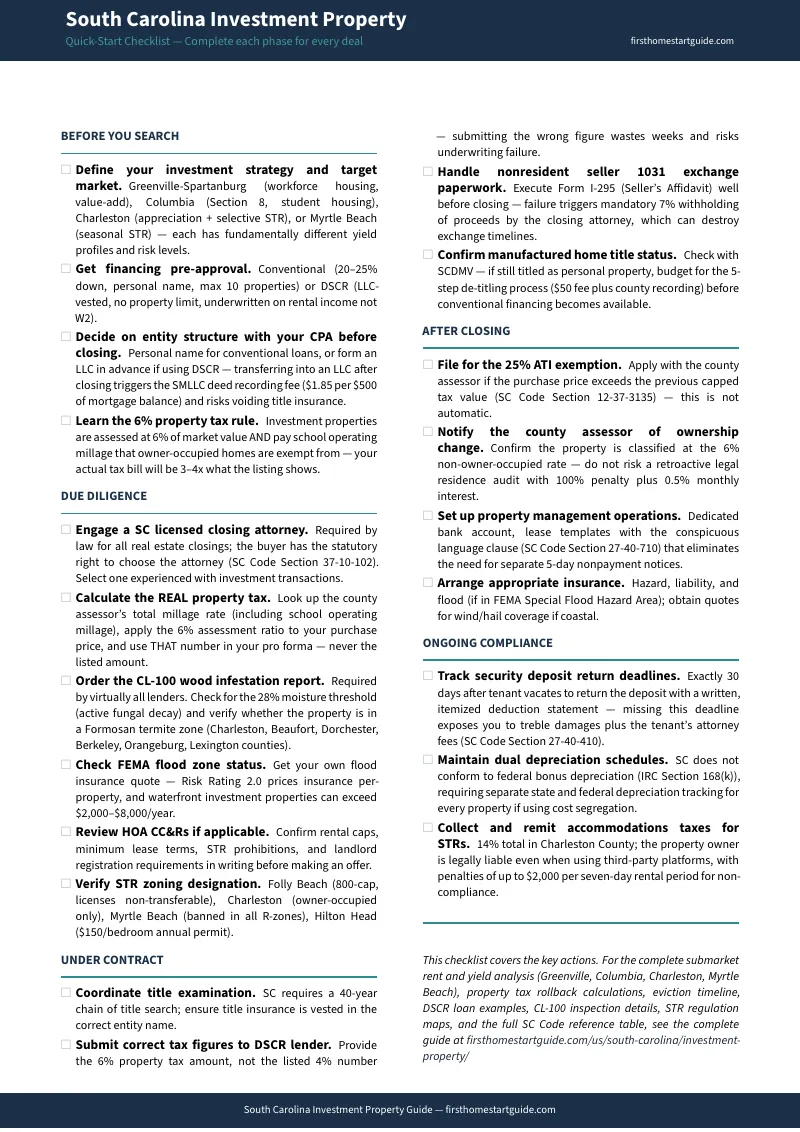
Download the free South Carolina Quick-Start Home Buying Checklist to see the due diligence framework covering pre-search preparation, property analysis, closing coordination, and ongoing compliance. When you're ready for the full 6% tax analysis, STR regulatory map, CL-100 protocol, and 12-chapter investment system, the complete guide is here.
The deal looks good on the spreadsheet. This guide tells you whether South Carolina agrees.
Frequently Asked Questions
What if the rules change after I buy?
We update the guide when the rules change. Email us any time, even years later, and we'll send you the current edition free.