Your Lender Will Pre-Approve You. Nobody Will Mention the Radon Levels That Exceed Federal Danger Limits in 47 of 65 Counties.
You have browsed the SDHDA website and looked at the Fixed Rate Plus program. You have used a mortgage calculator to estimate monthly payments on a $335,000 Sioux Falls listing. You have probably scrolled through r/SiouxFalls threads where someone asks whether radon mitigation is "really necessary" and another poster shares a $2,500 remediation quote for a gas they cannot see or smell. But nobody has explained why the statewide average indoor radon reading is 10.26 picocuries per liter -- more than double the EPA action level -- or that the seller who checked "Do Not Know" on the disclosure form just transferred a potential lung cancer risk and a four-figure remediation bill directly to you.
South Dakota is not a complicated state to buy a home in. It is a complicated state to buy a home in correctly. The market is shaped by severe inventory compression in Sioux Falls (46 days on market, multiple-offer situations under $300,000), a massive military expansion at Ellsworth Air Force Base injecting $886.8 million annually into the Rapid City corridor, an influx of out-of-state remote workers drawn by zero state income tax who have never closed through a title company, and rural properties carrying hidden liabilities in well water, septic systems, and Right to Farm covenants that no listing description mentions. Add the SDHDA's powerful but poorly understood 0% interest down payment assistance, a Mortgage Credit Certificate that delivers up to $2,000 per year in direct tax credits with a recapture risk the state itself reimburses, county-specific Time of Transfer septic ordinances that can kill a deal two weeks before closing, and expansive Pierre Shale clay that heaves foundations from beneath -- and you have a state where a single overlooked hazard costs more than learning to navigate all of them.
Here is the core problem: South Dakota layers extreme environmental hazards, powerful but obscure state assistance programs, a title-company closing process unfamiliar to most transplants, and county-specific rural inspection mandates across a market moving so fast that buyers routinely waive the very protections they need most. The free resources that cover each topic are scattered across SDHDA program pages, county planning department websites, EPA radon maps, Reddit threads mixing outdated quotes with current advice, and agent blogs that emphasize speed over safety. There is no single resource that maps how radon testing interacts with your inspection contingency timeline, how to stack SDHDA down payment assistance with seller concessions for near-zero cash to close, how the title company escrow process actually works if you have never bought outside an attorney state, or which counties enforce septic Time of Transfer inspections that can delay or destroy your transaction. Until now.
The South Dakota First-Time Home Buyer Guide is a Prairie Buyer Navigation System -- a structured decision framework that connects every South Dakota-specific environmental hazard, financial program, closing procedure, and rural inspection requirement into a single step-by-step roadmap from pre-approval through key collection.
What's Inside the Prairie Buyer Navigation System
The complete guide, a quick-start checklist, and 8 standalone printable tools -- an SDHDA program comparison card, a closing cost worksheet, a DPA stacking guide, a compliance income calculator, an inspection checklist, a radon defense protocol, a regional market reference card, and a post-closing deadlines fridge sheet you can print and bring to lender meetings, title company closings, and inspections. Ten printable files total.
Covering every stage from calculating your true South Dakota borrowing power through closing day and beyond:
SDHDA Program Decision Framework
South Dakota Housing Development Authority offers the state's most powerful financing tools, but most buyers learn about only one option from their lender. The guide maps every SDHDA product: the Standard Fixed Rate for buyers bringing their own down payment, the Fixed Rate Buy Down for long-term residents seeking the lowest monthly payment, the Fixed Rate Plus 3% for moderate assistance, and the Fixed Rate Plus 5% for maximum cash preservation. Each DPA option is a 0% interest silent second mortgage with zero monthly payments -- the balance is only due when you sell, refinance, or pay off the loan. But the trade-off is real: the 5% option adds approximately 1.125 percentage points to your primary rate, translating to roughly $225 more per month on a $300,000 loan. The guide models when accepting the higher rate makes sense, when bringing your own down payment saves more over time, and how to stack SDHDA assistance with seller concessions for near-zero cash to close. It also covers the SD Housing Tax Credit (Mortgage Credit Certificate) -- up to $2,000 per year in direct federal tax credits -- including the critical detail that SDHDA reimburses the recapture tax if you sell within nine years, effectively eliminating the risk that keeps most buyers from using it.
Radon Defense Protocol
This is the single most important chapter in the guide. South Dakota has some of the highest indoor radon concentrations in the nation. The statewide average is 10.26 pCi/L -- more than double the EPA action level of 4.0. Forty-seven of the state's 65 counties are classified EPA Zone 1 (High Risk). Rapid City averages 10.50 pCi/L. Some counties approach 20.0. Despite this, first-time buyers routinely skip radon testing to make their offers look competitive, and sellers who have never tested legally check "Do Not Know" on the disclosure form under SDCL 43-4-44, transferring the entire risk to you. The guide explains the science of radon in South Dakota's specific geology, walks you through the 48-hour continuous electronic testing protocol, details the Active Soil Depressurization mitigation system that reduces levels by up to 99%, provides current local cost ranges ($800-$2,500 for standard installations), and shows you exactly how to use your inspection contingency to negotiate seller-paid mitigation or a closing credit -- without losing your competitive position in a fast-moving market.
Market-Specific Buying Strategy
South Dakota is not one housing market. It is several, and the strategy that works in Sioux Falls will fail in rural Meade County. The guide breaks down each zone: Sioux Falls (median $335,000, 46 days on market, 2.7-month inventory, fierce competition under $300,000), Rapid City and Box Elder (median $353,000, driven by the B-21 Raider mission at Ellsworth AFB), secondary cities like Aberdeen, Watertown, and Brookings (more affordable, less competitive, USDA-eligible), Black Hills resort communities (largely out of reach for first-time buyers), and rural South Dakota (affordable but carrying complex well, septic, and mineral rights due diligence). Each zone includes pricing data, competition intensity, which loan programs apply, and the specific pitfalls that catch buyers in that market.
Federal Loan Program Comparison
Beyond SDHDA, the guide covers every major federal loan program available in the state: USDA Rural Development loans offering 100% financing across most of South Dakota (income limits, eligible areas, the manufactured home restriction), VA loans for Ellsworth-area military buyers (zero down, no PMI, the mandatory well water testing requirement, and the Veterans Waiver that opens SDHDA programs to repeat military buyers), FHA loans with their higher DTI allowances but mortgage insurance trade-offs and strict spatial separation requirements for rural properties, and conventional loans with the $832,750 conforming limit. The guide compares each program's credit requirements, down payment, insurance costs, and rural property constraints so you can choose the right product for your situation -- not just the one your lender pushes first.
Rural Property Due Diligence System
Buying outside city limits in South Dakota means navigating well water testing, septic system inspections, and agricultural land law -- none of which your listing agent will walk you through in detail. The guide covers the mandatory VA well water testing protocol (coliform, nitrates, manganese, arsenic), the FHA spatial separation requirements (10 feet from property line, 50 feet from septic tank, 75-100 feet from drain field), and the county-specific Time of Transfer septic ordinances that require full pump-and-inspect before the deed transfers. In Pennington County, a failing septic system triggers a 30-day mandatory repair-or-replace order. In Meade County, similar ToT rules apply. The guide also explains South Dakota's Right to Farm laws -- recorded covenants that legally prevent you from suing neighboring farms over dust, odor, noise, or chemical application -- and the agricultural tax assessment rules that can significantly reduce your tax bill if the land qualifies.
The Title Company Closing Process
If you are relocating from New York, Massachusetts, or any other attorney state, this chapter eliminates the confusion that trips up every out-of-state buyer. South Dakota does not require a closing attorney. Title companies handle the entire settlement: title search, title insurance, escrow, closing documents, tax proration, recording, and disbursement. The guide explains exactly what the title company does and does not do (they cannot give legal advice or negotiate contract terms), when to retain independent counsel, how to read the Title Insurance Commitment for exceptions and mineral severances, the simultaneous-issue discount on Owner's and Lender's title policies, and the full closing-day sequence from wire transfer through deed recording. It also covers the ALTA 35-06 endorsement for western South Dakota properties where mineral rights may be severed from the surface estate.
Post-Closing Survival Guide
Closing is not the finish line in South Dakota -- it is the start of a short, unforgiving deadline. You must file the Owner-Occupied Certificate with your County Director of Equalization by March 15 or pay the significantly higher non-owner-occupied property tax rate for the entire year. This cannot be corrected retroactively. The guide covers this deadline, the voter registration requirement that legally defines your principal residence, the property tax assessment timeline, homeowners insurance strategies for a state with premiums averaging $3,152-$3,965 per year due to hail and tornado exposure, ongoing radon monitoring protocols, and the domicile establishment steps that remote workers need to satisfy aggressive tax auditors from their previous states.
Who This Guide Is For
This guide is for first-time buyers in South Dakota who:
- Are competing in the Sioux Falls market where homes under $300,000 receive multiple offers within days and need a strategy that balances speed with the environmental inspections this state demands
- Are military families assigned to Ellsworth Air Force Base navigating PCS timelines, VA loan requirements, and the Box Elder housing market -- and want to stack a VA zero-down loan with SDHDA's Veterans Waiver for below-market rates and down payment assistance
- Are relocating from a high-tax state to capitalize on South Dakota's zero income tax and need to understand how to establish legal domicile, close through a title company instead of an attorney, and budget for climate-driven costs they have never encountered
- Want to access SDHDA programs but need to understand the interest rate trade-off on the Fixed Rate Plus DPA, whether stacking with seller concessions for near-zero cash to close is worth the higher monthly payment, and how the Mortgage Credit Certificate delivers up to $20,000 in tax savings over a decade
- Are buying rural or acreage property and need to navigate well water testing, county-specific septic Time of Transfer inspections, Right to Farm covenants, mineral rights severances, and agricultural tax assessment rules that can save or cost thousands depending on what you know
- Have been told that radon is "common" in South Dakota but do not understand that the statewide average is more than double the federal danger limit, that sellers can legally disclaim knowledge, and that skipping a $150 test can lead to a $2,500 remediation bill and a serious health risk discovered after closing
- Want every assistance program, every environmental hazard, every closing procedure, and every rural inspection requirement in one document so they walk into lender meetings, title company closings, and property viewings knowing exactly what to ask and what to protect
Why Not Free Resources?
Free information on buying your first home in South Dakota is everywhere. Here is what each source actually delivers:
- SDHDA (sdhda.org) publishes program parameters with precision -- income limits, purchase price caps, credit score thresholds, interest rates. What it does not do: compare the Fixed Rate Plus 3% against the 5% option with the actual monthly payment difference modeled out, explain when the interest rate premium costs more than the DPA saves, or walk you through stacking DPA with seller concessions. The data is there. The decision framework for choosing between programs is not.
- The South Dakota Department of Agriculture and Natural Resources (DANR) publishes septic system rules and administrative codes. What it does not do: explain which counties enforce Time of Transfer inspections, what happens when a system fails inspection two weeks before your closing date, or how a failing septic interacts with VA and FHA loan requirements. The regulations are available. The buyer-specific implications are buried.
- Reddit (r/SiouxFalls, r/RapidCity, r/FirstTimeHomeBuyer) is where real South Dakota buyers share unfiltered experiences -- radon mitigation quotes from 2023 sitting alongside current prices, one poster's SDHDA success story from a program version that has since changed, and advice to "just skip the radon test to stay competitive" from someone who has never seen the statewide average. The signal is real. So is the noise.
- Local real estate agent blogs provide genuine market insight from professionals who earn a commission when you close. They will tell you to "act fast" and "get pre-approved early" but will rarely walk you through the radon testing protocol that slows a deal down, the septic ToT inspection that can kill one, or the SDHDA interest rate trade-off that might steer you toward a different program than the one they partner with.
This guide fills the navigation gap -- the space between knowing South Dakota has assistance programs, radon risk, title company closings, and rural inspection mandates, and understanding how they all interact across a single home purchase. It is the analysis an independent advisor with no commission to earn would give you, structured as a permanent reference you own.
-- Less Than a 48-Hour Radon Test
A professional 48-hour radon test costs $150-$250. Discovering elevated levels after closing and paying for mitigation yourself runs $800-$2,500. Missing the March 15 Owner-Occupied filing deadline costs you a full year of inflated property taxes. Choosing the wrong SDHDA program without modeling the interest rate trade-off can cost tens of thousands over the life of the loan. A failing septic system discovered after closing in Pennington County triggers a 30-day mandatory repair-or-replace order at your expense.
This guide does not replace your lender, your title company, or your real estate agent. But it gives you the SDHDA program decision framework, the radon defense protocol, the rural due diligence system, and the title company closing walkthrough that ensure you walk into every appointment knowing exactly what to ask, exactly what to test, and exactly what to negotiate -- instead of discovering expensive hazards after you have already signed.
If it catches one radon disclosure evasion, helps you access one SDHDA program you did not know you qualified for, or prevents one missed Owner-Occupied filing deadline, it pays for itself before you have finished reading it.
Money-back guarantee, no time limit. If the guide does not make your South Dakota home buying process clearer and your financial position stronger, you pay nothing.
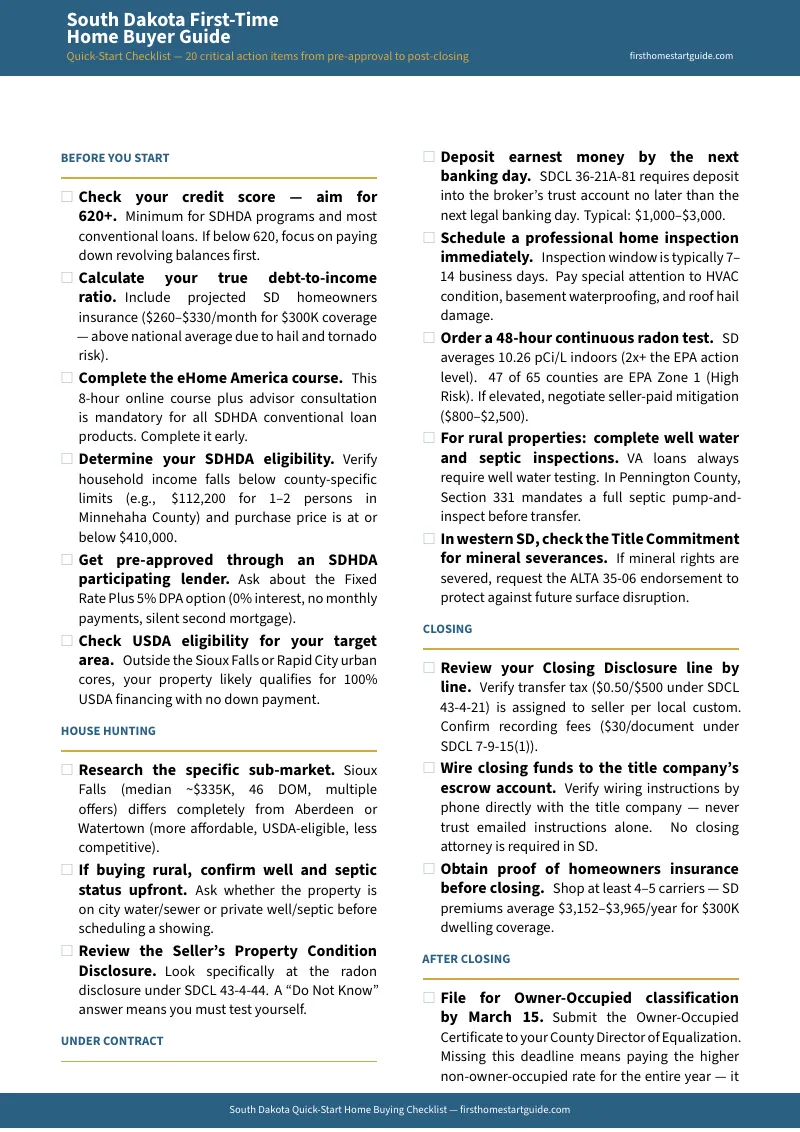
Download the free South Dakota Quick-Start Checklist to see the step-by-step action plan covering SDHDA eligibility, radon testing, rural inspection requirements, and the title company closing process. When you are ready for the full navigation system -- complete with program decision frameworks, cost breakdowns, inspection protocols, and the closing timeline -- the complete guide is here.
The prairie rewards buyers who test before they trust. Make sure you are one of them.