
Zero State Income Tax and 5% Cap Rates. But Miss the 14-Day Security Deposit Deadline and You Forfeit Everything You're Owed.
You ran the numbers on a Sioux Falls duplex throwing off $2,400 a month in gross rent. Or a single-family in Box Elder where military BAH rates guarantee the mortgage payment. Or a Black Hills cabin with $45,000 in projected Airbnb revenue during Sturgis Rally season. The cap rates beat anything on the coast. There's no state income tax. The eviction timeline is measured in weeks, not months. You're ready to deploy capital.
Then you hit the operational reality. The Sioux Falls duplex tenant moves out and your property manager takes three weeks to get contractor estimates for drywall patching. On day 15, you've already forfeited your entire right to withhold any portion of the security deposit -- South Dakota's 14-day return deadline is absolute, and it doesn't matter that the tenant left holes in every wall. The Box Elder rental closes clean, but you discover the property sits in a radon zone where indoor concentrations rank among the highest in the country. You never tested during inspection. Six months later, the tenant tests independently, finds elevated levels, and the implied warranty of habitability gives them the right to vacate immediately and walk away from the lease. The Black Hills cabin is in Deadwood, where city ordinance explicitly bans residential short-term rentals -- your $45,000 revenue projection is legally impossible. The only STR exception is a 14-day window in August for the Sturgis Rally.
Here's what no single resource explains: South Dakota layers a 14-day security deposit return deadline that forfeits all withholding rights and exposes landlords to $200 in punitive damages for a single missed day, a 2024 eviction overhaul (SB89 and SB90) that eliminated the Notice to Quit and cut month-to-month termination from 30 days to 15 but that most property management playbooks haven't incorporated, radon concentrations that create habitability liability without any explicit landlord disclosure statute to warn you, a Black Hills STR patchwork where a property legal in unincorporated Lawrence County is an illegal commercial operation two miles away in Deadwood with $250/day fines in Pennington County, and a property tax system where losing the owner-occupied mill levy reduction at acquisition silently increases your tax bill by 20% to 30% -- into an operating environment that punishes investors who assume a landlord-friendly state means a forgiving one.
The South Dakota Investment Property Guide is a Zero-Tax State Operations Manual -- not a motivational overview of Midwest investing, but a structured due diligence and operations framework that maps every South Dakota statutory trap, environmental hazard, regulatory restriction, and tax calculation into a process you work through before you wire earnest money. It replaces months of cross-referencing SDCL statutes, county zoning ordinances, Pennington County VHR rules, Ellsworth AFB housing data, and BiggerPockets threads with a single reference that tells you exactly what to verify, exactly what the numbers should look like, and exactly where deals go wrong in the state that looks easy until you operate in it.
What's Inside the Zero-Tax State Operations Manual
A 12-chapter guide, a quick-start due diligence checklist, and 5 standalone reference sheets (14-day deposit compliance timeline, BAH rate reference card, Black Hills STR compliance matrix, environmental due diligence checklist, LLC maintenance calendar) -- covering every stage from market selection through post-purchase operations, built specifically for the statutory traps, environmental risks, and regulatory complexity that catch investors who mistake landlord-friendly for operationally simple:
The 14-Day Security Deposit Rule and the 2024 Eviction Overhaul
The single most dangerous compliance requirement in South Dakota rental operations. Under SDCL 43-32-24, you have exactly 14 days after the tenant vacates and provides a forwarding address to return the deposit or mail an itemized deduction statement. Miss day 14 by a single day and you forfeit all rights to withhold any portion of the deposit -- regardless of actual damage to the property. The guide covers the mandatory 72-hour contractor SLA process you must establish before your first tenant moves in, deposit caps (one month's rent standard, 1.5x for furnished units), the 45-day accounting rule for tenant-requested itemizations, and the complete 2024 eviction overhaul under SB89 and SB90 -- the elimination of the Notice to Quit requirement for non-payment evictions, the reduction of month-to-month termination notice from 30 days to 15, the new 5-day summons response window, and sheriff lockout execution including county-specific fees.
Four-Market Investment Playbook: Sioux Falls, Rapid City, Aberdeen, and Brookings
Each market analyzed with current median prices, rent ranges by unit type, cap rates by asset class, vacancy rates, economic drivers, and the specific strategy that works. Sioux Falls ($335,000 median, 4.85% to 5.76% cap rates, diversified economy anchored by Sanford Health and Wells Fargo) for stable buy-and-hold. Rapid City ($363,000 to $368,000 median, only 332 active listings, military-driven demand creating near-zero vacancy for single-family rentals near Ellsworth) for high-yield cash flow. Aberdeen for low-leverage agricultural-adjacent plays. Brookings for per-bedroom SDSU student housing with seasonal vacancy underwriting. County-by-county effective property tax rates and the owner-occupied mill levy reduction penalty that increases your tax bill 20% to 30% upon acquisition.
Military Investment: Ellsworth AFB and the B-21 Expansion
The $1 billion Department of Defense investment at Ellsworth Air Force Base is relocating thousands of active-duty personnel, defense contractors, and families to the Rapid City corridor. On-base housing waitlists run three to twelve months. The guide covers 2026 BAH rates by grade (E-5: $1,986/month, E-6: $2,211/month, O-3: $2,475/month) that exceed median Rapid City rents at every grade, creating surplus debt service coverage for investors. VA loan portfolio-building strategies for service members (zero down, occupy, PCS, retain as rental, repeat), the Box Elder corridor targeting strategy for 20-minute commute properties, and why military tenants are functionally zero-default-risk -- income backed by the federal government, UCMJ consequences for financial delinquency, 2- to 4-year predictable tenure.
Zero State Income Tax: What It Covers and What It Doesn't
South Dakota levies no individual income tax, no corporate income tax, no capital gains tax, and no estate or inheritance tax. The guide separates the real savings (an investor domiciled in Minnesota or California retains $6,000 to $10,000 per year on a portfolio generating $80,000 in net rental income) from the common overestimation (federal tax obligations remain fully intact). Property tax mechanics including the 85% equalization ratio and mill levy calculations, 1031 exchange efficiency through the title company closing model (no attorney required, qualified intermediaries work directly with title agents), cost segregation strategies, and agricultural land adjacency classifications that can dramatically alter rural property tax burdens.
Black Hills Short-Term Rental Regulations
The regulatory patchwork that traps out-of-state STR investors buying on projected gross revenue without verifying local zoning. Deadwood's effective ban on residential STRs (the only exception: a 14-day August window for Sturgis). Lead's municipal licensing and Department of Health lodging requirements with bedroom egress specifications. Pennington County's comprehensive VHR framework -- $150 license fee, septic system occupancy caps, $200/day fines for unlicensed advertising, $250/day for operational violations, three-violation revocation hearings. Lawrence County's current permissive environment and why Pennington-style restrictions are an imminent legislative inevitability. State-level sales tax (4.5%) and tourism tax (1.5%) registration requirements. The jurisdiction-by-jurisdiction compliance matrix you need before acquiring any Black Hills property.
Environmental and Structural Due Diligence
South Dakota's environmental risks are not coastal risks. The guide covers radon testing during inspection contingency (EPA action threshold: 4.0 pCi/L, sub-slab depressurization systems: $1,500 to $2,500), frost heave and foundation inspection protocols for severe freeze-thaw cycles (what to look for: horizontal cracking, bowed basement walls, slab-on-grade without frost protection as a disqualifier for long-term holds), well and septic system verification for rural rentals (county permit closure, sludge depth, drain field condition -- failing systems cost $10,000 to $25,000 to replace), hail claims history via C.L.U.E. reports (multiple claims mean prohibitive insurance premiums), agricultural spray drift risk on urban-fringe properties, mineral rights severance verification, and Native American trust land restrictions in western South Dakota.
Entity Structure: The South Dakota LLC
Why a domestic South Dakota LLC ($150) beats registering a foreign LLC ($750). Formation through the Secretary of State, registered agent requirements, annual report deadlines and the $50 late fee that triggers "Delinquent" status and eventually administrative dissolution -- which pierces your liability protection. Privacy advantages over other jurisdictions. The maintenance calendar that prevents a missed filing from exposing you personally to property-level claims.
Financing: Conventional, DSCR, VA, and Manufactured Home Loans
DSCR loan mechanics for portfolio scaling (minimum DSCR of 1.0 to 1.25, 620+ credit score, 20% to 25% down, 3 to 6 months liquidity reserves, closes in the LLC's name). Local lenders who understand South Dakota's asset classes -- Dacotah Bank, First National Bank of South Dakota, First Dakota National Bank. VA loan strategies for Ellsworth military investors. Manufactured home financing (21st Mortgage, BankWest) for rural properties where chattel loans produce strong cash-on-cash returns despite higher rates.
Closing Process and Property Management
South Dakota's title company closing model (no attorney required), deed types and when to use each one (Warranty Deed for acquisitions, Quitclaim for internal LLC transfers), transfer tax ($0.50 per $500 of consideration), title insurance, and the full 30- to 40-day closing timeline. Property management selection criteria focused on the 14-day deposit SLA -- the specific questions to ask before hiring, the day-by-day compliance timeline from tenant departure to itemized statement mailing, winterization protocols for vacant units in sub-zero temperatures (a single pipe burst costs $10,000 to $30,000), and remote management challenges for out-of-state investors.
Who This Guide Is For
This guide is for real estate investors targeting South Dakota markets who:
- Are analyzing a Sioux Falls or Rapid City rental property and need to understand how the 14-day security deposit deadline, 2024 eviction law changes, property tax reclassification upon acquisition, and radon liability create operational traps that don't exist in the states where you currently invest
- Are an out-of-state investor from California, Minnesota, New York, or another high-tax state attracted by South Dakota's zero state income tax and need every SD-specific statutory requirement, environmental risk, and regulatory complication in one reference before you deploy capital
- Are a military investor or service member at Ellsworth AFB evaluating the BAH arbitrage -- the spread between your housing allowance and local rents -- and need the market data, VA loan strategies, and Box Elder corridor targeting to execute the buy-occupy-PCS-rent cycle
- Are evaluating a Black Hills short-term rental and need to verify whether the property's exact jurisdiction allows STRs at all, what permits and licenses are required, and what the penalty structure looks like before you buy based on projected Airbnb revenue
- Are a local South Dakota professional converting your primary residence to a rental and need the landlord-tenant compliance framework -- the 14-day deposit rule, habitability requirements, lead paint disclosure, and winterization protocols -- to make the transition from homeowner to regulatory-compliant landlord without a statutory violation on your first turnover
- Are an agricultural investor diversifying farm revenue into residential real estate and need the entity structuring, property tax analysis, and financing options specific to South Dakota's market dynamics
Why Not Free Tools and Forums?
Free information on South Dakota real estate investing exists across several sources. Here's what it actually delivers:
- BiggerPockets forums contain experienced investors discussing Sioux Falls cap rates and Rapid City military demand, but the threads mix current advice with analysis that predates the 2024 eviction overhaul (SB89 and SB90). Posts recommending a "3-day Notice to Quit" are citing repealed law. You'll find useful data points surrounded by outdated legal guidance that takes longer to verify than reading a guide that has already incorporated the current statutes.
- The South Dakota Codified Laws (SDCL) database gives you the raw statutes, but reading 43-32-24 tells you the deposit deadline is 14 days without explaining the day-by-day contractor SLA process you need to actually meet it, how to handle the 45-day accounting request, or the interaction between the deposit cap and pet deposits and furnished units. You get the law without the operational implementation.
- Pennington County and Deadwood municipal code portals publish the zoning ordinances and STR regulations, but they don't show you the jurisdiction-by-jurisdiction comparison that reveals the regulatory arbitrage between Lawrence County and Pennington County, don't explain the practical consequence of Deadwood's residential STR ban for an investor who just found a cabin on Zillow, and don't connect zoning restrictions to your deal economics. You get compliance requirements without investor-specific interpretation.
- Military housing resources and BAH tables provide allowance rates by grade and zip code, but they don't connect those numbers to cap rates, don't explain how the B-21 expansion timeline maps to rental demand, and don't cover the VA loan portfolio-building strategy that lets service members accumulate properties across duty stations. You get housing stipend data without the investment thesis.
This guide fills the South Dakota-specific gap -- the space between knowing how to analyze a rental property in general and knowing how to operate one in a state where a 14-day deposit deadline forfeits your money, radon creates silent habitability liability, the Black Hills STR landscape changes every two miles, and a missed LLC annual report dissolves your liability protection. It's the analysis that would take a South Dakota real estate attorney, an environmental inspector, a military housing specialist, and a property tax analyst to assemble -- structured as a reference you own permanently.
-- Less Than One Radon Mitigation Estimate
A security deposit you can't legally withhold because your contractor took 16 days instead of 14 to deliver an estimate. A radon mitigation system you didn't install because nobody told you South Dakota has no explicit landlord disclosure statute -- until your tenant tested independently and invoked the implied warranty of habitability to break the lease. A Black Hills cabin purchased for STR revenue in a jurisdiction that bans residential short-term rentals. A property tax bill that jumped 25% because you didn't underwrite the loss of the owner-occupied mill levy reduction. An LLC dissolved for a missed $50 annual report, exposing you personally to a slip-and-fall claim on the property.
This guide doesn't replace your South Dakota attorney or your CPA. But it gives you the 14-day deposit compliance process, radon testing protocol, STR jurisdiction matrix, property tax analysis, and LLC maintenance calendar that ensure you identify every South Dakota-specific risk before you're contractually committed -- instead of discovering them in a forfeited deposit, a broken lease, a zoning violation, or an administrative dissolution notice.
If it catches a single deposit deadline you would have missed, prevents a single habitability claim, or saves you from a single STR zoning violation, it pays for itself before you've finished reading it.
Money-back guarantee, no time limit. If the guide doesn't sharpen your underwriting and protect your capital in South Dakota's operating environment, you pay nothing.
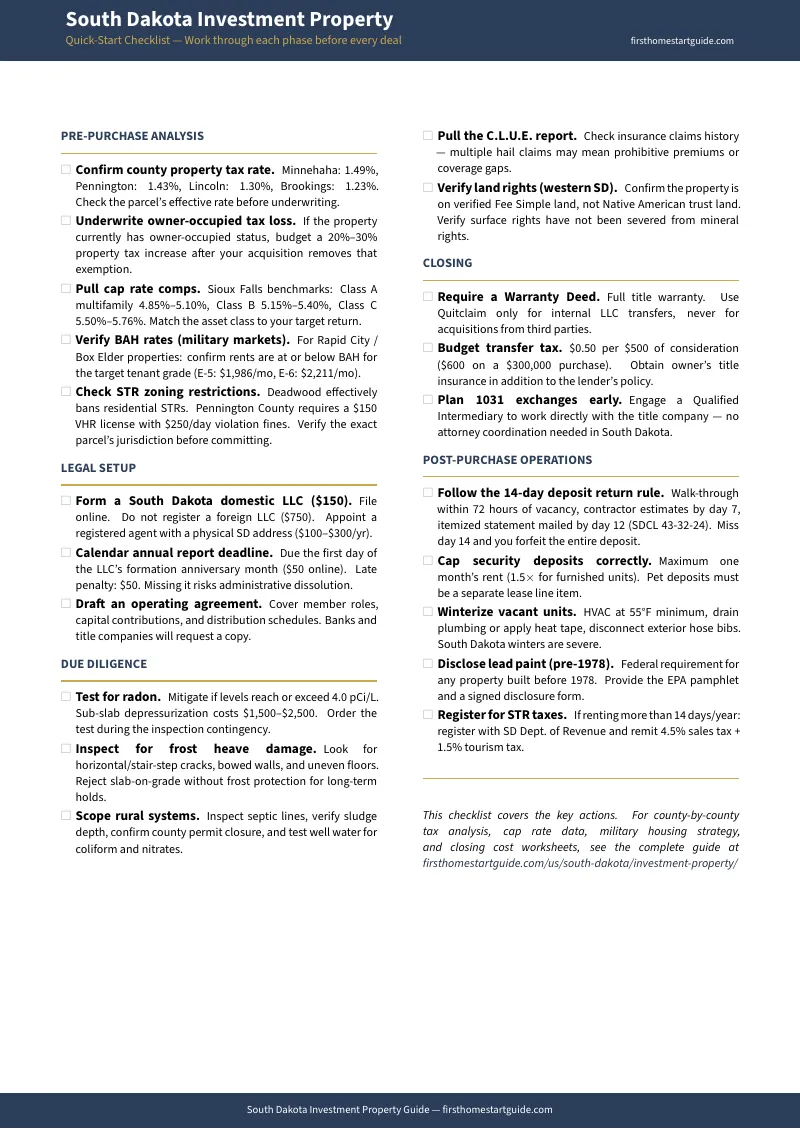
Download the free South Dakota Quick-Start Checklist to see the due diligence framework covering property tax verification, environmental inspections, legal setup, and closing steps. When you're ready for the full 14-day deposit compliance system, military investment playbook, STR regulatory matrix, and 12-chapter investment guide, the complete guide is here.
The yield looks right on the spreadsheet. This guide tells you whether South Dakota's statutes agree.
Frequently Asked Questions
What if the rules change after I buy?
We update the guide when the rules change. Email us any time, even years later, and we'll send you the current edition free.