
The Gross Yield Says 10%. The County Tax Bill Says Think Again.
You found a duplex in Memphis listed at $185,000 with tenants paying $1,850 a month. That's a 12% gross yield — better than anything in your home market. Or a three-bedroom in Clarksville where the E-5 BAH rate covers the mortgage with room to spare. Or a cabin in Gatlinburg generating $95,000 in annual short-term rental revenue on a $550,000 acquisition. The spreadsheet works. You're ready to move.
Then you run the real numbers. The Memphis duplex sits inside city limits where the combined Shelby County plus City of Memphis property tax rate hits $6.08 per $100 of assessed value — not the $2.69 you modeled from the county-only rate the turnkey provider quoted. On a $185,000 property assessed at 25%, that's $2,812 in taxes instead of $1,244. Your property management company charges 10% because Memphis management intensity demands it. Your 12% gross yield just compressed to 4.5% net — and that's before the tenant fails the Memphis Housing Authority's HQS inspection for the third time and your Section 8 unit sits vacant for another six weeks. The Gatlinburg cabin's septic system is permitted for 8 guests, but you marketed it to sleep 14 by adding bunk beds. Sevier County just flagged your listing, and your property is being reclassified from 25% residential to 40% commercial assessment — a 60% increase in your property tax bill that wipes out your entire margin.
Here's what no single resource explains: Tennessee layers a bifurcated landlord-tenant law that creates two entirely different legal systems depending on county population, a statewide property tax reclassification that bumps non-owner-occupied short-term rentals from 25% to 40% assessment, a city-plus-county tax structure in Memphis that produces one of the heaviest property tax burdens in the Southeast, a military BAH economy in Clarksville where government stipends — not market demand — set your rental ceiling, a non-judicial foreclosure timeline as short as 30 days that eliminates the safety net investors from judicial states assume exists, a 2025 Landlord Transparency Act requiring a Tennessee-based registered agent for legal notices, and a California FTB worldwide income rule that taxes your Tennessee rental profits at California rates if you haven't changed your residency — into a regulatory environment where every region operates under fundamentally different rules. Every one of these has cost real investors five to six figures because the information existed — scattered across URLTA statute sections, Shelby County Trustee tax tables, Sevier County STRU permit applications, Fort Campbell BAH lookup tools, and three-year-old BiggerPockets threads — but nobody had assembled it into a single underwriting system.
The Tennessee Investment Property Guide is a Tennessee Market Intelligence System — not a motivational pitch about zero income tax, but a structured due diligence framework that maps every Tennessee-specific financial trap, regional market dynamic, and regulatory divergence into a process you work through before you wire earnest money. It replaces months of cross-referencing URLTA vs. common law county statutes, Memphis city-plus-county tax layering, Sevier County STR permit requirements, Fort Campbell BAH rate tables, and Tennessee Secretary of State entity filings with a single reference that tells you exactly what to verify, exactly what the numbers should look like, and exactly where deals break.
What's Inside the Tennessee Market Intelligence System
A 14-chapter guide with appendices, a quick-start checklist, and 8 printable standalone worksheets and reference cards — covering every stage from entity formation through portfolio strategy, built specifically for the regional fragmentation and regulatory traps that make Tennessee different from every other investment state:
The URLTA Divide — Two Legal Systems in One State
Most national content treats Tennessee as a single legal jurisdiction for landlord-tenant matters. It is not. Counties with populations over 75,000 — including Davidson (Nashville), Shelby (Memphis), Montgomery (Clarksville), Knox (Knoxville), and Hamilton (Chattanooga) — operate under the Uniform Residential Landlord and Tenant Act. Every other county operates under common law rules with different notice periods, deposit handling, and eviction procedures. The guide maps both systems: the URLTA's mandatory 14-day notice for nonpayment, the 30-day requirement for month-to-month termination, the strict security deposit segregation rules — and the common law counties' powerful waiver-of-notice provision that lets you bypass the 14-day wait entirely if the clause is printed in bold 12-point font in the lease. An investor using a standard internet lease template in a non-URLTA county is operating under the wrong legal framework. An investor applying common law speed to a URLTA county eviction will have their detainer warrant thrown out. The guide ensures you know which system applies to your property before you draft the lease.
Memphis: The Yield Deconstruction
Memphis routinely ranks near the top nationally for gross rental yields, with turnkey providers advertising 10% to 12% returns. The guide dissects those numbers with the actual tax structure: Shelby County at $2.69 per $100 of assessed value plus City of Memphis at $3.39, for a combined $6.08 inside city limits. On a $200,000 property, that's $3,040 in annual property taxes — before the 10% management fee that Memphis's management intensity demands, before realistic vacancy and maintenance reserves on older housing stock, and before the collection losses that hit market-rate portfolios in high-eviction zip codes. The guide models what 10% gross actually delivers as net yield after every real expense, and covers the Section 8 stabilization strategy — including MHA Housing Quality Standards inspection requirements, HAP contract mechanics, and why Section 8 tenants produce lower turnover and guaranteed government direct deposits that eliminate the credit risk destroying market-rate returns.
Clarksville and the BAH Economy
Clarksville's rental market is not driven by traditional supply and demand — it's driven by the Department of Defense. The guide provides 2026 BAH rates for Fort Campbell by pay grade and dependent status, from E-1 through O-5, and shows how to reverse-engineer an acquisition price from a BAH ceiling. An E-5 with dependents at $1,815 per month maps to a maximum acquisition price range. An E-4 at $1,743 sets a different ceiling. The guide covers the on-post competition from Campbell Crossing's privatized housing (which absorbs the full BAH and includes utilities), the $250-to-$300 monthly utility burden that off-post rentals must offset in pricing, the SCRA lease-break provisions that create unpredictable vacancy spikes during PCS rotations, and the turnover reserves military landlords must maintain that civilian landlords in other markets can ignore.
Smoky Mountain Cabins: STR Economics and the Regulatory Gauntlet
Gatlinburg and Sevierville operate as a pure hospitality asset class with fundamentally different economics from long-term rentals. The guide covers the management fee tiers — 15% for marketing-only services through 25% to 35% for full-service boutique operators — and models what a $100,000 gross revenue cabin actually delivers after management, the 40% commercial property tax reclassification, HOA dues, utilities, and debt service. It maps the septic capacity constraint that ties maximum occupancy to your septic permit (not your bed count), the 13-guest threshold that triggers commercial fire sprinkler requirements, the Sevier County STRU permit program with its $250 annual fee and mandatory fire and life-safety inspection, and the "three strikes" nuisance rule that results in permanent permit revocation. If your cabin investment thesis depends on sleeping 14 guests in a property with an 8-person septic permit, this chapter tells you before you close.
The 40% Commercial Reclassification and the California Tax Trap
Two tax traps catch more out-of-state investors than any other issue. First: Tennessee assesses residential property at 25% of appraised value and commercial property at 40%. Short-term rentals that are not the owner's primary residence are increasingly reclassified to commercial by county assessors. On a $600,000 cabin, that's the difference between being taxed on $150,000 and being taxed on $240,000 — a 60% increase in your tax bill. Second: California residents investing in Tennessee must report all rental income on CA Schedule 540NR and pay California state income tax on the profits. The "no state income tax" benefit applies to Tennessee residents, not to the investor's home state. If a California-based management company handles your Tennessee property, the FTB mandates a 7% withholding on gross payments. The guide models both traps with specific dollar impacts so you underwrite them from day one instead of discovering them at tax time.
Entity Structuring, Foreclosure, and Financing
Tennessee LLC formation, the 6.5% excise tax, and the two exemptions that eliminate it — the Obligated Member Entity (OME) exemption and the Family-Owned Non-Corporate Entity (FONCE) exemption — with the specific filing requirements for each. The Tennessee Investment Services Trust (TIST) for multi-property portfolios. Non-judicial foreclosure mechanics under the Deed of Trust system — including the 30-to-45-day timeline from default to auction that makes Tennessee one of the fastest foreclosure states in the country and the near-universal waiver of post-sale redemption rights. Conventional, DSCR, and hard money financing compared by down payment, qualification method, and Tennessee-specific considerations. The RF401 purchase agreement's default non-assignment clause and why failing to add "and/or assigns" language before signing is a breach if you plan to close in your LLC.
Who This Guide Is For
This guide is for real estate investors targeting Tennessee markets who:
- Are analyzing a Memphis property and need the actual combined city-plus-county tax rate, realistic net yield calculations, and a Section 8 strategy that accounts for MHA inspection timelines — not the gross yield number from a turnkey provider's marketing sheet
- Are buying a Smoky Mountain cabin and need to verify whether the property's septic capacity supports your revenue model, whether the STR will be reclassified to 40% commercial assessment, and what the STRU permit and fire inspection require before you can legally operate
- Are purchasing in Clarksville and need to reverse-engineer the acquisition price from actual BAH rates by pay grade, account for on-post competition and utility cost differentials, and build turnover reserves for SCRA-protected lease breaks
- Don't know whether your Tennessee property sits in a URLTA county or a common law county — and need to understand why that distinction determines your lease template, eviction timeline, deposit handling, and whether a waiver-of-notice clause is even enforceable
- Are a California resident investing in Tennessee and need to model your true after-tax returns at California rates, account for the 7% FTB withholding if using a California-based management company, and stop assuming the zero-state-income-tax headline applies to you
- Are forming a Tennessee LLC and need to know whether to file for the OME or FONCE exemption — and what happens to your returns if you miss the filing and owe 6.5% excise tax on net earnings
- Are an out-of-state investor evaluating Tennessee for the first time and want every region-specific regulation, tax calculation, and due diligence requirement in one reference — instead of assembling it from URLTA code sections, Shelby County Trustee tax tables, Sevier County permit applications, Fort Campbell BAH tools, and Reddit threads that may have been accurate two legislative sessions ago
Why Not Free Tools and Forums?
Free information on Tennessee real estate investing exists across dozens of sources. Here's what it actually delivers:
- BiggerPockets forums are where someone in a 2022 thread says Tennessee is "the most landlord-friendly state in the country," someone in 2024 mentions the URLTA, and nobody has posted about the 2025 Landlord Transparency Act's registered agent requirement. Memphis threads discuss gross yields without deconstructing the city-plus-county tax layering, management fee intensity, or MHA inspection timelines that determine net returns. Smoky Mountain threads mention management fees but don't model the 40% commercial reclassification, septic capacity constraints, or STRU permit inspection requirements. You'll find genuinely useful experience reports mixed with advice predating the latest statutory changes. Sorting current from outdated takes longer than reading a guide that has already done it.
- Turnkey provider marketing quotes gross yields of 10% to 12% on Memphis properties. They don't include the combined $6.08 tax rate inside city limits, don't disclose the 10% management fee their affiliated company charges, don't model realistic vacancy on older housing stock, and don't mention that the property needs $15,000 in deferred maintenance within the first year. You get the yield number that generates the sales call, not the yield number that determines whether the deal works.
- State government websites give you the statutes and tax rates without the investment analysis. The Tennessee Secretary of State has the LLC filing forms but doesn't explain the OME versus FONCE exemption decision. The Shelby County Trustee publishes the tax rate but doesn't calculate its impact on your net yield. Sevier County's STRU permit page lists the requirements but doesn't connect them to your revenue model. You get the raw data without the framework that turns it into an investment decision.
- National investing courses teach cap rate, cash-on-cash, and 1031 mechanics that apply everywhere. They don't cover the URLTA vs. common law divide, the 40% commercial reclassification, Memphis's layered tax burden, Clarksville's BAH-driven rental ceiling, the California FTB worldwide income trap, or the waiver-of-notice provision that halves your eviction timeline in rural counties. Applying national frameworks to Tennessee's fragmented regulatory environment is how investors lose five figures on their first deal.
This guide fills the Tennessee-specific gap — the space between knowing how to analyze a rental property in general and knowing how to underwrite one in a state where the URLTA divide, Memphis's layered tax burden, the 40% commercial reclassification, Clarksville's BAH ceiling, Sevier County's septic capacity rules, and the California FTB trap can each independently turn a profitable deal into a losing one. It's the analysis that would take a Tennessee real estate attorney, a Memphis property tax specialist, and a military housing consultant to assemble — structured as a reference you own permanently.
— Less Than One Memphis Tax Miscalculation
A Memphis property tax rate modeled at the county-only $2.69 instead of the combined $6.08 inside city limits understates your annual holding costs by $1,768 on a $200,000 property. A Gatlinburg cabin underwritten at the 25% residential assessment instead of the 40% commercial rate inflates your projected cash flow by thousands per year. A Clarksville rental priced above the E-5 BAH ceiling sits vacant while every military family chooses the on-post option that includes utilities. A California investor who skips the FTB worldwide income calculation discovers at tax time that their "tax-free" Tennessee returns owe California rates. A lease in a URLTA county without the mandatory 14-day notice procedure gets your eviction case dismissed and adds months of carrying costs.
This guide doesn't replace your real estate attorney or your property manager. But it gives you the URLTA compliance framework, the Memphis yield deconstruction worksheet, the BAH underwriting worksheet, the STR compliance worksheet, the entity structuring decision tree, and the region-specific due diligence checklists — all as printable standalone PDFs you can bring to property viewings, closing meetings, and underwriting sessions — so you identify every Tennessee-specific risk before you're contractually committed, instead of discovering them on your first tax bill, your first eviction filing, or your first conversation with the California FTB.
If it catches a single tax jurisdiction error you didn't model, prevents a single lease template mismatch between URLTA and common law counties, or saves you from underwriting a Smoky Mountain cabin at the wrong assessment ratio, it pays for itself before you've finished reading it.
Money-back guarantee, no time limit. If the guide doesn't sharpen your underwriting and protect your capital in Tennessee's fragmented regulatory environment, you pay nothing.
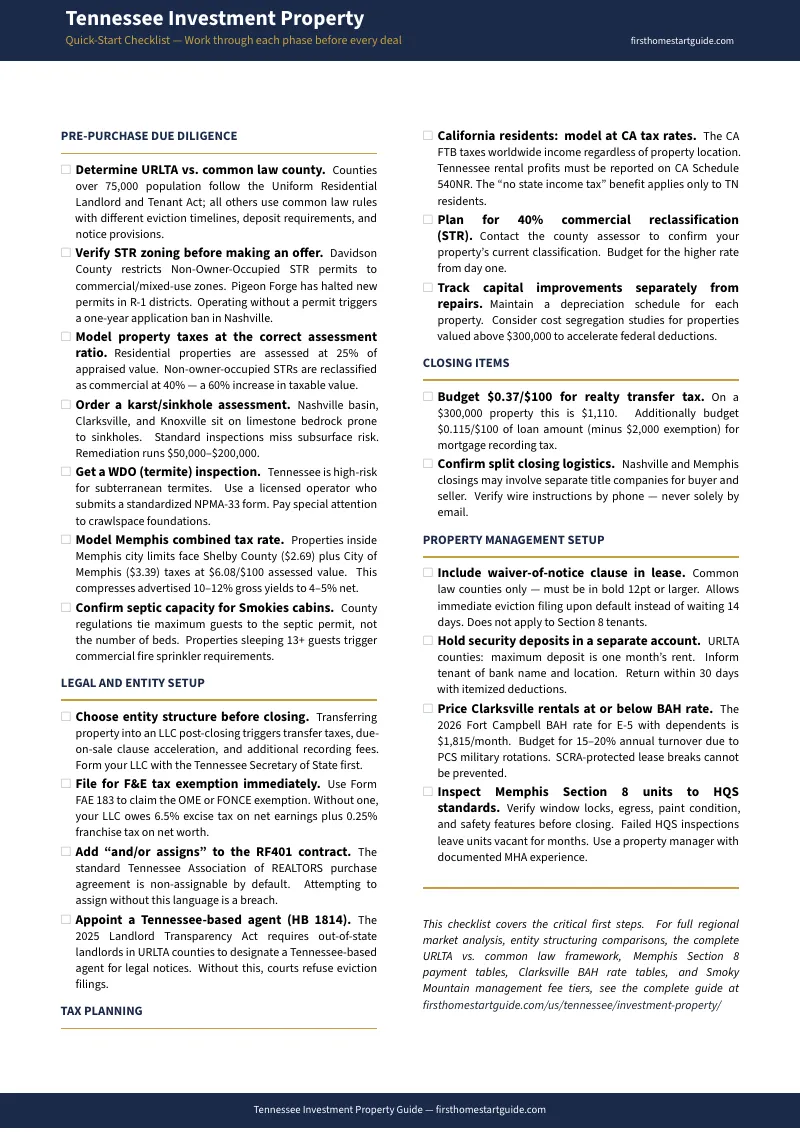
Download the free Tennessee Quick-Start Checklist to see the due diligence framework covering URLTA vs. common law verification, property tax assessment ratios, STR permitting, entity formation, and market-specific traps. When you're ready for the full regional market analysis, Memphis yield deconstruction, Clarksville BAH tables, Smoky Mountain STR economics, and the complete 14-chapter investment system, the complete guide is here.
The deal looks good on the spreadsheet. This guide tells you whether Tennessee agrees.