
The Spreadsheet Says 8% Gross Yield. Texas Property Tax Code Says Otherwise.
You found a turnkey rental in Garland pulling $1,650/month on a $220,000 purchase. Or a BRRRR project in Arlington where the after-repair value supports a cash-out refi at 75% LTV. Or a duplex near Joint Base San Antonio where E-5 BAH of $1,869/month covers the mortgage with room to spare. The numbers work. You're ready to wire earnest money from California or New York.
Then Texas reveals its operating costs. The Garland rental was owned by a homesteader for twelve years. The seller's tax bill shows $4,200/year because the Section 23.23 appraisal cap held the taxable value at $165,000 — but the property's uncapped market value is $285,000. When the homestead exemption strips on January 1 after closing, the appraisal district reassesses at full market value. Your property tax jumps to $7,125 overnight. That 8% gross yield drops below 5% before you've collected a single rent check. The Arlington flip sits in a Municipal Utility District where a 1.20% MUD tax adds $3,600/year that no online mortgage calculator captured because consumer algorithms use median county rates, not the hyper-local special taxing jurisdiction rate for your specific subdivision. The San Antonio duplex tenant moves out, and you deduct $1,800 from the security deposit for damage repairs — then miss the 30-day return deadline by six days. Under Texas Property Code Section 92.109, the tenant's attorney files a bad-faith claim: $100 statutory fine, three times the wrongfully withheld amount, plus attorney fees. Your $1,800 deduction becomes a $6,500 judgment — and the statute imposes liability on the property owner personally, not your management company.
Here's what BiggerPockets threads and agent blogs never consolidate into one framework: Texas layers a homestead appraisal cap (Section 23.23) that explicitly excludes investment properties, MUD and PID taxes that add $1,500 to $4,200/year in holding costs invisible to standard calculators, a 30-day security deposit deadline backed by a 3x bad-faith penalty with personal owner liability, JP Court evictions filed by precinct with constable service rules that vary by county, a FEMA Risk Rating 2.0 Glide Path that escalates Houston flood insurance premiums 18% annually until they hit actuarial rates, Series LLC structuring under Business Organizations Code Chapter 101 Subchapter M, an Austin/Galveston/Fredericksburg STR regulatory patchwork where operating without a license triggers $2,000/day fines and platform delisting, and DSCR loan mechanics where the 50(a)(6) home equity exemption doesn't apply to non-owner-occupied properties. Each one of these has cost real out-of-state investors five to six figures because the information existed — scattered across county appraisal district portals, Texas Property Code chapters, FEMA flood maps, and municipal licensing databases — but nobody assembled it into a single operational system.
The Texas Investment Property Guide is a Texas Investor Tax & Compliance System — not a motivational overview of Texas real estate, but a structured due diligence and compliance framework that maps every Texas-specific financial trap, regulatory requirement, and operational risk into a process you work through before you wire earnest money. It replaces months of cross-referencing county appraisal district records, Texas Property Code sections, FEMA flood zone databases, and municipal STR ordinances with a single reference that tells you exactly what to verify, exactly what the numbers should look like, and exactly where deals go wrong.
What's Inside the Texas Investor Tax & Compliance System
A 12-chapter guide, 5 standalone printable reference tools, and a 20-item due diligence checklist — covering every stage from submarket selection through post-purchase landlord operations, built specifically for the financial traps and regulatory complexity that make Texas different from every other state:
Property Tax Mechanics and the Section 23.23 Exclusion
Texas has no state income tax — but effective property tax rates of 1.6% to 2.5% make it one of the most expensive states for holding investment real estate. The #1 underwriting mistake out-of-state investors make is modeling cash flow using the seller's current tax bill. Under Section 23.23, homestead properties are capped at 10% annual appraised value increases — but this cap applies exclusively to owner-occupied primary residences. When you buy a rental from a homesteader, the cap strips on the next January 1 and the county appraisal district reassesses at full uncapped market value. A property with a capped taxable value of $250,000 and a true market value of $450,000 triggers an immediate 80% increase in the tax liability. The guide covers the gap-year timeline, the temporary 20% non-homestead circuit breaker (expiring December 31, 2026), how to calculate your true post-acquisition tax burden, and the protest process that can reduce your assessment — because if you don't protest in the first year after the homestead strips, you've locked in the highest possible baseline.
MUD and PID Tax Analysis
Municipal Utility Districts are political subdivisions that issue bonds to finance water, sewer, drainage, and road infrastructure in newly developed, unincorporated areas — heavily concentrated in the sprawling Houston and DFW master-planned suburbs where out-of-state investors buy most frequently. MUD tax rates range from $0.25 to $1.40 per $100 of assessed value. On a $300,000 property in a new development, a 1.20% MUD tax adds an unbudgeted $3,600 to annual holding costs. These taxes are not billed separately — they're collected alongside county and school district taxes and folded into your mortgage escrow, but consumer mortgage calculators systematically miss them because they use median county rates instead of the hyper-local special taxing jurisdiction rate for your subdivision. The guide explains the difference between MUDs and PIDs (Public Improvement Districts), how to look up the exact MUD rate for a specific property before you make an offer, and the declining-rate trajectory as initial bonds are paid down — so you can model the real holding cost in years one through ten, not the optimistic county average.
Landlord-Tenant Law: Security Deposits and Evictions
Texas is landlord-friendly — no rent control, fast eviction timelines — but its Property Code contains procedural landmines that punish administrative negligence with statutory damages. Under Sections 92.103 and 92.109, landlords must return or itemize security deposit deductions within exactly 30 days of the tenant surrendering the premises. Miss the deadline and the statute presumes bad faith: $100 fine, three times the wrongfully withheld amount, plus the tenant's attorney fees — and the liability falls on the property owner personally, not the management company. A $2,000 deposit deduction becomes a $6,100+ judgment. Evictions (Forcible Detainer suits) are filed exclusively in the Justice of the Peace Court for the precinct where the property is located — not county court, not district court. The guide covers the 3-day Notice to Vacate requirements, constable service procedures, the 5-day appeal window that halts all JP Court proceedings and transfers the case to County Court at Law for a trial de novo, Writ of Possession costs ($200-$400), and the CARES Act 30-day notice requirement for covered properties — so you file correctly the first time instead of discovering you picked the wrong precinct or drafted a conditional notice that invalidates the entire proceeding.
Submarket Investment Analysis
Five Texas MSAs dissected with specific yield profiles, risk factors, and strategy alignment: Dallas-Fort Worth (Garland at 8%+ gross yields on $180K-$250K assets, Irving/Las Colinas at 6.5-7.5% on corporate relocation tenants, Lewisville/Flower Mound appreciation plays at $300K-$420K), Houston (lowest entry point but flood insurance Risk Rating 2.0 Glide Path exposure — private carriers retreating from Harris County, 43% floodplain expansion in draft 2026 FEMA MAAPnext maps), San Antonio (BAH-backed military rentals at JBSA with E-5 rates of $1,869/month, Section 8 SAFMR zip-code-level payment standards), Austin (STR regulatory turbulence — Type 1/2/3 license classifications, $2,000/day unlicensed fines effective July 2026), and emerging markets (El Paso, Lubbock, Corpus Christi). Each submarket maps the regulations, tax rates, hazard risks, and tenant profiles that determine whether your strategy is viable — not just whether the cap rate looks right on Zillow.
Houston Flood Insurance and Risk Rating 2.0
Standard homeowners insurance excludes flood damage entirely. In Houston, where 80% of homes flooded during Hurricane Harvey lacked flood insurance because they sat outside FEMA's designated high-risk zones, standalone flood coverage is a non-negotiable operating cost. FEMA's Risk Rating 2.0 abandoned the old binary flood zone maps and now calculates a true risk premium for every individual property. If you acquire a property with a subsidized NFIP rate of $1,200/year but the actuarial true risk is $4,500, FEMA's mandatory Glide Path escalates your premium 18% annually — $1,200 becomes $1,416 in year two, $1,971 by year four, $2,745 by year six. The private flood insurance market is simultaneously retreating from Harris County: properties with three or more historical claims are blacklisted. The guide covers Elevation Certificate strategy, how to identify Glide Path exposure before closing, the draft 2026 MAAPnext maps projecting 43% floodplain expansion, and the Bolivar Peninsula geographic exception — so you model the real insurance cost trajectory, not the artificially low current premium.
Short-Term Rental Regulatory Patchwork
Texas has no statewide STR framework — municipal authorities dictate operational viability, and the rules vary dramatically. Austin classifies STRs into Type 1 (owner-occupied), Type 2 (non-owner-occupied investment, 1,000-foot spacing rule), and Type 3 (multifamily) licenses at $836 per two-year term. Effective July 1, 2026, unlicensed listings face platform delisting within 10 days of a city request and fines of $2,000/day. Galveston imposes a combined 15% Hotel Occupancy Tax on all gross rental revenues including cleaning fees, plus a Business Personal Property Tax on furnishings. Fredericksburg enforces density caps that make permit availability the threshold due diligence question — not just property viability. The guide maps each market's license requirements, tax obligations, safety compliance standards, enforcement mechanisms, and the geographic exceptions (Bolivar Peninsula, unincorporated Gillespie County) that offer lighter regulatory loads.
Entity Structuring, Financing, and Tax Strategy
Texas Business Organizations Code Chapter 101 Subchapter M authorizes Series LLCs — a single parent entity with individually shielded series, each holding a separate property with its own asset protection without requiring separate state filings or franchise tax returns for each series. The guide covers Series LLC formation and operating agreement requirements, DSCR loan mechanics (the primary financing vehicle for investors whose personal income doesn't support conventional qualification), the 50(a)(6) home equity exemption that applies only to owner-occupied properties, 1031 exchange structuring with no state capital gains tax layered on top, cost segregation for accelerated depreciation, and the Texas franchise tax margin calculation — so your entity structure, financing, and tax strategy are optimized for Texas law specifically, not adapted from a template designed for California or New York.
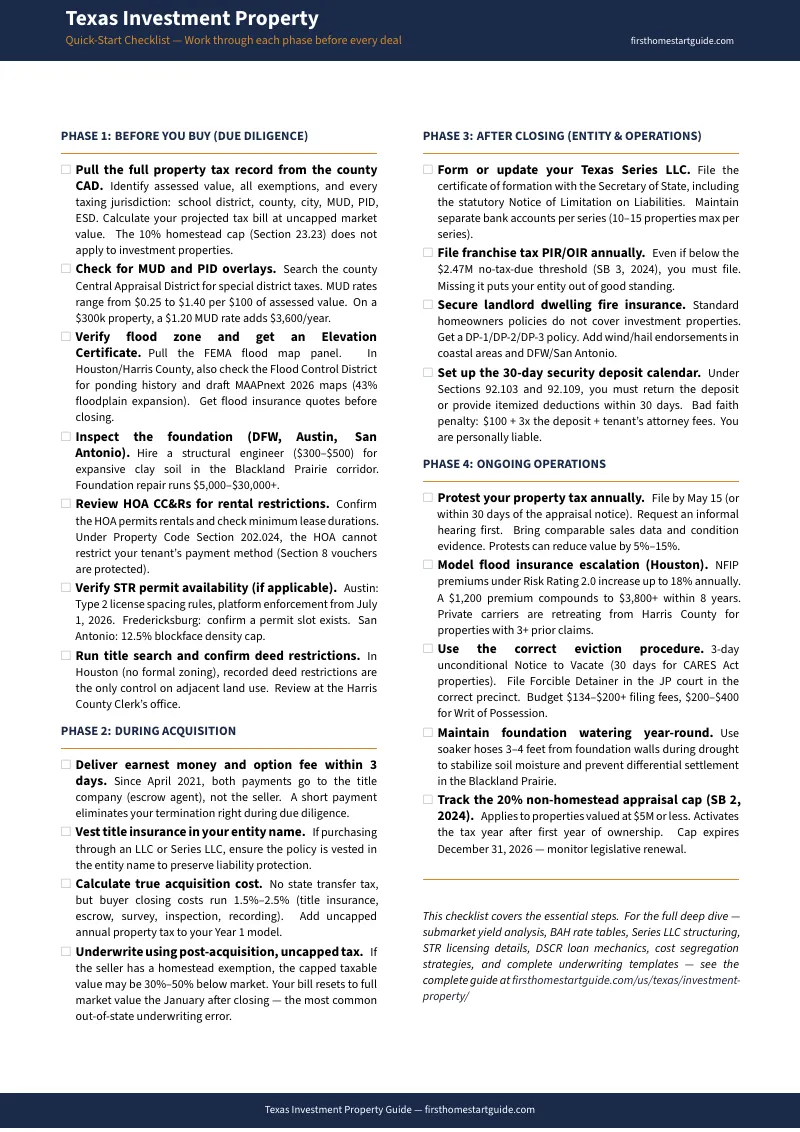
20-Item Due Diligence Checklist
A standalone printable checklist organized across four phases — Before You Buy, At Closing, Before Renting, and Ongoing — covering the Texas-specific verification steps that most out-of-state investors either skip or discover after they've committed capital. Homestead cap status verification, MUD/PID tax district lookup, flood zone and claims history check, county appraisal district protest deadlines, title company coordination, JP Court precinct identification, security deposit account setup, and STR licensing verification. Print it, run it on every deal, and catch the compliance gaps before they become five-figure problems.
5 Standalone Printable Reference Tools
- Underwriting Worksheet — Fillable line-item NOI template with the Texas-specific adjustments (uncapped property tax, MUD/PID, flood insurance Glide Path) plus a worked example showing how the seller's homestead-capped tax bill creates a 49% cost increase after closing.
- Metro Comparison Reference Card — One-page side-by-side of DFW, Houston, San Antonio, Austin, and El Paso with gross yields, cap rates, entry prices, and strategy alignment, plus a DFW submarket deep dive covering Garland through McKinney.
- Eviction Process Quick Reference — The 5-step JP Court Forcible Detainer procedure with filing fees, constable service rules, the 5-day appeal window, Writ of Possession costs, and the 4 common procedural mistakes that get cases dismissed.
- Property Tax Protest Quick Reference — The annual protest process from filing by May 15 through informal hearing, ARB hearing, and arbitration, with the Section 23.23 exclusion alert and 20% circuit breaker status.
- Key Contacts and Resources — Every government agency, registry, and form you need — TREC, county CADs, Secretary of State, Comptroller, FEMA, Harris County Flood Control, Opportunity Home San Antonio, Austin Code Department, Galveston STR Registration, Fredericksburg Planning — organized by workflow stage.
Who This Guide Is For
This guide is for out-of-state real estate investors targeting Texas markets who:
- Are analyzing a Texas property and need to verify whether the deal actually works once you calculate the uncapped post-acquisition property tax, MUD/PID liabilities, flood insurance Glide Path trajectory, and JP Court eviction costs — not the seller's current tax bill and a generic mortgage calculator estimate
- Are under contract on a DFW suburban property and just discovered a MUD tax rate of 1.20% that adds $3,600/year in holding costs your underwriting never captured — and need to understand whether the rate declines as bonds are paid down or stays elevated for the next decade
- Own a Houston rental and your NFIP flood insurance renewal came in 18% higher than last year — and need to understand the Risk Rating 2.0 Glide Path, whether private coverage is available given your property's claims history, and how the draft 2026 MAAPnext floodplain expansion affects your long-term hold thesis
- Self-manage from out of state and need to understand the 30-day security deposit deadline, the 3x bad-faith penalty with personal liability, JP Court eviction procedures by precinct, and the constable service rules that vary by county — before your first tenant dispute turns into a statutory damages judgment
- Are evaluating Austin, Galveston, or Hill Country properties for short-term rental and need the specific license type, tax rate, safety compliance, and enforcement timeline for each municipality — because a Type 2 Austin license requires 1,000-foot spacing verification, Galveston charges 15% HOT on cleaning fees, and Fredericksburg has density caps that may already be full in your target neighborhood
- Want every Texas-specific regulation, tax calculation, and compliance requirement in one reference — instead of assembling it from county appraisal district portals, Texas Property Code chapters, FEMA flood databases, and municipal licensing sites across two dozen browser tabs
Why Not Free Tools and Forums?
Free information on Texas real estate investing exists across hundreds of sources. Here's what it actually delivers:
- BiggerPockets forums are where someone in a 2023 thread says "Texas has no income tax, the math is easy," someone else replies with a horror story about a $4,000 tax increase after the homestead cap stripped, and a third poster recommends a property management company that dissolved two years ago. You'll find useful DFW submarket analysis mixed with advice predating the 20% non-homestead circuit breaker, the 2026 Austin STR enforcement deadline, and current Risk Rating 2.0 Glide Path mechanics. Sorting current from outdated takes longer than reading a guide that has already done it.
- County appraisal district websites give you individual data points — an assessed value here, a tax rate there. They don't tell you that the assessed value reflects a homestead cap that won't apply to your investment LLC, don't flag the MUD tax rate for your specific subdivision, and don't connect the current NFIP premium to the Glide Path trajectory that will double it in four years. You get the data without the analysis that determines whether the deal works.
- National investing books and courses teach cap rate, DSCR, and 1031 mechanics that apply everywhere. They don't mention the Section 23.23 homestead exclusion, the 30-day security deposit 3x penalty with personal owner liability, JP Court precinct-specific filing, MUD tax districts, Risk Rating 2.0 Glide Path escalation, or Series LLC structuring under BOC Chapter 101 Subchapter M. Applying national frameworks to Texas-specific problems is how investors from California and New York lose five figures on compliance gaps they never knew existed.
- Real estate agent advice focuses on getting the deal closed, not on protecting your post-purchase economics. Your agent won't calculate the uncapped post-acquisition tax assessment, won't model the MUD rate into your cash flow projection, won't check whether private flood insurance is available given the property's claims history, and won't tell you that the 30-day security deposit deadline runs from the date the tenant surrenders the premises — not from the date you inspect for damages.
This guide fills the Texas-specific gap — the space between knowing how to analyze a rental property in general and knowing how to underwrite one in a state where uncapped property tax reassessment, invisible MUD liabilities, escalating flood insurance, punitive security deposit penalties, and a municipal STR patchwork can each independently turn a profitable deal into a losing one. It's the analysis that would take a Texas real estate attorney, a property tax consultant, and a flood insurance specialist to assemble — structured as a reference you own permanently.
— Less Than One MUD Tax Surprise
A single uncapped property tax reassessment after the homestead strips adds $2,000 to $4,000/year in holding costs your spreadsheet never modeled. A MUD tax you didn't account for depletes $1,500 to $3,600 annually. A missed 30-day security deposit deadline triggers a $6,100+ judgment with personal liability. An 18% annual flood insurance escalation under the Glide Path doubles your premium in four years. An unlicensed Austin STR after July 2026 costs $2,000/day in fines.
This guide doesn't replace your real estate attorney or your CPA. But it gives you the property tax reassessment framework, MUD/PID lookup methodology, flood insurance Glide Path analysis, landlord-tenant compliance system, and STR regulatory map that ensure you identify every Texas-specific risk before you're contractually committed — instead of discovering them in your first tax bill, your first tenant dispute, or your first FEMA renewal notice.
If it catches a single homestead cap miscalculation, prevents a single security deposit penalty, or saves you from one year of unbudgeted MUD taxes, it pays for itself before you've finished reading it.
Money-back guarantee, no time limit. If the guide doesn't sharpen your underwriting and protect your capital in Texas's compliance environment, you pay nothing.
Download the free Texas Quick-Start Home Buying Checklist to see the 20-item due diligence framework covering pre-purchase verification, closing, pre-rental compliance, and ongoing operations. When you're ready for the full property tax analysis, flood insurance system, landlord-tenant compliance framework, and 12-chapter investment guide, the complete guide is here.
The deal looks good on the spreadsheet. This guide tells you whether Texas agrees.
Frequently Asked Questions
What if the rules change after I buy?
We update the guide when the rules change. Email us any time, even years later, and we'll send you the current edition free.