
The Cap Rate Looks Strong. Your Nonresident Tax Filing, Water Rights Conveyance, and Municipal STR Ban Say Otherwise.
You found a fourplex in Ogden cash-flowing at $2,400/month. Or a student rental near BYU where the listing says "contracted housing eligible." Or a cabin near Moab that grossed $85,000 last year on Airbnb. Or a brand-new townhome in St. George where the HOA allows nightly rentals. The numbers work. The Utah growth story is real. You're ready to wire earnest money.
Then you run the real numbers. The Ogden fourplex generates $50,000 in net operating income, but you didn't model the 4.5% flat state income tax that applies to every dollar of Utah-sourced rental income -- even if you live in Texas, Wyoming, or any other zero-tax state. That's $2,250 per year you didn't underwrite, and it pushes your DSCR below lender minimums. The BYU rental is a single condo unit -- but BYU's Off-Campus Housing Office contracts entire buildings, not individual units, so you're locked out of the freshman market and restricted to upperclassmen who can legally rent anywhere in Provo. The Moab cabin sits in a jurisdiction where Grand County charges $100 per advertised occupant annually, requires a local manager who lives in the county and can respond within one hour, and House Bill 256 now lets code enforcement use your Airbnb listing as primary evidence to issue daily fines. The St. George townhome is in a standard residential zone -- and St. George bans all nightly rentals outside designated Vacation Rental Overlay Zones.
Here's what no single resource explains: Utah layers a flat 4.5% state income tax on all rental income and capital gains for nonresidents, a binary property tax system where losing the residential exemption doubles your effective rate, the strictest prior appropriation water rights law in the Mountain West where owning land with a well doesn't mean you can legally pump water from it, municipality-by-municipality short-term rental bans that vary between Park City, Moab, and St. George, and a BYU student housing policy that overrides normal market dynamics with university-administered contracting rules -- into an investment environment that punishes anyone who applies national assumptions to Utah-specific problems. Every one of these has cost real investors five to six figures because the information existed -- scattered across the Utah Division of Water Rights database, municipal zoning portals, BYU's OCHO handbook, county assessor websites, and BiggerPockets threads from 2022 -- but nobody had assembled it into a single underwriting system.
The Utah Investment Property Guide is a Utah Investor Compliance System -- not a motivational overview of Mountain West real estate investing, but a structured due diligence framework that maps every Utah-specific tax trap, water rights hazard, STR restriction, and landlord-tenant advantage into a process you work through before you wire earnest money. It replaces months of cross-referencing county assessor exemption forms, the Division of Water Rights database, BYU's OCHO contracting portal, municipal STR licensing applications, and Hill AFB BAH rate tables with a single reference that tells you exactly what to verify, exactly what the numbers should look like, and exactly where deals go wrong.
What's Inside the Utah Investor Compliance System
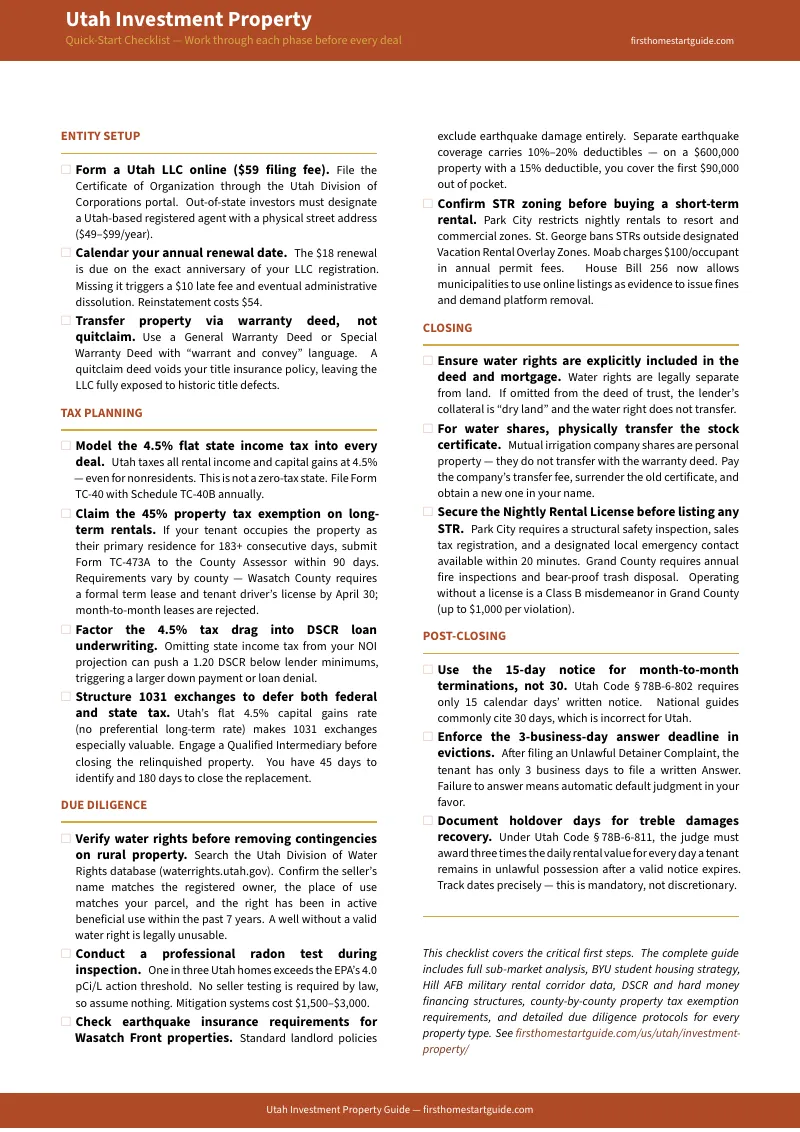
A 12-chapter guide, a quick-start checklist, and 7 standalone reference tools -- covering every stage from entity formation through post-purchase operations, built specifically for the tax mechanics, water rights complexity, and regulatory fragmentation that make Utah different from every other state. The standalone tools include printable due diligence checklists for LTR, STR, water rights, and BYU student housing acquisitions, plus reference cards for Hill AFB BAH rates, eviction timelines, and Utah statutory citations:
The 4.5% Nonresident Tax Trap and DSCR Underwriting Failure
The most common underwriting error among out-of-state Utah investors. Utah enforces a flat 4.5% individual income tax on all Utah-sourced rental income -- no exceptions for nonresidents, no preferential rate for long-term capital gains. You file Form TC-40 with Schedule TC-40B annually, reporting gross rents minus allowable expenses, and the 4.5% rate applies to whatever is left. On a property generating $50,000 in net operating income, that's $2,250 per year in state tax drag that investors from Texas, Wyoming, and Florida routinely forget to model. If you're using a DSCR loan with tight debt service parameters, omitting this tax from your underwriting can push a projected 1.20 DSCR below lender minimums -- triggering a larger down payment requirement or outright loan denial. The guide walks through the filing mechanics, calculates the cash-on-cash impact at multiple NOI levels, and shows you how to model the 4.5% drag before you make an offer -- not when your CPA flags it at tax time.
Water Rights Due Diligence -- The Deeded Well Trap
For any property outside the Wasatch Front -- ranch land, agricultural parcels, off-grid properties near Moab, the Uintah Basin, or the Escalante region -- water is not a utility you turn on. It's a deeded real property asset governed by Utah's prior appropriation doctrine: "first in time, first in right." Owning land with a physical well casing and pump does not mean you can legally pump water. If a previous owner severed the water rights and sold them separately, the well is legally unusable -- pumping without a valid water right violates state law, subject to civil and criminal penalties from the State Engineer. To fix it after closing, you must purchase a water right on the open market, file a Permanent Change Application to move the point of diversion to your well, survive a public protest period from senior water rights holders, and wait months with no guarantee of approval. The guide gives you a four-step verification protocol -- database audit, document retrieval, place-of-use verification, and status-title alignment -- that you complete before removing contingencies, not after discovering the well is stranded.
BYU Student Housing Investment Mechanics
Provo's student rental market operates under rules that exist nowhere else in American real estate. BYU's Student Housing Policy requires all single undergraduates in their first two semesters to live in BYU-contracted housing -- and the Off-Campus Housing Office contracts entire buildings, not individual units. If you buy a single condo near campus planning to rent "by the bed" to freshmen, OCHO will reject your application. You're locked out of the highest-demand, most consistently renewing tenant pool in the market. Contracted properties must maintain absolute sex-separation by building, enforce midnight curfews on opposite-sex visitors, and report Honor Code violations including substance use directly to the university. The guide maps the contracted versus community housing market structure, explains who you can actually rent to, and shows you how to target the upperclassman community housing segment where individual unit ownership works -- or how to evaluate whole-building acquisitions where contracted status is achievable.
Short-Term Rental Regulatory Map -- Park City, Moab, and St. George
Utah's premier tourism markets have systematically restricted, capped, or banned unpermitted short-term rentals. Park City limits nightly rentals to designated resort and commercial zones -- single-family neighborhoods are prohibited. Moab has a complete moratorium on new STR construction outside legacy commercial zones, charges $100 per advertised occupant annually for county permits, and caps occupancy at 16 persons (10 within Moab city limits). St. George bans all nightly rentals in standard residential zones -- STRs are legal only within Vacation Rental Overlay Zones or master-planned resort communities like Desert Color. House Bill 256 removed the old "Knotwell Rule" that prevented municipalities from using your Airbnb listing as evidence -- code enforcement can now use active online listings as direct evidence to issue daily fines and demand platform removal of unpermitted listings. The guide compares all three jurisdictions side by side and covers the 30-day medium-term rental pivot strategy that legally bypasses nearly all municipal nightly rental bans.
Hill Air Force Base Military Rental Corridor
The Ogden-Clearfield metropolitan area anchored by Hill AFB employs over 22,000 personnel including 5,000 active-duty members and major defense contractors -- Northrop Grumman, BAE Systems, and Williams International. Military tenants receive Basic Allowance for Housing that acts as a government-backed housing budget, insulating landlords from default risk. The guide details 2026 BAH rates by rank and dependency status, calculates estimated VA purchasing power at current interest rates, and shows why 3-bedroom properties in the $220,000-$270,000 range align perfectly with the budgets of mid-grade enlisted personnel and junior officers. Entry-level duplexes, triplexes, and townhomes in Weber and Davis counties remain accessible while Salt Lake County cap rates have compressed below 5%.
Utah's Landlord-Favorable Eviction System
Utah gives landlords the fastest eviction timeline and strongest financial deterrent in the Mountain West. Terminate a month-to-month tenancy with 15 days' notice -- not the 30 days that national guides incorrectly prescribe. If a tenant doesn't pay or vacate within 3 business days of a non-payment notice, file an unlawful detainer action where the tenant has exactly 3 business days to file an answer or receive an automatic default judgment. If they answer, an expedited occupancy hearing is typically scheduled within 10 days. The mandatory treble damages provision under Utah Code Section 78B-6-811 requires the court to award three times the daily rental value for every day of holdover, three times unpaid rent, and three times any damage or late fees. The guide covers every step with statutory references, notice templates, and the procedural precision requirements that prevent dismissal.
Sub-Market Analysis Across the Wasatch Front
Nine sub-markets dissected with median listing prices, rent ranges, cap rates, vacancy metrics, and economic drivers: Salt Lake City proper, South Valley and Draper, Lehi and the Silicon Slopes corridor, Provo and Utah County, Ogden and the Hill AFB corridor, Park City and Summit County, St. George and Washington County, Logan and Cache County, and rural Southern and Eastern Utah. Know which markets deliver cash flow, which are appreciation plays, which have compressed cap rates, and which carry environmental or regulatory risk before you deploy capital.
Entity Formation, Financing, and Tax Optimization
Utah LLC formation ($59 filing fee, $18 annual renewal, registered agent requirement for nonresidents), warranty deed versus quitclaim transfer pitfalls, title insurance implications, conventional versus DSCR versus FHA house-hack versus hard money financing, 1031 exchange mechanics for deferring both federal and state capital gains, the 45% residential property tax exemption for long-term rentals (file Form TC-473A within 90 days of tenant occupancy), and the pass-through entity tax credit with its extended 10-year carryforward for syndications and multi-member LLCs.
Who This Guide Is For
This guide is for real estate investors targeting Utah markets who:
- Are analyzing a Utah rental property and need to model the 4.5% state income tax drag on their cash-on-cash return and DSCR calculation -- not discover it when their CPA files their first Form TC-40
- Are evaluating rural or agricultural property and need to verify that the physical well on the parcel actually has valid, associated water rights -- not close on a property where the prior owner severed and sold the rights separately
- Are targeting student housing near BYU and need to understand whether their property type qualifies for contracted status or is limited to the upperclassman community housing market
- Are planning to operate a short-term rental in Park City, Moab, or St. George and need the exact zoning restrictions, licensing requirements, occupancy caps, and penalty structures for their specific jurisdiction -- not a generic "check local laws" disclaimer
- Are an out-of-state investor from California, Texas, Washington, or any other state attracted by Utah's growth numbers and need every Utah-specific tax trap, regulatory restriction, and underwriting variable in one reference before deploying capital from 1,000 miles away
- Are a military family at Hill AFB or a landlord targeting the military rental corridor and need to understand BAH-aligned pricing, property types, and the stable demand dynamics of the Ogden-Clearfield market
Why Not Free Tools and Forums?
Free information on Utah real estate investing exists across dozens of sources. Here's what it actually delivers:
- BiggerPockets forums are where someone in a 2022 thread says Utah is a "landlord-friendly, low-tax state" and nobody clarifies that nonresidents owe 4.5% state income tax on every dollar of rental income, that capital gains are taxed at the same flat rate with no preferential treatment, or that the LLC pass-through entity credit has changed since that post was written. You'll find genuinely useful experience reports mixed with advice that predates House Bill 256, the latest BYU contracting rules, and current BAH rate tables. Sorting current from outdated takes longer than reading a guide that has already done it.
- The Utah Division of Water Rights database lets you search water rights by geographic coordinates. It doesn't explain the difference between deeded water rights and mutual water company shares, doesn't warn you that shares are personal property that don't transfer with a warranty deed, doesn't cover the seven-year forfeiture risk for unused rights, and doesn't walk you through the Permanent Change Application process for moving a point of diversion to your well. You get the raw data without the investment analysis.
- Municipal planning portals publish zoning maps and STR ordinance text in legal language. Park City's, Grand County's, and Washington County's rules are spread across three separate government websites with different terminology, different permit structures, and different fee schedules. They don't compare all three jurisdictions side by side, don't explain the 30-day medium-term rental pivot that legally bypasses nightly rental bans, and don't flag House Bill 256's new enforcement authority. You get compliance documents without the investor-specific interpretation.
- National investing courses and YouTube channels teach cap rate analysis, DSCR mechanics, and 1031 exchanges that apply everywhere. They don't mention the 4.5% nonresident tax drag on underwriting, the binary property tax system that doubles your bill when you lose the residential exemption, the BYU contracted housing monopoly over freshmen, or the water rights forfeiture risk on rural parcels. Applying national frameworks to Utah-specific problems is how investors lose five figures on their first deal.
This guide fills the Utah-specific gap -- the space between knowing how to analyze a rental property in general and knowing how to underwrite one in a state where nonresident income tax, water rights law, university-administered housing policy, and municipality-by-municipality STR enforcement can each independently turn a profitable deal into a losing one. It's the analysis that would take a Utah real estate attorney, a water rights specialist, a Provo property manager, and a tax advisor to assemble -- structured as a reference you own permanently.
-- Less Than One DSCR Underwriting Mistake
A single tax miscalculation that omits the 4.5% state income tax from your DSCR underwriting triggers a larger down payment or outright loan denial. A rural property where the previous owner severed the water rights leaves you with a well you can't legally use and a Permanent Change Application process that takes months with no guarantee of approval. A BYU student rental where you assumed individual condo contracting was possible costs you the entire freshman tenant pool. A Moab STR listed on Airbnb without a valid county license exposes you to daily fines under House Bill 256. A month-to-month termination using the national 30-day standard instead of Utah's 15-day notice wastes two weeks of lost rent on every turnover.
This guide doesn't replace your real estate attorney or your CPA. But it gives you the tax underwriting framework, water rights verification protocol, student housing market map, STR compliance analysis, and landlord-tenant law reference that ensure you identify every Utah-specific risk before you're contractually committed -- instead of discovering them on your first Form TC-40, your first OCHO rejection, or your first code enforcement citation.
If it catches a single tax drag you didn't model, prevents a single stranded water rights purchase, or saves you from a single STR zoning violation, it pays for itself before you've finished reading it.
Money-back guarantee, no time limit. If the guide doesn't sharpen your underwriting and protect your capital in Utah's regulatory environment, you pay nothing.
Download the free Utah Quick-Start Checklist to see the due diligence framework covering entity setup, tax planning, water rights, rental compliance, and closing. When you're ready for the full tax underwriting model, water rights verification protocol, sub-market analysis, and 12-chapter investment system, the complete guide is here.
The deal looks good on the spreadsheet. This guide tells you whether Utah agrees.