
You Found the House. But You Don't Know About the April 15 Homestead Declaration Trap, the Oil Tank That Can't Receive Fuel, or the River Corridor That FEMA Doesn't Map.
You found a cape in Williston with a manageable commute to Burlington. Or a farmhouse on five acres in Washington County where you can finally work from home without paying Chittenden County prices. Or a fixer-upper in Rutland where the listing says "taxes $3,200/year" and the monthly payment looks almost too good to be true. You got pre-approved. You're ready to make an offer.
Then Vermont happens. Your first property tax bill arrives at the nonhomestead rate -- hundreds of dollars higher than expected -- because nobody told you that Vermont requires an annual Homestead Declaration filing by April 15 or your property automatically defaults to the punitive nonhomestead education tax rate, with penalties up to 8%. You schedule a heating oil delivery for your first winter and the driver refuses to fill the tank -- it's been red-tagged for a failed vent alarm and corroded legs, and state law prohibits delivery until the entire system is replaced, a $3,000-$5,000 emergency you didn't budget for. You bought the house partly because it wasn't in a FEMA flood zone, but six months later the brook behind the property carves three feet into the bank during a rainstorm -- because the property sits inside a Vermont River Corridor that FEMA maps don't show, and nobody checked the ANR Natural Resources Atlas before closing.
Here's what no single free resource explains: Vermont layers an annual Homestead Declaration requirement that doesn't exist in any state you've lived in before, against a bipartite education property tax system where listed tax bills routinely reflect the seller's income-sensitized rate (not what you'll actually pay), against an attorney-state closing process where 246 individual town clerks maintain separate land records requiring 40-year title searches through handwritten grantor-grantee indexes, against a Property Transfer Tax that the buyer pays (not the seller) at rates ranging from 0.5% to 3.62% depending on how you classify the property, against a heating oil infrastructure where red-tagged tanks legally cannot receive fuel and the Petroleum Cleanup Fund won't reimburse any remediation work done before your application is approved, against post-2023 flood erosion risks that FEMA maps fundamentally fail to capture, against well water arsenic contamination so prevalent that two out of five private wells in some towns test positive, against Act 250 land use jurisdiction that can make a rural parcel completely undevelopable for your intended purpose. Each of these has cost real first-time buyers thousands of dollars because the information existed -- scattered across the Vermont Department of Taxes, the VHFA website, the ANR Natural Resources Atlas, the Agency of Natural Resources tank database, 246 town clerk offices, and Reddit threads from buyers who found out the hard way -- but nobody had assembled it into a single decision system calibrated to how Vermont actually works.
The Vermont First-Time Home Buyer Guide is a Vermont Due Diligence System -- not a lifestyle overview of covered bridges and ski towns, but a structured reference that maps every Vermont-specific program, tax structure, environmental hazard, legal requirement, and regional market dynamic into a process you work through before your earnest money is at risk. It replaces months of cross-referencing VHFA program pages, Department of Taxes statutory language, ANR floodplain data, town clerk recording requirements, and forum posts with a single guide that tells you exactly what to verify, exactly what the numbers should look like, and exactly where deals go wrong in this state.
What's Inside the Vermont Due Diligence System
A comprehensive guide, a quick-start checklist, and 8 standalone printable worksheets (10 PDFs) -- covering every stage from financial readiness through post-closing compliance, built specifically for the programs, tax structures, environmental risks, and legal machinery that make Vermont different from every other state:
The Homestead Declaration and Property Tax Credit System
The single most expensive administrative mistake a Vermont homeowner can make. The guide explains Vermont's bipartite property tax system -- the split between municipal taxes and statewide education taxes under Act 68 -- and walks through the annual Form HS-122 filing requirement that doesn't exist in any other state. It covers the April 15 hard deadline, the penalty structure (up to 3% if the nonhomestead rate is higher, up to 8% if it's lower), the absolute October 15 cutoff after which your property is classified nonhomestead for the entire year with no recourse, and the income-sensitized Property Tax Credit (Schedule HI-144) that provides up to $5,600 in education tax relief and $2,400 in municipal tax relief for households earning $115,400 or less. The guide also exposes the tax bill trap: listings routinely advertise the seller's income-sensitized tax bill, which can be dramatically lower than what you'll actually pay if your income exceeds the threshold. It includes a worksheet to calculate your real, unadjusted property tax before you commit.
VHFA Down Payment Assistance Decision Framework
Vermont's down payment assistance programs can put up to $30,000 toward your purchase -- but only if you understand the fine print. The guide breaks down the VHFA ASSIST program ($15,000 at 0% interest, no monthly payments -- but not forgivable; due in full on sale, refinance, or move-out) alongside the First Generation Homebuyer Grant ($15,000 true grant, no repayment ever, for buyers whose parents never owned a home or who were in foster care). It shows how these two programs stack to cover your entire down payment and most closing costs on a typical Vermont home. Plus the MOVE below-market rate mortgage, the Mortgage Credit Certificate (up to $2,000/year federal tax credit), and the Champlain Housing Trust Shared Equity Program for Chittenden County buyers -- including the 25/75 appreciation split and 99-year ground lease structure. The guide includes a VHFA eligibility checklist so you know which programs you qualify for before your first lender meeting.
The Property Transfer Tax -- and How to Claim Your Exemptions
In Vermont, the buyer pays the Property Transfer Tax. The rate you pay depends entirely on how you classify the property -- and the difference is staggering. A $350,000 principal residence costs $3,205 in transfer tax. The same property purchased as a second home costs $12,670 -- a $9,465 difference at the closing table. The guide covers the full rate structure under Act 181: 0.5% on the first $200,000 for principal residences (exempt from the 0.22% Clean Water Surcharge), 1.47% on the balance, and the critical Exemption 99 that gives VHFA/USDA borrowers 0% on the first $250,000. It includes fillable transfer tax calculators for all three scenarios -- principal residence, Exemption 99, and non-principal residence -- with worked examples showing the exact dollar amounts.
Heating Oil Tank Compliance -- Red Tags, Inspections, and the Petroleum Cleanup Fund
Natural gas barely exists outside Burlington. If you're buying a home heated by oil or kerosene, you're inheriting a storage tank that must pass a five-point state inspection or the fuel carrier is legally prohibited from delivering. The guide details the five compliance categories (structural integrity, concrete foundation, fuel line protection, vent alarm, fill pipe standards), the red tag system that can leave you without heat in November, the July 2030 deadline for all existing tanks to meet upgraded standards, and the Vermont Petroleum Cleanup Fund -- which offers up to $4,000 for underground tank remediation, but only if you apply before doing any work. It tells you exactly what to demand from the seller during the inspection period and how to avoid the $3,000-$5,000 emergency replacement that catches unprepared buyers every winter.
Flood Risk After 2023 -- Beyond FEMA Maps
The catastrophic flooding of July 2023 destroyed homes that were not in FEMA flood zones. Vermont's primary flood hazard is fluvial erosion -- high-velocity water tearing apart riverbanks and undermining foundations -- not the slow-rise inundation that FEMA maps model. The guide explains the state's River Corridor Maps, shows you how to cross-reference FEMA data with the Vermont ANR Natural Resources Atlas and the Flood Ready Atlas, covers the enhanced flood disclosure requirements under Act 181 and Act 52 (sellers must now disclose any flooding or erosion during their ownership), and details the insurance implications -- including the fact that properties that received FEMA Individual Assistance must maintain flood insurance permanently, regardless of zone classification.
Well Water, Arsenic, and Septic Systems
Approximately 40% of Vermont households rely on private wells. Vermont's granite and slate bedrock contains naturally occurring arsenic and uranium that you cannot see, smell, or taste. In some towns, two out of five wells test positive for elevated arsenic. The guide covers the full testing protocol (coliform, arsenic, uranium, copper, chloride), the action levels that trigger remediation, the cost of reverse osmosis filtration, and the mandatory disclosure requirements sellers must follow. It also covers the septic system reality: in Vermont's clay soils with shallow bedrock and high water tables, a conventional gravity septic won't work -- an engineered mound system costs $25,000-$35,000, versus $8,000-$10,000 for conventional. The guide includes a complete inspection due diligence checklist with every test, its cost, and its timeline.
Act 250 Land Use Review
If you're buying rural land with any plans to build, add outbuildings, or subdivide, Act 250 can stop you cold. Vermont's landmark 1970 land use law imposes a quasi-judicial review across ten environmental and community criteria. The guide covers the jurisdictional triggers (as low as 1 acre in towns without permanent zoning), the new tiered location-based framework under Act 181 (Tiers 1A/1B, 2, and 3), the $15,000-$60,000 in typical legal and consulting fees, and the 60-90 day timeline impact. It tells you to schedule a free pre-application conference with the regional Act 250 coordinator before you finalize a rural purchase -- an out-of-state buyer who assumes they can clear timber and build a long driveway without triggering review is making a potentially deal-breaking mistake.
The Attorney Closing Process and Town Clerk System
Vermont is an attorney state. You cannot close without a Vermont-licensed attorney. There is no title company handling the process independently. Your attorney conducts the title search -- examining 40 years of land records at the specific town clerk's office among 246 municipal offices statewide. In rural towns, those records may still be handwritten in vault books. The guide walks through the entire closing timeline week by week, from title search through deed recording, covers the recording fees ($15/page, $25/sheet for survey plats), the title insurance you need (lender's and owner's policies), and the Property Transfer Tax Return (Form PTT-172) that must accompany every recorded deed or the town clerk rejects it.
Regional Market Analysis
Vermont is not one market. Burlington and Chittenden County median prices exceed $450,000-$500,000 with 2.2% rental vacancy and multi-offer bidding wars. Montpelier faces post-2023 flood risk repricing. Stowe and Woodstock are luxury enclaves where local workforce buyers compete against second-home purchasers willing to absorb a 3.62% transfer tax. Rutland offers the lowest entry prices for historic architecture. The Northeast Kingdom provides maximum acreage at minimum cost, but demands the most extensive due diligence on wells, septic, roads, and Act 250. The guide covers each region's pricing dynamics, competitive environment, and specific risks so you calibrate your strategy to the market you're actually buying in.
Quick-Start Checklist
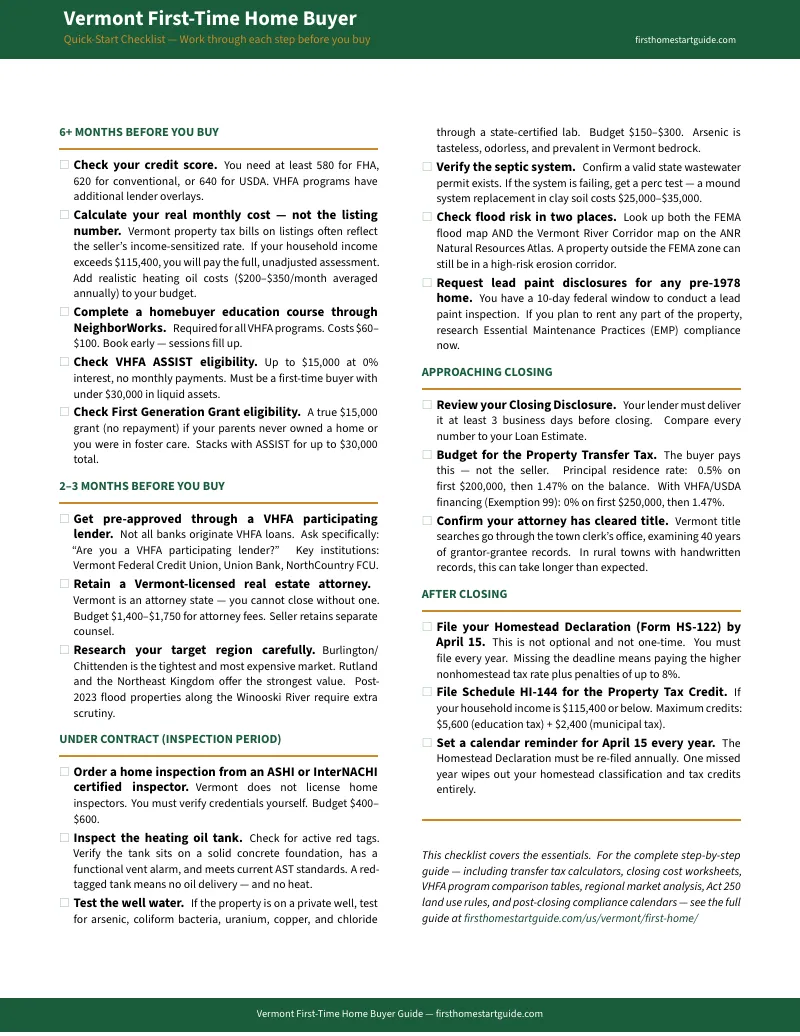
A structured checklist covering four phases -- 6+ months out, 2-3 months out, under contract, and after closing -- with the specific Vermont deadlines, program requirements, inspection protocols, and filing obligations you need at each stage. Print it and check items off as you go.
8 Standalone Printable Worksheets
Every calculator, checklist, and reference card from the guide -- extracted as standalone PDFs you can print and use independently:
- VHFA Program Comparison -- side-by-side analysis of ASSIST, First Generation Grant, MOVE, MCC, and CHT Shared Equity with a decision flow to identify your best program stack
- Transfer Tax Calculator -- fillable worksheets for all three scenarios (principal residence, Exemption 99, non-principal residence) with worked examples and a price-point comparison table
- Inspection Checklist -- every Vermont-specific inspection with checkboxes: oil tank red tag verification, well water arsenic testing, septic system evaluation, FEMA plus River Corridor flood risk, Act 250, and lead paint
- Closing Cost Worksheet -- itemized buyer's closing costs with typical ranges, VHFA DPA credits, cash-to-close summary, and a $350,000 FHA worked example
- Homestead Declaration Guide -- the complete Form HS-122 filing reference with deadline penalties, Property Tax Credit amounts, the tax bill trap, and a filing checklist
- Monthly Budget Worksheet -- three-property comparison using Vermont's Total Monthly Cost formula, including the heating oil and unadjusted property tax adjustments that national calculators miss
- Post-Closing Deadlines -- a print-and-post reference card covering immediate tasks, the April 15 Homestead Declaration deadline, annual compliance calendar, and fillable key contacts
- Regional Market Reference -- Burlington, resort towns, Montpelier, Rutland, and the Northeast Kingdom side-by-side with a decision matrix matching buyer profiles to the best zones and programs
Who This Guide Is For
This guide is for first-time home buyers in Vermont who:
- Are relocating to Vermont for a position at UVM, UVM Medical Center, or a Burlington-area employer -- and need to understand why Chittenden County prices rival Boston suburbs, how the attorney-led closing process works, and what the Homestead Declaration will cost you if you miss the April 15 deadline
- Are a remote worker moving from New York, Massachusetts, or Connecticut, drawn by Vermont's quality of life -- and need the complete procedural map for a state where deeds are recorded at 246 individual town clerks, property tax bills on listings don't reflect what you'll actually pay, and the transfer tax is the buyer's responsibility, not the seller's
- Are renting in Burlington or South Burlington and watching rent consume your paycheck -- and want to know whether VHFA's $30,000 in stacked assistance can get you into ownership, whether the Champlain Housing Trust shared equity program is worth the appreciation tradeoff, and which compromise locations in Franklin or Washington County offer more house for the money
- Are buying a rural property in the Northeast Kingdom, central Vermont, or southern Vermont -- and need to understand well water arsenic testing, septic system replacement costs, Act 250 jurisdictional triggers, heating oil tank compliance, and the mud season road conditions that Zillow doesn't mention
- Want every Vermont-specific program, tax structure, environmental hazard, legal requirement, and closing cost in one reference -- instead of assembling it from VHFA program pages, Department of Taxes statutory language, ANR flood maps, town clerk recording schedules, and Reddit threads designed to commiserate, not structure a transaction
Why Not Free Tools and Forums?
Free information on buying a home in Vermont exists. Here's what it actually delivers:
- The VHFA website publishes detailed program guidelines and income limits. It doesn't explain how the Homestead Declaration interacts with your property tax bill, doesn't cover well water arsenic risks, doesn't address Act 250 jurisdiction, and doesn't mention the oil tank red-tag system. You get the lending programs without the due diligence framework that determines whether the house you're financing is actually safe to buy.
- The Vermont Department of Taxes website outlines the Homestead Declaration and transfer tax in statutory language. It doesn't translate the penalty math into dollar amounts for your specific purchase price, doesn't explain why the tax bill on the listing is probably wrong for your income level, and doesn't connect the transfer tax to the Exemption 99 discount you get with VHFA or USDA financing. You get the law. You don't get the decision framework.
- Zillow and Realtor.com show estimated monthly payments using national-average property tax rates. Vermont's split education-plus-municipal tax system, $200-$350/month heating oil costs, and buyer-paid transfer tax make those estimates unreliable by hundreds of dollars per month. No listing platform shows River Corridor flood risk, oil tank inspection status, well water test results, or Act 250 encumbrances. You get a number that looks affordable and might not be.
- Reddit threads (r/vermont, r/burlington) contain genuine buyer experiences -- Homestead Declaration panic, red-tagged tank stories, flood anxiety, sticker shock from out-of-state transplants. But advice from 2022 doesn't reflect the Act 181 transfer tax changes effective August 2024, the updated VHFA ASSIST limits, or the enhanced flood disclosure requirements enacted after the 2023 disaster. Sorting current from outdated takes longer than reading a guide that has already done it.
This guide fills the Vermont-specific gap -- the space between knowing how to buy a house in general and knowing how to buy one in a state where you must file a declaration every year to keep your property tax rate, where the buyer pays a transfer tax that ranges from $3,205 to $12,670 on the same $350,000 home depending on classification, where your heating oil tank can legally prevent you from heating your home, where FEMA flood maps miss the state's primary flood hazard, where 40% of homes rely on wells sitting in arsenic-bearing bedrock, and where 246 town clerks each maintain their own land records in their own offices. It's the analysis that would take a VHFA-approved lender, a Vermont real estate attorney, and a state environmental consultant to assemble -- structured as a reference you own permanently.
-- Less Than Twenty Minutes With a Real Estate Attorney
A Vermont real estate attorney charges $1,400-$1,750 for a closing. Replacing a red-tagged heating oil tank runs $3,000-$5,000. An engineered mound septic system costs $25,000-$35,000. Missing the April 15 Homestead Declaration deadline means paying the nonhomestead education tax rate plus penalties of up to 8% -- and forfeiting up to $8,000 in combined property tax credits. Buying a home in a River Corridor without checking the ANR Atlas means discovering your flood risk the hard way. Not knowing about the First Generation Grant means leaving $15,000 in free money on the table.
This guide doesn't replace your real estate attorney or your lender. But it gives you 10 PDFs -- including the Homestead Declaration filing guide, the transfer tax calculators, the VHFA program comparison, the oil tank inspection checklist, the flood risk cross-referencing protocol, the well water testing guide, the closing cost worksheets, the monthly budget comparison tool, the post-closing compliance calendar, and the regional market reference card -- that ensure you identify every Vermont-specific risk before your earnest money is committed, instead of discovering them on your first tax bill, your first oil delivery attempt, or your first spring when the brook behind the house eats three feet of your backyard.
If it catches a single Homestead Declaration penalty, prevents a single red-tagged tank emergency, or saves you from missing $30,000 in stacked down payment assistance you qualified for, it pays for itself before you've finished reading it.
Money-back guarantee, no time limit. If the guide doesn't sharpen your decision-making and protect your investment in Vermont's unique real estate landscape, you pay nothing.
Download the free Vermont Quick-Start Home Buying Checklist to see the action plan covering pre-qualification, inspections, offer strategy, closing preparation, and post-closing compliance. When you're ready for the full Homestead Declaration walkthrough, transfer tax calculators, VHFA decision framework, environmental due diligence system, and closing cost worksheets, the complete guide is here.
The listing looks perfect on Zillow. This guide tells you whether Vermont agrees.