
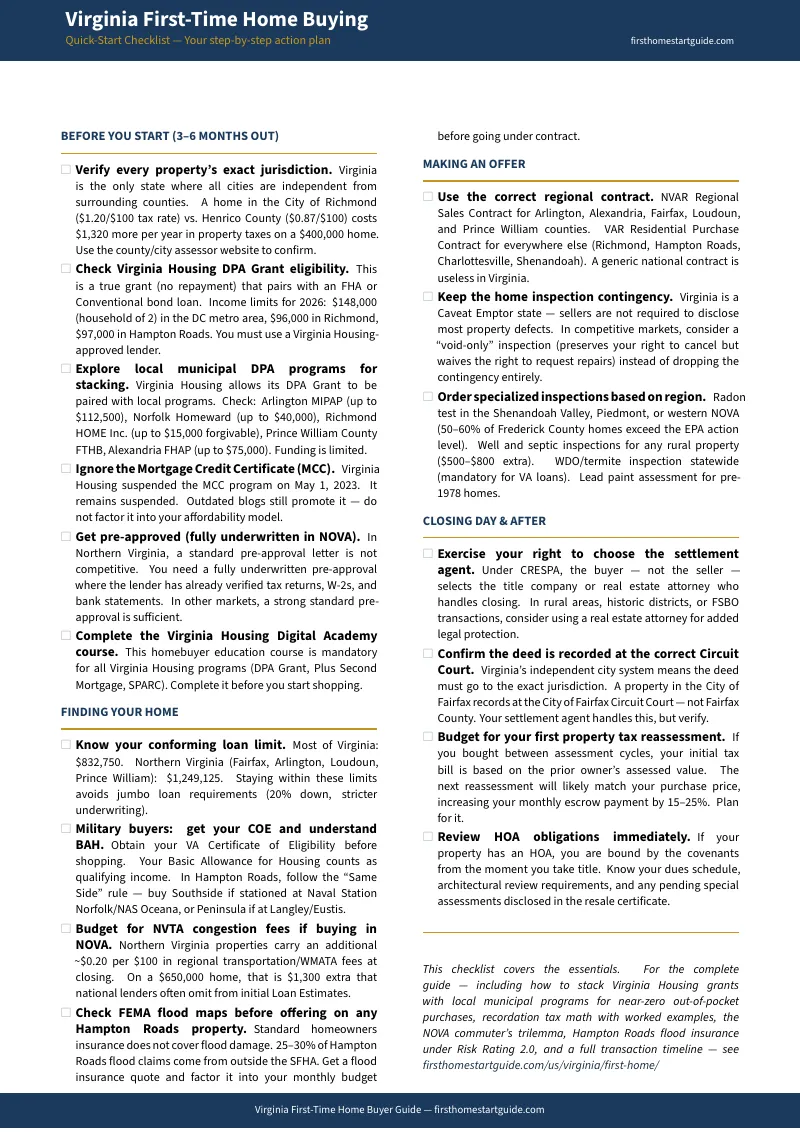
You Got Pre-Approved. But the Property Sits in an Independent City Where Taxes Are $1,320 Higher Than the County Next Door, the NVTA Fee Wasn't on Your Loan Estimate, and the DPA Grant You're Counting On Can Be Stacked With Local Funds Nobody Mentioned.
You found a three-bedroom in Henrico for $395,000 with a manageable tax estimate. Or a townhouse in Fairfax County where the commute to the Pentagon clocks 35 minutes. Or a place in Virginia Beach where your BAH covers the mortgage and the neighborhood is 15 minutes from base. You ran the numbers. You got pre-approved. You're ready to make an offer.
Then Virginia happens. The home you liked in Henrico County turns out to be technically inside the City of Richmond --- an independent city with a tax rate of $1.20 per $100 instead of Henrico's $0.87. Your monthly payment jumps $110 and your DTI ratio fails underwriting. You close on a townhouse in Fairfax County and your settlement statement shows a $1,300 charge labeled "NVTA Regional Congestion Relief Fee" that your out-of-state lender never mentioned. You apply for the Virginia Housing DPA Grant and learn it covers a percentage of the purchase price --- but nobody told you it could be stacked with Arlington's MIPAP ($112,500), Norfolk's Homeward program ($40,000), or Richmond's HOME Inc. ($15,000 forgivable), potentially eliminating your entire cash-to-close burden. And you've been factoring a Mortgage Credit Certificate into your affordability model for months --- except Virginia Housing suspended the MCC program in May 2023 and it remains dead.
Here's what no single free resource explains: Virginia layers the only independent city system in the country --- where crossing an invisible municipal border swings your property tax by $1,000 to $2,400 per year --- against a bifurcated transfer tax with separate recordation and grantor levies, against NOVA-only regional congestion fees that add $1,300+ to closing costs in nine specific jurisdictions, against a single-settlement-agent directive where the buyer chooses the title company but neither party gets independent legal advocacy by default, against a DPA ecosystem where state grants, Plus Second Mortgages, and local municipal programs can be stacked for near-zero out-of-pocket purchases but require navigating competing bureaucratic timelines and eligibility rules, against a Hampton Roads coastal market where 25-30% of flood claims come from outside federally designated flood zones. Each of these has cost real first-time buyers five figures because the information existed --- scattered across Virginia Housing program sheets, county assessor websites, CRESPA legal opinions, Reddit threads, and real estate agent blogs calibrated to generate leads --- but nobody had assembled it into a single decision system built for how Virginia actually works.
The Virginia First-Time Home Buyer Guide is a Commonwealth Navigation System --- not a generic overview of the housing market, but a structured reference that maps every Virginia-specific jurisdiction boundary, tax calculation, assistance program, and legal process into a system you work through before you sign a contract, accept a Loan Estimate, or miss a DPA stacking opportunity that would have saved you thousands. It replaces months of cross-referencing assessor websites, Virginia Housing eligibility tables, CRESPA settlement rules, regional congestion fee statutes, and forum posts with a single guide that tells you exactly what to verify, exactly what the numbers should look like, and exactly where deals go wrong in this Commonwealth.
What's Inside the Commonwealth Navigation System
A comprehensive 10-chapter guide, a quick-start checklist, and 8 standalone printable tools (10 PDFs) --- covering every stage from pre-approval through post-closing, built specifically for the jurisdictional complexity, tax structures, and assistance programs that make Virginia unlike any other state:
The Independent City Property Tax Map
Virginia is the only state where all incorporated cities are completely separate taxing authorities from the counties that surround them. The City of Richmond is not part of Henrico County. The City of Alexandria is not part of Fairfax County. The City of Falls Church --- all 2.2 square miles of it --- is its own jurisdiction. The guide includes a jurisdiction-by-jurisdiction tax rate table showing exactly how a $400,000 home in the City of Richmond ($4,800/year) compares to the same home in Henrico County ($3,480/year), why generic mortgage calculators that apply the statewide average rate of 0.71% systematically underestimate escrow requirements in high-rate independent cities, how assessment cycles work (every 2 years in cities over 30,000, every 4 years in large counties), and why buying between assessment cycles means your escrow payment will spike 15-25% at the next reassessment. If your DTI is tight, this chapter prevents the mortgage denial that catches relocating buyers weeks before closing.
The DPA Stacking Playbook
Virginia Housing runs two primary mechanisms --- the DPA Grant (a true grant, no repayment ever) and the Plus Second Mortgage (3.5% at 620 FICO, 5% at 680+). But the real power is in stacking. Virginia Housing explicitly allows its DPA Grant to be paired with local municipal programs. The guide maps every major local program --- Arlington MIPAP (up to $112,500), Norfolk Homeward (up to $40,000), Richmond HOME Inc. (up to $15,000 forgivable), Prince William County FTHB, Alexandria FHAP (up to $75,000) --- and shows how a buyer with a 680+ credit score can construct a complete financing stack: FHA first mortgage, 5% Plus Second Mortgage, Virginia Housing DPA Grant, and a local municipal grant, effectively eliminating the entire down payment and closing cost burden. Income limits by region (DC metro $148,000, Richmond $96,000, Hampton Roads $97,000) and the mandatory Virginia Housing Digital Academy requirement are covered. This chapter is the single most valuable section for buyers who think they can't afford to buy.
The MCC Suspension and What Replaces It
High search volume still exists for "VHDA Mortgage Credit Certificate" and "Virginia Housing MCC." The program was suspended on May 1, 2023 and remains dead. Dozens of outdated real estate blogs and lender websites still promote it as active, causing buyers to build affordability models on a tax credit that no longer exists. The guide addresses this directly --- explaining what the MCC was, confirming its suspension, and pivoting to the active DPA programs that actually replace the financial benefit. If you've been counting on a 20% mortgage interest tax credit in your budget, this chapter corrects the math before it costs you.
Closing Cost Anatomy: Recordation Tax, Grantor Tax, and the NVTA Fee
Virginia's closing costs run 2-5% for buyers, but the composition is uniquely layered. The buyer pays the state recordation tax ($3.33 per $1,000 on the purchase price, applied again on the loan amount). The seller pays the grantor tax ($1 per $1,000). But in nine NOVA jurisdictions --- Fairfax, Loudoun, Arlington, Prince William counties and the cities of Alexandria, Fairfax, Falls Church, Manassas, and Manassas Park --- an additional NVTA Regional Congestion Relief Fee of $1.50 per $1,000 is levied on the buyer's loan amount. On a $650,000 purchase, that is roughly $1,300 that out-of-state lenders routinely omit from Loan Estimates. The guide includes a complete worked closing cost example with every line item --- recordation tax, grantor tax, NVTA fee, ALTA title insurance, settlement fee, and recording fees --- so you can verify your Closing Disclosure line by line instead of trusting a national lender's first estimate.
The Legal Framework: Settlement Agents, CRESPA, and Caveat Emptor
Virginia operates under a single-settlement-agent directive. Under CRESPA (Virginia Code 55.1-1006), the buyer chooses the title company or settlement agent --- the seller cannot mandate one. But the settlement agent acts in a fiduciary capacity for the transaction, not for either party individually. Neither buyer nor seller gets independent legal advocacy unless they hire separate counsel. In a state where Caveat Emptor applies to most residential sales --- meaning the seller has limited disclosure obligations --- this distinction matters enormously. The guide explains when to use a title company vs. a real estate attorney, the difference between the NVAR Regional Sales Contract (NOVA) and the VAR Residential Purchase Contract (rest of state), and how to manage the four critical contingencies: financing, home inspection, appraisal, and sale of existing home.
The NOVA Commuter's Trilemma
The decision matrix for Northern Virginia buyers revolves around an unavoidable trilemma: school quality, commute time, and affordability. Loudoun County offers A+ schools and data-center-subsidized tax rates ($0.805/$100) but a median home price exceeding $774,000. Prince William County is the affordability sweet spot ($456,000 median, VRE commuter rail access) but with a combined effective tax rate near $0.99/$100 including fire and rescue levies. Stafford County delivers maximum square footage at the lowest price point but imposes 90-minute peak commutes and weaker school rankings. The guide provides a data-driven comparison of all three jurisdictions --- price entry points, commute corridors, tax rates, and school quality --- so you can optimize the tradeoff instead of guessing at it. For military buyers at Fort Belvoir or Quantico, the I-95 corridor analysis narrows the search to the viable window.
Hampton Roads: The Military PCS Playbook
If you're buying in Hampton Roads on PCS orders, the guide covers the "Same Side" commute rule (Southside for Naval Station Norfolk/NAS Oceana buyers, Peninsula for Langley/Eustis), why Suffolk is leading the region with 9.6% year-over-year appreciation, how BAH rates work with VA loans (zero down, funding fee rolled into the loan), why sellers' bias against VA offers is based on myths that clean pre-approved VA offers disprove daily, and the critical flood insurance gap --- standard homeowners insurance excludes flood damage, and 25-30% of Hampton Roads flood claims originate outside FEMA-designated flood zones. Under Risk Rating 2.0, your flood insurance premium is property-specific, not zone-based. The guide explains how to use Norfolk's Forerunner public database to check elevation certificates and historical flood data before you make an offer.
Inspections, Radon, and Regional Environmental Hazards
Virginia is a Caveat Emptor state with limited seller disclosure obligations. The guide covers the inspection priorities that vary by region: radon testing in the Shenandoah Valley and western NOVA (50-60% of Frederick County homes exceed the EPA action level of 4 pCi/L), well and septic inspections for rural properties ($500-$800), WDO/termite inspections statewide (mandatory for VA loans), lead paint assessments in pre-1978 historic districts, and the Hampton Roads flood insurance analysis. For competitive NOVA markets, the guide explains the "void-only" inspection strategy --- preserving your right to cancel while waiving the right to request repairs.
Financing Options by Region
Northern Virginia operates under a high-cost conforming loan limit of $1,249,125 while the rest of the state uses $832,750. The Shenandoah Valley and Southwest Virginia qualify for USDA Rural Development zero-down financing. The guide maps every loan type to the region where it makes the most sense --- VA loans for Hampton Roads military buyers, USDA for rural markets, FHA paired with Virginia Housing programs for first-time buyers in Richmond and mid-cost markets, and conventional loans with the DPA Grant for NOVA buyers under income limits. Each financing option includes credit score thresholds, down payment requirements, and the specific Virginia Housing programs that pair with it.
30-45 Day Transaction Timeline and Closing Day
A step-by-step timeline from offer submission through deed recordation at the correct Circuit Court (critical in a state where independent cities maintain separate courts --- a property in the City of Fairfax records at the City of Fairfax Circuit Court, not Fairfax County). The timeline maps every phase: offer and negotiation, earnest money deposit, due diligence and inspections, appraisal, title search, loan processing, final walkthrough, settlement, and deed recordation. Plus guidance on the post-closing reality --- assessment adjustments, escrow changes, and HOA obligations that begin the moment you take title.
Who This Guide Is For
This guide is for first-time home buyers in Virginia who:
- Are buying their first home anywhere in Virginia and need to understand how the independent city system affects property taxes, why two homes a mile apart can have tax bills differing by $1,320 per year, and how to verify the exact jurisdiction before your DTI calculation surprises your lender
- Are relocating from another state --- especially from Texas, Florida, or Georgia where a homestead exemption dramatically reduces your tax bill --- and need to know that Virginia's Homestead Exemption is a bankruptcy protection tool, not a property tax reduction, and that there is no blanket tax break for owner-occupied homes
- Want to claim every dollar of down payment assistance available and need to understand how to stack the Virginia Housing DPA Grant with local municipal programs for near-zero out-of-pocket purchases --- and why the Mortgage Credit Certificate that outdated blogs still promote is suspended and cannot be factored into your affordability model
- Are buying in Northern Virginia and need the NVTA Regional Congestion Relief Fee explained, the closing cost math broken down line by line, and a data-driven comparison of Loudoun vs. Prince William vs. Stafford that maps price, commute, schools, and tax rates side by side
- Are active-duty military or a military spouse buying in Hampton Roads on PCS orders and need the "Same Side" commute rule, the VA loan myth-busting section, the BAH-to-mortgage coverage analysis, and a flood insurance risk assessment that goes beyond whether FEMA technically requires it
- Want every Virginia-specific jurisdiction boundary, tax rate, DPA program, legal requirement, and inspection priority in one reference --- instead of assembling it from Virginia Housing eligibility tables, county assessor websites, CRESPA legal opinions, NVTA fee statutes, and Reddit threads that may predate the MCC suspension or the latest income limit updates
Why Not Free Tools and Forums?
Free information on buying a home in Virginia exists. Here's what it actually delivers:
- Virginia Housing's website publishes program fact sheets, income limit tables, and lender lists. It doesn't explain how to stack the DPA Grant with local municipal programs, doesn't show the credit-score-driven difference between a 3.5% and 5% Plus Second Mortgage, doesn't cover the dozens of city-level programs that layer on top, and doesn't mention that the MCC program it used to administer is suspended. You get program specs without the stacking strategy that maximizes total assistance.
- Zillow, Realtor.com, and national mortgage calculators show estimated monthly payments using a statewide average tax rate that systematically underestimates payments in independent cities. They don't flag the NVTA congestion fee, don't distinguish independent city rates from surrounding county rates, and don't account for assessment cycle timing. You get a number that looks affordable in Henrico and turns out to be priced for Richmond.
- Real estate agent blogs and lender content focus on market trends, listing inventory, and "the best neighborhoods." They minimize the jurisdictional tax traps, omit the NVTA fee math, and never explain that Virginia's Homestead Exemption doesn't reduce your taxes --- because correcting misconceptions doesn't generate leads. The content is designed to start conversations, not to identify the structural risks that change your budget.
- Reddit threads (r/nova, r/rva, r/hampton_roads) contain genuinely useful buyer experience reports --- people sharing NVTA fee surprises, independent city tax sticker shock, and DPA program frustrations. But advice from 2023 doesn't reflect the latest Virginia Housing income limits, the current Plus Second Mortgage rates, or the ongoing MCC suspension. Sorting current from outdated requires more research than the original question.
This guide fills the Virginia-specific gap --- the space between knowing how to buy a house in general and knowing how to buy one in a Commonwealth where crossing a municipal border changes your tax bill by thousands, where regional congestion fees add $1,300 to your closing costs in nine specific jurisdictions, where a suspended tax credit program is still promoted on dozens of websites, where DPA stacking can eliminate your entire cash-to-close burden if you navigate the bureaucratic timelines correctly, and where 25-30% of Hampton Roads flood claims come from outside the zones that require insurance. It's the analysis that would take a Virginia real estate attorney, a Virginia Housing-approved lender, and a Hampton Roads flood specialist to assemble --- structured as a reference you own permanently.
--- Less Than One Hour With a Real Estate Attorney
A one-hour consultation with a Virginia real estate attorney runs $250 to $400. A missed DPA stacking opportunity can cost $15,000 to $112,500 in assistance you never applied for. Filing a homestead exemption claim that doesn't exist in Virginia wastes weeks of planning around a phantom tax break. A NOVA closing with an unexpected $1,300 NVTA fee forces a last-minute scramble for funds three days before settlement. And choosing a property in an independent city without verifying the tax rate can swing your annual bill by $1,320 to $2,430 depending on jurisdiction.
This guide doesn't replace your settlement agent or your lender. But it gives you the jurisdictional tax map, DPA stacking strategy, closing cost anatomy, NOVA commuter comparison, Hampton Roads military playbook, and inspection protocol that ensure you identify every Virginia-specific risk before you sign --- instead of discovering them on your Closing Disclosure, your first escrow shortage notice, or your first conversation with a flood insurance adjuster.
If it catches a single jurisdictional tax miscalculation, prevents a single missed DPA stacking opportunity, or saves you from budgeting around a suspended tax credit, it pays for itself before you've finished reading it.
Money-back guarantee, no time limit. If the guide doesn't sharpen your decision-making and protect your budget in Virginia's uniquely complex real estate system, you pay nothing.
Download the free Virginia Quick-Start Home Buying Checklist to see the 17-step action plan covering pre-approval, jurisdiction verification, DPA eligibility, house hunting, inspections, and closing. When you're ready for the full DPA stacking playbook, closing cost anatomy, NOVA commuter trilemma, Hampton Roads military playbook, and transaction timeline, the complete guide is here.
The listing looks perfect online. This guide tells you whether Virginia's jurisdictions, taxes, and hidden fees agree.
Frequently Asked Questions
What if the rules change after I buy?
We update the guide when the rules change. Email us any time, even years later, and we'll send you the current edition free.