
The Numbers Work. Graduated REET, the SMLLC Capital Gains Trap, and Just-Cause Eviction Will Make Sure They Don't.
You found a 12-unit building in Tacoma with rents 20% below market and a cap rate north of 6%. Or a fourplex near JBLM where BAH-backed tenants guarantee $2,556/month per unit regardless of what the economy does. Or a duplex in Spokane listed at $389,000 where the rent-to-price ratio actually produces positive cash flow on day one. The DSCR clears. The NOI pencils. You're ready to wire earnest money.
Then you discover the Tacoma building triggers mandatory relocation assistance the moment you raise rents more than 5% — two months' rent per unit on a 20-unit building is $88,000 in capital penalties before a single renovation starts. The JBLM fourplex is inside Tacoma city limits where Measure 1 requires 210 days' advance notice for any rent increase, caps late fees at $10 per month, and bans evictions from November through April — and you served a standard 20-day notice to a month-to-month tenant last week, which is now illegal statewide under HB 1236. The Spokane duplex is held in an SMLLC, and when you sell the entity interest instead of the deed, Washington's 7% capital gains tax applies to every dollar above $278,000 — a tax that would have been zero if the LLC had sold the property directly. On a $165,000 gain above threshold, that is $11,550 you did not budget for. At 9.9% on gains above $1 million, the hit scales to six figures.
Here is what no single resource tells you: Washington layers a graduated Real Estate Excise Tax that pushes the combined marginal rate to 3.50% on high-value Seattle dispositions ($144,075 on a $5 million sale), a 7%/9.9% capital gains tax with an SMLLC structural trap that catches every sophisticated investor holding assets in LLCs, statewide just-cause eviction under HB 1236 that eliminated no-cause tenancy termination entirely, Seattle's EDRA relocation assistance triggered at 10% rent increases, Tacoma's Measure 1 relocation assistance triggered at just 5%, HB 1074 security deposit rules that impose double damages plus attorney's fees for missing the 30-day return deadline by a single day, seasonal eviction bans in Seattle (November through April) and Tacoma (November through April) that can freeze property repossession for six months, and a condominium defect litigation environment that renders entire buildings non-warrantable and severs your exit strategy. Every one of these has cost real Washington investors five to six figures because the information existed — scattered across DOR rulings, municipal codes, RCW chapters, BiggerPockets threads mixing pre-2021 advice with current law, and county assessor databases — but nobody had assembled it into a single underwriting system.
The Washington Investment Property Guide is a Washington Investor Regulatory Navigation System — not a motivational overview of Pacific Northwest real estate, but a structured framework that maps every Washington-specific tax trap, transfer cost, compliance deadline, municipal regulation, and submarket dynamic into a process you work through before you wire earnest money. It replaces months of cross-referencing DOR publications, RCW statutes, Seattle Municipal Code, Tacoma Municipal Code, and outdated forum posts with a single reference that tells you exactly what to verify, exactly what the numbers should look like, and exactly where deals go wrong.
What's Inside the Washington Investor Regulatory Navigation System
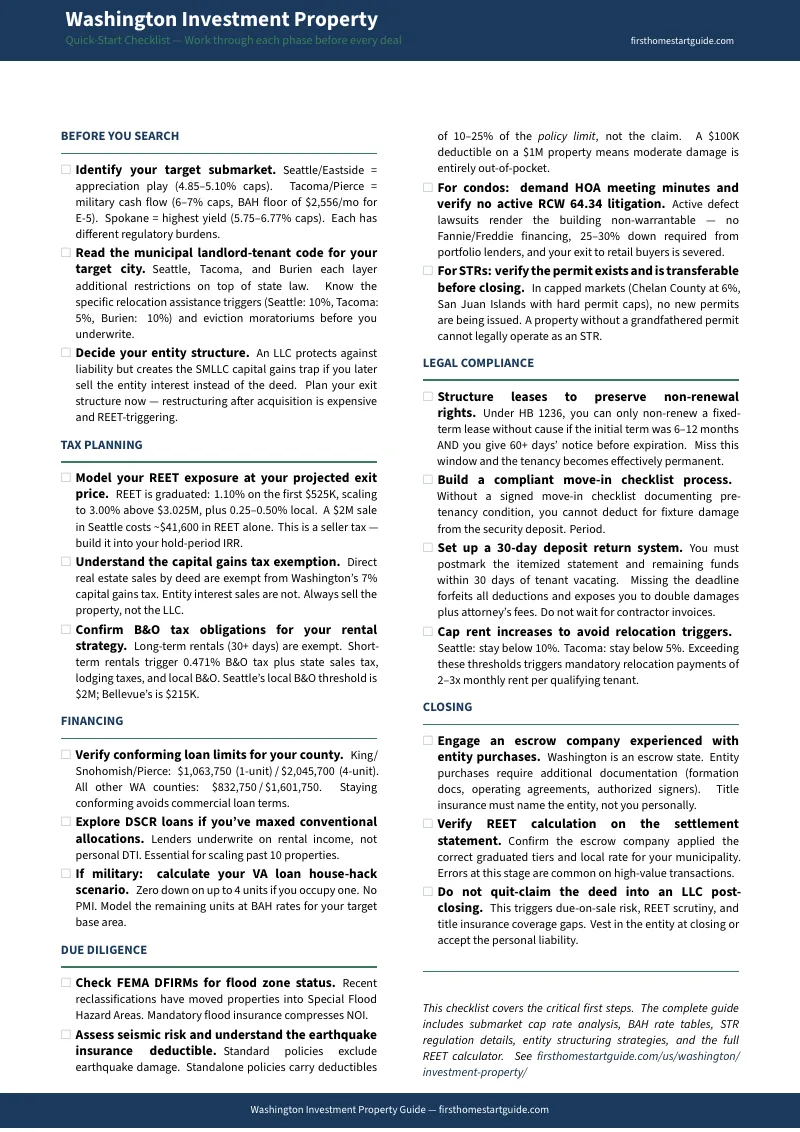
A 14-chapter guide, a quick-start due diligence checklist, and 8 standalone printable tools — covering every stage from pre-acquisition analysis through ongoing compliance, built specifically for the tax structures, transfer costs, and regulatory complexity that make Washington different from every other state:
Graduated REET Analysis with Worked Examples
The complete four-tier state REET schedule (1.10% on the first $525,000, 1.28% to $1,525,000, 2.75% to $3,025,000, 3.00% above) plus local municipal additions of 0.25%–0.50% that push combined marginal rates to 3.50% in King County. A worked $5 million Seattle multifamily example showing $144,075 in total REET — a blended 2.88% effective rate that consumes nearly a full year of NOI on a 5-year hold. The precise calculation method so you can model any sale price in any jurisdiction before making an offer.
The SMLLC Capital Gains Trap and Pre-Transaction Restructuring
Washington's 7% capital gains tax on gains above $278,000 (9.9% above $1 million) explicitly exempts direct real estate sales by deed — but not entity interest transfers. The guide covers exactly how the Department of Revenue classifies SMLLC membership interest sales as intangible asset transfers, why the real estate deduction fails for indirect holdings, and the pre-transaction restructuring strategies (LLC dissolution, direct deed conveyance) that preserve the exemption. The difference between knowing this and not knowing it is the difference between a zero tax bill and a $190,000+ liability on a $3 million asset.
Statewide Just-Cause Eviction Under HB 1236
The 16 specific statutory causes required to terminate any tenancy in Washington, with exact notice periods for each (14-day pay or vacate, 10-day material breach, 3-day waste/nuisance, 90-day owner-occupancy or sale). The fixed-term lease trap: how missing the 60-day non-renewal window converts your tenant into a permanent occupant removable only for cause. Wrongful eviction penalties of 4.5 times monthly rent plus attorney's fees. The complete eviction timeline from notice through writ of restitution — 4 to 8 weeks uncontested, months if contested.
Seattle Regulatory Deep Dive: EDRA, Winter Ban, STR Caps
Seattle's Economic Displacement Relocation Assistance triggers at 10% rent increases within 12 months — a $6,000 per-unit capital penalty on qualifying tenants that scales to $60,000 on a 10-unit building. The winter eviction ban (November through April for tenants at or below 80% AMI, which is $81,700 for a single individual in 2026) and the critical 4-unit ownership exemption that makes entity structuring a risk-mitigation necessity. The 2-unit STR cap with mandatory primary residence requirement. Move-in fee restrictions that cap total upfront tenant costs.
Tacoma Measure 1: The 5% Relocation Trigger and 210-Day Notice
Tacoma's Landlord Fairness Code Initiative requires two separate written notices (210–180 days and 120–90 days) before any rent increase takes effect. The relocation assistance schedule: 2x monthly rent at 5%–7.5% increases, 2.5x at 7.5%–10%, 3x at 10% or more. Late fees capped at $10 per month — eliminating meaningful financial incentive for timely payment. The cold-weather eviction ban and the 4-unit exemption. Why Tacoma acquisitions must be underwritten at current rents, not pro forma.
Security Deposit Compliance Under HB 1074
The 30-day return deadline that triggers forfeiture of the entire deposit plus double damages and attorney's fees if missed by even one day. The prohibition on carpet cleaning deductions without documented wear beyond ordinary use. The move-in checklist requirement that nullifies all deduction rights if it was never completed. The itemized statement standard requiring actual invoices or detailed hourly logs — estimates alone are insufficient. Every compliance detail that turns a $3,000 security deposit into a $9,000 liability.
Military BAH-Backed Market Analysis (JBLM and Kitsap)
2026 Basic Allowance for Housing rates by rank: E-5 with dependents at $2,556/month (JBLM) and $2,358/month (Bremerton), scaling to $3,105/month for O-3E officers. The VA house-hack math: a fourplex near JBLM purchased at $800,000 with zero down, three rental units at $2,200/month generating $560/month positive cash flow while the investor lives rent-free. Cap rates of 6%–7% in Pierce County versus 6%–6.84% in Kitsap. Why Kitsap offers comparable military demand with significantly less regulatory friction than Tacoma.
Submarket Yield Analysis: Seattle, Spokane, Bellingham, Snohomish
Seattle/Eastside Class A multifamily cap rates at 4.85%–5.10% (wealth preservation, not cash flow). Spokane's $389,950 median home price with $1,374 average rents and 6.79% year-over-year rent growth — the only metro in the state where leveraged acquisitions produce positive cash flow. Bellingham's supply-constrained student housing market averaging $1,809/month. Snohomish County's middle ground with high-cost conforming limits ($1,063,750 single-unit) at lower per-unit costs than King County. Short-term rental regulatory breakdown by market, including Chelan County's 6% housing stock cap and Bellevue's investor-friendly exception.
Financing, Entity Structure, and Due Diligence
2026 conforming loan limits ($1,063,750 single-unit in King/Snohomish/Pierce high-cost counties, $2,045,700 for fourplexes), DSCR loan qualification for portfolio scaling beyond the 10-property Fannie/Freddie ceiling, VA loan house-hack mechanics with zero down payment and no PMI. The quit-claim risk (due-on-sale triggers, REET scrutiny, title insurance gaps). Cascadia Subduction Zone seismic risk with earthquake insurance deductibles at 10%–25% of policy limits. FEMA DFIRM flood zone verification. Condominium defect litigation under RCW 64.34 that renders entire buildings non-warrantable. The complete due diligence checklist covering every Washington-specific hazard.
Property Management and Ongoing Compliance
The self-manage vs. hire decision matrix calibrated to Washington's punitive compliance regime (double deposit damages, 4.5x monthly rent wrongful eviction penalties). Typical management fees: 8%–10% for long-term rentals, 15%–25% for STRs. Seattle's RRIO registration requirements. Municipal-level variation in relocation assistance triggers (10% in Seattle, 5% in Tacoma, 10% in Burien). The five qualifying questions to ask every property management company before hiring — focused on deposit deadline systems, eviction timelines, and EDRA/Measure 1 awareness.
8 Standalone Printable Tools
Every tool extracts directly from the guide so you can print it separately and bring it to closings, property walkthroughs, and underwriting sessions: a REET Calculator Worksheet for computing graduated transfer taxes on any sale price, an SMLLC Decision Flowchart for avoiding the capital gains trap, a Security Deposit Compliance card for HB 1074 rules, an Eviction Timeline for the HB 1236 just-cause process, a Seattle/Tacoma/Burien Compliance Card comparing municipal regulations side by side, a Submarket Comparison with cap rates and BAH rates across all Washington markets, an STR Jurisdiction Breakdown for short-term rental viability by city, a Due Diligence Worksheet with fill-in fields for every property-specific risk, and a Statute and Cost Reference card with every key RCW citation, deadline, and penalty amount.
Who This Guide Is For
This guide is for real estate investors targeting Washington markets who:
- Are analyzing a Washington property and need to verify whether the deal actually works once you account for the correct graduated REET tier at exit, the municipal landlord-tenant overlay for the specific jurisdiction, the capital gains tax exposure based on entity structure, and the earthquake and flood insurance costs that never appear in the seller's operating history
- Are under contract on a multifamily property in Seattle or Tacoma and need to know the exact relocation assistance exposure if rents are below market — including EDRA's 10% trigger in Seattle, Measure 1's 5% trigger in Tacoma, the 210-day advance notice requirement, and the seasonal eviction bans that can freeze property repossession for six months
- Are deploying capital from out of state and need to understand why Washington's "no income tax" advantage disappears if you hold assets in SMLLCs, how REET consumes 1.60%–3.50% of your sale price at closing, why the 30-day deposit return deadline creates mechanical double-damages liability, and how localized municipal codes in Seattle, Tacoma, and Burien create compliance traps that require specialized local knowledge
- Are military personnel or veterans evaluating VA loan house-hack strategies near JBLM or Naval Base Kitsap and need the BAH-backed underwriting math, the comparison between Pierce County's regulatory burden and Kitsap's relative freedom, and the PCS cycle turnover budget
- Are evaluating short-term rental investments and need jurisdiction-by-jurisdiction clarity on permit caps (Chelan County's 6% housing stock cap is already reached in Leavenworth), licensing fees ($600 initial in Chelan, $266 annual in Seattle), owner-occupancy requirements, and Bellevue's investor-friendly exception
- Want every Washington-specific regulation, tax calculation, transfer cost, environmental hazard, and compliance requirement in one reference — instead of assembling it from DOR rulings, RCW chapters, Seattle and Tacoma municipal codes, county assessor databases, and forum posts that still cite pre-2021 at-will tenancy rules
Why Not Free Tools and Forums?
Free information on Washington real estate investing exists across dozens of sources. Here is what it actually delivers:
- BiggerPockets and Reddit forums are where someone in a 2020 thread recommends issuing a standard 20-day notice to terminate a month-to-month tenancy — advice that became illegal statewide when HB 1236 passed in 2021. Someone else claims Washington is a "no-tax state" for real estate investors without mentioning that REET graduates to 3.00% at the state level, that local additions push it to 3.50%, or that selling an SMLLC interest triggers capital gains tax at 7%–9.9% on a transaction that would have been tax-free as a direct deed sale. You will find useful experience reports on Spokane cash flow and JBLM military tenants mixed with advice that predates HB 1236 just-cause, HB 1074 deposit reform, and Tacoma's Measure 1. Sorting current from obsolete takes longer than reading a guide that has already done it.
- Washington Department of Revenue publications provide the REET tier schedule and capital gains tax statute text. They are written in regulatory language for tax professionals, not investors underwriting deals. You will find RCW 82.45 and RCW 82.87 but not a worked $5 million disposition showing how graduated tiers produce $144,075 in combined REET. You will find the capital gains exemption for real estate deed transfers but not a decision flowchart showing why your SMLLC membership interest sale does not qualify. The rules are there. The underwriting analysis that tells you whether to buy or restructure is not.
- Nolo's Washington Landlord's Legal Guide covers lease preparation, security deposits, habitability standards, and the eviction process. It is defensive — it tells you how to manage a property you already own. It does not cover how to underwrite a value-add acquisition against Tacoma's 5% relocation trigger, how to calculate the REET burden at your projected exit price, how to structure entities to preserve the capital gains exemption, or how to evaluate BAH-backed military market yields against Spokane's cash-flow metrics. You get the operating manual without the acquisition strategy.
- National investing books and courses teach cap rate, DSCR, and 1031 exchange mechanics that apply everywhere. They do not cover Washington's graduated REET tiers, the SMLLC capital gains trap, HB 1236 just-cause eviction, Tacoma's 210-day notice requirement, Seattle's EDRA relocation costs, the seasonal eviction bans, the condominium defect litigation that makes buildings non-warrantable, or the Cascadia Subduction Zone seismic risk with 10%–25% earthquake insurance deductibles. Applying national frameworks to Washington-specific problems is how investors lose five to six figures on their first deal.
This guide fills the Washington-specific gap — the space between knowing how to analyze a rental property in general and knowing how to underwrite one in a state where graduated REET, the SMLLC capital gains trap, HB 1236 just-cause eviction, Tacoma Measure 1, Seattle EDRA, HB 1074 deposit penalties, and seasonal eviction bans can each independently turn a profitable deal into a losing one. It is the analysis that would take a Washington real estate attorney, a CPA with DOR specialization, and a property manager familiar with Seattle and Tacoma municipal codes to assemble — structured as a reference you own permanently.
— Less Than One Closing Adjustment
A single REET miscalculation on a $2 million Seattle sale produces a $41,637 tax bill you never modeled. An SMLLC membership interest sale instead of a direct deed conveyance triggers $190,000+ in capital gains tax on a transaction that would have been exempt. A missed 30-day security deposit deadline on a $3,000 deposit creates a $9,000 liability — triple what you held. A 20-day termination notice served without just cause in Seattle exposes you to 4.5 times monthly rent in damages plus attorney's fees. A 7% rent increase in Tacoma without the required 210-day advance notice invalidates the entire increase.
This guide does not replace your Washington real estate attorney or your CPA. But it gives you the graduated REET calculator, the SMLLC restructuring analysis, the HB 1236 just-cause eviction framework, the Tacoma Measure 1 compliance timeline, the HB 1074 deposit rules, and the due diligence checklist that ensure you identify every Washington-specific risk before you are contractually committed — instead of discovering them at the closing table, on your first rent increase, or in your first eviction hearing.
If it catches a single REET miscalculation, prevents a single SMLLC capital gains trap, or saves you from triggering relocation assistance on a building-wide rent correction, it pays for itself before you have finished reading it.
Money-back guarantee, no time limit. If the guide does not sharpen your underwriting and protect your capital in Washington's regulatory environment, you pay nothing.
Download the free Washington Quick-Start Home Buying Checklist to see the due diligence framework covering pre-acquisition verification, closing and tax compliance, post-closing obligations, and ongoing operations. When you are ready for the full REET analysis, SMLLC capital gains strategy, HB 1236 eviction framework, Tacoma Measure 1 compliance, and 14-chapter investment system, the complete guide is here.
The deal looks good on the spreadsheet. This guide tells you whether Washington agrees.