
The Spreadsheet Says 15% Yield Until West Virginia's Mineral Rights, Mine Subsidence, and Zoning Traps Rewrite It
You found a $45,000 rental in Logan County generating $650/month. Or a five-bedroom house near WVU campus that pencils at $3,000/month in student rent. Or a cabin near New River Gorge with $38,000 in projected Airbnb revenue. The cap rate clears. The acquisition cost is a fraction of what you'd pay anywhere on the East Coast. You're ready to wire earnest money.
Then West Virginia shows up. The Logan County rental sits atop a severed mineral estate — the coal beneath your property belongs to an energy company that can legally mine it, crack your foundation, and destroy your water supply under SB 686's forced subsidence law, with no obligation to compensate you at replacement value. The Morgantown student house falls in an R-1A zone where the city's "Functional Family Unit" ordinance caps occupancy at two unrelated persons — your five-bedroom, five-tenant pro forma just became a two-tenant reality. The New River Gorge cabin requires a West Virginia Business Registration Certificate, a Fayetteville Vacation Rental Permit, a Municipal Business License, an annual Health Department Permit, and 6% state sales tax plus county occupancy tax — none of which appeared in the Airbnb revenue calculator.
Here's the problem: West Virginia combines some of the lowest acquisition costs in America with severed mineral estates that make your surface ownership legally subordinate, a forced subsidence bill that lets coal companies destroy your property without consent, mine subsidence insurance capped at $200,000 per structure, zoning ordinances that slash student rental income by 60%, eviction courts fast enough to process a case in three weeks but with a statutory pay-and-dismiss loophole that resets the clock, and a distressed housing stock in the southern coalfields that national lenders won't finance — trapping your cash permanently. Each of these has cost real investors thousands because the information existed — scattered across WVDEP databases, county clerk deed books, municipal zoning codes, and BiggerPockets threads from 2019 — but nobody had assembled it into a single underwriting system.
The West Virginia Investment Property Guide is a Split-Estate Risk Assessment System — not a motivational overview of cheap real estate, but a structured due diligence framework that maps every West Virginia-specific mineral rights trap, zoning restriction, tax classification, and eviction procedure into a process you work through before you commit capital. It replaces months of cross-referencing county deed books, WVDEP mine maps, municipal occupancy ordinances, and state insurance regulations with a single reference that tells you exactly what to verify, exactly what the numbers should look like, and exactly where deals go wrong in this state.
What's Inside the Split-Estate Risk Assessment System
A 10-chapter guide, a standalone 20-item due diligence checklist, and 5 printable reference worksheets — covering every stage from market selection through post-purchase operations, built specifically for the mineral rights hazards, zoning traps, and financing barriers that make West Virginia unlike any other state:
Mineral Rights Chain of Title Search Protocol
The single most critical due diligence failure in West Virginia real estate. Standard residential title searches span 30-60 years — nowhere near deep enough to identify mineral severances that occurred in the 1890s or 1920s. You need a separate mineral rights chain of title search tracing deed books back to the original land grant. The guide walks through exactly how to determine whether you're buying a unified fee simple estate or a severed estate where the coal, oil, and gas beneath your rental belong to someone else — and your surface property is legally subordinate to their extraction rights. If the mineral rights were severed, you need to identify active extraction leases, forced pooling exposure under the Cotenancy Modernization Act, and SB 686 forced subsidence risk before you sign anything.
SB 686 Forced Subsidence and Insurance Gap Analysis
Senate Bill 686 permits longwall coal mining to intentionally cause surface subsidence — the sinking or collapsing of the ground — without the surface owner's consent and without replacement value compensation. Your rental property's foundation can be cracked, its water supply destroyed, and its structural integrity compromised. Legally. The state's mine subsidence insurance, managed by the Board of Risk and Insurance Management (BRIM), caps reinsurance at $200,000 per structure — leaving multifamily and student housing assets inherently underinsured. Properties with existing, unrepaired subsidence damage may be denied coverage entirely. The guide maps subsidence risk zones using WVDEP and WVOMR mine databases, calculates your actual insurance exposure, and identifies which counties and parcels carry the highest actuarial risk.
Morgantown Zoning and Occupancy Trap Analysis
Morgantown's "Functional Family Unit" ordinance is the most common underwriting failure for out-of-state investors targeting WVU student housing. In R-1 and R-1A zones, a dwelling occupied by three or more unrelated persons — or specifically, three or more college students over age 16 — is presumed not to be a family unit. Occupancy in single-family zones is capped at two unrelated individuals. An investor buying a five-bedroom home planning to rent to five students at $600/bedroom will find legal occupancy capped at two tenants, destroying 60% of projected income overnight. The only exception is a pre-existing non-conforming occupancy permit established before November 1979 that hasn't been abandoned for more than one year. The guide explains how to verify zoning classification, check for grandfathered permits, navigate mandatory rental registration, and model 10-month income cycles that account for June-July student vacancy.
Magistrate Court Eviction System and Pay-and-Dismiss Override
West Virginia's eviction process moves fast — 5-day notice to quit, hearing within 5-10 judicial days, total timeline of 3-5 weeks from default to physical removal. But the speed is counterbalanced by a critical tenant defense: the pay-and-dismiss statute (WV Code §37-6-23), which gives tenants the absolute right to halt any nonpayment eviction by producing full back rent, fees, and court costs in cash, certified check, or money order — at or before the hearing. Investors using generic, nationally sourced lease templates unknowingly leave this loophole open, resulting in chronic late-paying tenants who repeatedly halt evictions at the eleventh hour. The West Virginia Supreme Court, in Kincaid v. Patterson, ruled that a landlord can insert specific lease language that waives this right. The guide provides the complete eviction timeline, notice requirements, and the exact lease provision you need to override pay-and-dismiss.
6-Region Investment Market Analysis
Six distinct West Virginia sub-markets analyzed with current acquisition prices, rent ranges, gross yields, demand drivers, and specific risk profiles: Morgantown ($150,000-$350,000+, student housing with 8-12% yields and mandatory rental registration), the Eastern Panhandle ($875-$1,800/month rents, 19% population growth, DC commuter corridor with appreciation focus), Charleston/Kanawha Valley (government and medical workforce, 8-10% yields, structural renter population), Huntington (secondary university market with 15-20% vacancy risk), Southern WV (sub-$50,000 acquisitions with 40%+ vacancy rates and un-financeable housing stock), and New River Gorge/Snowshoe/Harpers Ferry (STR tourism with decentralized regulatory requirements). Each market section explains which investment strategy works there — and which ones will destroy your capital.
Closing Process, Tax Classification, and Entity Structure
West Virginia uses deeds of trust instead of traditional mortgages, and recording happens at the county clerk's office. Investment properties are assessed at Class III or Class IV rates — double the owner-occupied rate. Transfer tax runs $1.10 per $500 plus excise tax of $2.20 per $1,000. Conventional financing on sub-$100K properties is routinely declined by national lenders due to low appraised values and lack of comparable sales — you need relationships with regional lenders (WesBanco, MVB, United Bank, City National) or a cash-buyer strategy. The guide covers WV LLC formation, required property management licensing (WV Code §30-40-5), security deposit rules, self-help eviction prohibitions, and the Land Installment Contracts Act requirements for owner financing.
STR Compliance Framework for Tourism Markets
No statewide STR license exists — but regulatory authority is heavily decentralized. Fayetteville (New River Gorge gateway) requires a Business Registration Certificate, Vacation Rental Permit, Municipal Business License, and annual Health Department Permit. Snowshoe operators navigate HOA restrictions, Architectural Review Committee approvals (90-day notice for any exterior changes), and county-specific pet policies. Harpers Ferry sits in Jefferson County, which permits STRs as a Principal Permitted Use in residential zones — a rare regulatory advantage. The guide maps every permit, license, and tax obligation by market so you underwrite actual net revenue, not a gross number from an Airbnb calculator.
5 Printable Reference Worksheets
Standalone one-page PDFs you print and bring to property viewings, attorney meetings, and closing appointments: a due diligence worksheet with checkboxes for every verification step, a mineral rights search protocol to hand your closing attorney, a 6-market comparison card with prices and yields side by side, an eviction quick reference with the rocket docket timeline and pay-and-dismiss override, and an STR compliance checklist comparing Fayetteville, Jefferson County, and Snowshoe permit requirements.
Who This Guide Is For
This guide is for real estate investors targeting West Virginia markets who:
- Are analyzing a WV property and need to verify whether the deal actually works once you account for severed mineral rights, mine subsidence exposure, Class III/IV tax assessment, and the financing barriers that trap cash in un-refinanceable assets — not the pro forma gross yield that ignores every state-specific risk
- Are under contract on a property in the southern coalfields and need to know whether the mineral estate was severed in 1910, whether SB 686 exposes you to forced subsidence, whether BRIM insurance covers the structure at full value, and whether any national lender will refinance your cash out after stabilization
- Plan to invest in Morgantown student housing and need to verify the zoning district, confirm whether a pre-1979 non-conforming occupancy permit exists, understand mandatory rental registration and triennial inspection requirements, and model a 10-month income cycle that accounts for summer vacancy
- Are targeting the Eastern Panhandle for DC commuter rentals and need to understand the appreciation dynamics, tenant demographics, Charles Town Rental Registration Program, and the yield compression risk from federal government hiring freezes
- Want to operate short-term rentals near New River Gorge, Snowshoe, or Harpers Ferry and need the exact permit requirements, tax obligations, HOA covenant restrictions, and Architectural Review Committee rules for each market
- Need a WV-specific lease provision that overrides the pay-and-dismiss statute — because your generic national lease template leaves you exposed to chronic late-paying tenants who halt evictions at the courthouse door with a certified check
- Want every West Virginia-specific mineral rights search protocol, zoning trap, eviction procedure, tax classification, and STR regulation in one reference — instead of assembling it from WVDEP databases, county clerk deed books, municipal code PDFs, and BiggerPockets threads that may be three legislative sessions out of date
Why Not Free Tools and Forums?
Free information on West Virginia real estate investing exists across dozens of sources. Here's what it actually delivers:
- BiggerPockets forums contain genuinely useful experience reports from WV investors — mixed with outdated advice about property management companies that no longer operate, yield projections that ignore 40% vacancy in the southern coalfields, and acquisition strategies that don't mention mineral rights until a commenter who already lost money adds a warning post. Sorting current from outdated across a dozen threads takes longer than reading a guide that has already verified every procedure against current statute.
- WVDEP and WVOMR databases show you mine maps and permit records. They don't explain how to interpret a mineral severance in a 130-year-old deed, don't calculate your actual SB 686 exposure, and don't tell you whether BRIM insurance will cover your specific structure. You get raw data without the framework that determines whether your property sits on a legal time bomb.
- Morgantown city zoning portal shows you the zoning classification of a parcel. It doesn't explain the Functional Family Unit ordinance, doesn't tell you that occupancy is capped at two unrelated persons in single-family zones, and doesn't mention the pre-1979 non-conforming exception. You get a zone code without the income analysis that determines whether your student housing investment is viable.
- National investing courses ($997 to $5,000+) teach cap rate, DSCR, and 1031 mechanics that apply everywhere. They don't mention severed mineral estates, forced subsidence legislation, the pay-and-dismiss eviction loophole, Morgantown's student occupancy cap, or the fact that national lenders routinely decline sub-$100K WV properties. Applying national frameworks to West Virginia-specific problems is how investors discover their property can be legally destroyed by a third party they didn't know existed.
This guide fills the West Virginia-specific gap — the space between knowing how to analyze a rental property in general and knowing how to underwrite one in a state where severed mineral rights, forced subsidence, student housing zoning traps, un-financeable distressed assets, and a pay-and-dismiss eviction loophole can each independently turn a profitable deal into a total loss. It's the analysis that would take a WV mineral rights attorney, a county-level mine subsidence specialist, a Morgantown zoning consultant, and a magistrate court practitioner to assemble — structured as a reference you own permanently.
— Less Than One Mineral Rights Title Search
A single mineral rights chain of title search that you commission separately from your closing attorney costs $300 to $800 — and that's just to find out whether the minerals are severed. It doesn't tell you what SB 686 means for your specific parcel, doesn't calculate your BRIM insurance gap, and doesn't analyze whether the zoning allows your planned use. One Morgantown property purchased without verifying the Functional Family Unit ordinance loses $21,600 per year in rental income — every year you own it. One eviction derailed by the pay-and-dismiss loophole because your lease didn't include a Kincaid v. Patterson waiver costs months of vacancy and legal fees. One southern coalfield rental that can't be refinanced traps your capital permanently.
This guide doesn't replace your WV real estate attorney or your mineral rights specialist. But it gives you the split-estate assessment framework, zoning verification system, eviction procedure protocol, and market-by-market analysis that ensure you identify every West Virginia-specific risk before you're contractually committed — instead of discovering them when the ground under your rental starts sinking, your student tenant count gets capped by ordinance, or your cash gets locked in an asset no lender will touch.
If it catches a single severed mineral estate, prevents a single zoning-based income miscalculation, or saves you from buying an un-refinanceable distressed asset, it pays for itself before you've finished reading it.
Money-back guarantee, no time limit. If the guide doesn't sharpen your underwriting and protect your capital in West Virginia's mineral rights and regulatory environment, you pay nothing.
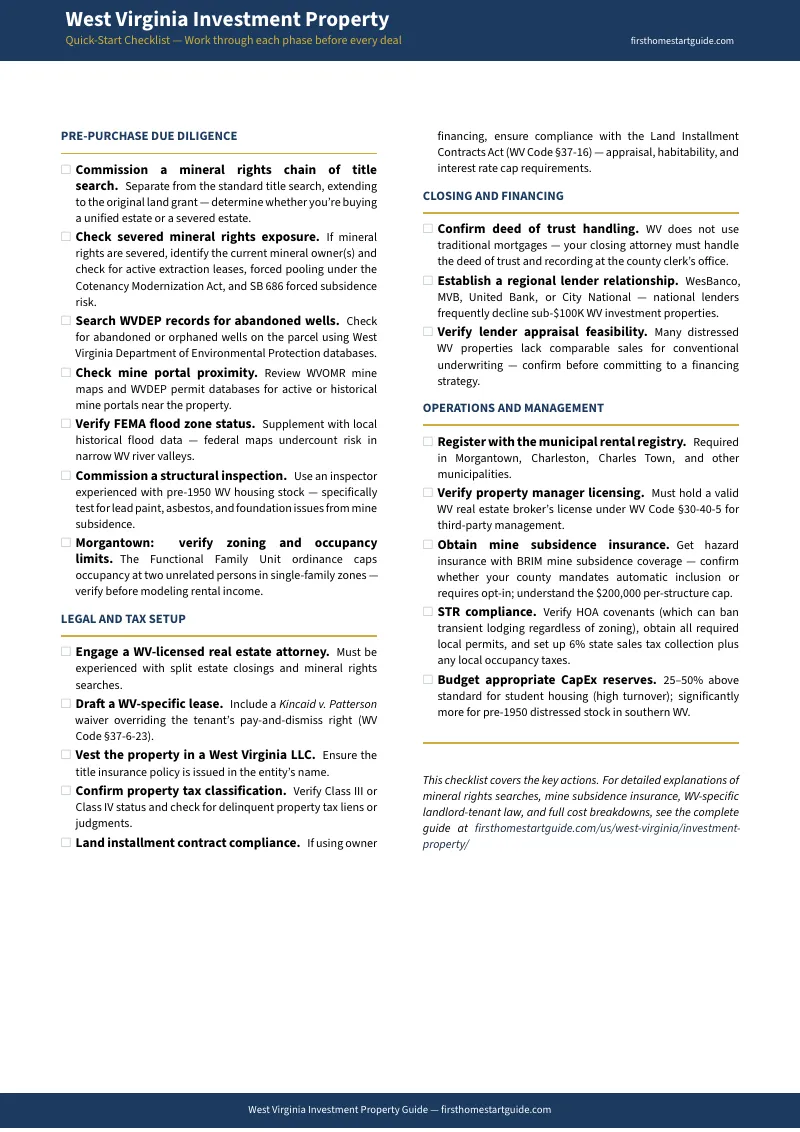
Download the free West Virginia Quick-Start Checklist to see the 20-item due diligence framework covering mineral rights searches, zoning verification, entity setup, closing procedures, and STR compliance. When you're ready for the full split-estate analysis, eviction system, market breakdowns, and 10-chapter investment guide, the complete guide is here.
The yield looks incredible on the spreadsheet. This guide tells you what's under the ground — and under the zoning code — before you find out the hard way.
Frequently Asked Questions
What if the rules change after I buy?
We update the guide when the rules change. Email us any time, even years later, and we'll send you the current edition free.