
You Signed the WB-11. Your Agent Said Congratulations. Nobody Mentioned the Contract Became Legally Binding the Moment the Seller Emailed It Back — Before You Even Opened It.
You found a three-bedroom ranch in Waukesha County listed at $315,000. Your agent drafted the offer. The seller's agent called back within two hours to say they accepted. Your agent sent you a text with a smiley face. You felt great — for about forty-five minutes.
Then you started reading the WB-11 more carefully. You noticed a clause about binding acceptance upon delivery. You Googled "can I back out of an offer in Wisconsin" and found a Reddit thread full of conflicting answers. You called your agent and asked for the attorney review period. Your agent went quiet.
There is no attorney review period in Wisconsin. The WB-11 became a binding contract the instant the seller's signed acceptance was transmitted to your side — by email, by fax, by text. Not when you opened it. Not when you read it. When it was sent. Your $5,000 earnest money deposit is now locked in escrow. If you walk away, the seller can issue a notice of default and either retain your deposit as liquidated damages or pursue you for actual losses. You wanted a weekend to think. Wisconsin law gave you zero seconds.
Or maybe the contract was fine — but the house wasn't. You bought a charming 1920s bungalow in Milwaukee's Bay View neighborhood. Your two-year-old started chewing on the window sills the way toddlers do. Six months later, a blood test came back with elevated lead levels. The home inspector had noted "pre-1978 construction" in his report. He did not test for lead. You did not know you needed to ask. Sellers in Wisconsin are required to disclose known lead paint hazards — but "known" is the operative word. They are not required to test. Full lead abatement — windows, doors, siding, interior drywall — runs $25,000 to $40,000. You also did not know that Milwaukee's Lead Hazard Reduction Program covers up to $40,000 in remediation for qualifying families, completely free. Nobody told you to apply before you closed.
Or maybe the house was in Portage County. Rural, quiet, well water. You loved the open land and the price. Three months after moving in, your wife got pregnant. Her OB ordered a water test as a precaution. Nitrates came back at 18 parts per million — nearly double the safe limit. Boiling the water does not remove nitrates. It concentrates them. At those levels, an infant drinking formula mixed with your tap water is at risk for Blue Baby Syndrome — a condition where the blood loses the ability to carry oxygen. Your affordable dream home just became a health emergency with no municipal water line to connect to.
The problem is not that Wisconsin is complicated. The problem is that Wisconsin layers risks and opportunities no other state combines in quite the same way:
An immediately binding contract with no grace period. Up to $35,000 in silent second mortgage assistance that most lenders never mention. A $40,000 lead abatement grant program that buyers with children discover after exposure has already occurred. A separate contractual addendum required just to test for radon. Aquifers contaminated with agricultural nitrates across entire counties. Shoreland zoning setbacks that can make your renovation plans illegal six weeks after closing. And no single resource maps all of this into a decision framework you can work through before your earnest money is at stake.
The Wisconsin First-Time Home Buyer Guide is a Badger State Transaction Blueprint — a structured walkthrough of every Wisconsin-specific contract mechanic, assistance program, environmental hazard, and financial advantage that determines whether your purchase builds equity or drains it. It replaces months of cross-referencing WHEDA program pages, county health department websites, WB-11 legal interpretations, and Reddit threads about well water with a single reference that tells you exactly what to negotiate, exactly which programs to apply for, and exactly where Wisconsin transactions destroy first-time buyers who assumed their lender and agent would catch everything.
What's Inside the Badger State Transaction Blueprint
A comprehensive guide, a quick-start checklist, and standalone printable tools — covering every stage from WHEDA pre-approval through post-closing tax credits, built specifically for the contract laws, environmental risks, and assistance programs that make Wisconsin unlike any other state:
WB-11 Contract Mechanics: Binding on Delivery, Not on Reading
Most first-time buyers — especially those relocating from Illinois, New York, or New Jersey — assume they'll have an attorney review period after signing an offer. Wisconsin does not offer one. The WB-11 Residential Offer to Purchase becomes binding the moment the seller's acceptance is delivered to your side, and "delivery" by email or fax means the moment of transmission, not the moment you open it.
The guide walks through how binding acceptance actually works, what constitutes legal delivery under the WB-11, the difference between inspection contingencies and testing contingencies (they are not the same thing), how earnest money disputes play out when a buyer tries to withdraw after acceptance, and exactly which addenda you need to negotiate into your offer before signing. If you sign a WB-11 without understanding the delivery mechanic, you have already made the most expensive mistake in your transaction.
WHEDA Capital Access: The $7,500 Silent Second Mortgage Your Lender Won't Push
WHEDA's Capital Access program provides $3,050 to $7,500 as a 30-year silent second mortgage at 0% interest with zero monthly payments — the balance is fully deferred until you sell, move out, or pay off the primary WHEDA mortgage.
Here's what WHEDA's own FAQ buries: funding comes from limited annual allocations that run out, you need a specific property address to lock the reservation, and your lender must be WHEDA-approved to originate the loan. Conventional lenders have no financial incentive to redirect you to WHEDA — they earn more keeping you on their own products. The guide covers WHEDA Advantage first mortgage rates versus conventional, Capital Access DPA eligibility and reservation timing, how the program interacts with FHA, VA, and USDA loans, and why most qualifying buyers never apply because they assume the "grant" requires monthly payments. It doesn't.
Madison vs. Milwaukee: Two Markets, Two Completely Different Problems
Madison and Milwaukee are ninety minutes apart by car and a world apart in buyer strategy.
In Madison, the problem is competition. Entry-level homes in Dane County routinely list above $450,000, and financed first-time buyers lose to cash offers and escalation clauses they've never heard of. You need to understand appraisal gap guarantees, escalation clause mechanics, and why FHA loans are practically disqualifying in a bidding war before you write your first offer.
In Milwaukee, the problem is the housing stock. Pre-1978 homes dominate the market, cosmetic flips mask structural and environmental issues, and the gap between a $180,000 listing and a $220,000 renovation reality catches first-generation buyers hard. Milwaukee's DPA programs — including a $7,000 forgivable grant designed to support workforce housing and anti-displacement efforts — specifically target this buyer pool.
The guide breaks down both markets with separate strategies, local DPA programs (Madison's $35,000 Home Buy the American Dream, Milwaukee's $7,000 forgivable grant, Dane County's $30,316 Momentum program), and the inspection priorities specific to each city's housing inventory.
Environmental Testing: Three Hazards, Three Different Protocols
Wisconsin's standard WB-11 inspection contingency authorizes visual inspections only. It does not authorize the taking of air, soil, or water samples. This means you cannot legally test for radon, well water nitrates, or lead under the standard inspection clause — you need a separate testing contingency, typically WRA Addendum A, explicitly negotiated into your offer. If your inspector places a radon canister without seller authorization through a testing addendum, the test is legally unauthorized and your ability to use the results to negotiate or withdraw is compromised.
The guide covers each hazard and its protocol:
- Radon — which addenda authorize air sampling, the EPA action level (4.0 pCi/L), mitigation system costs (approximately $1,200 for sub-slab depressurization), and how to make the seller cover remediation before closing
- Well water nitrates — the 10 ppm safety threshold, why boiling concentrates rather than removes nitrates, the link to Blue Baby Syndrome and thyroid disease, and how to require Wisconsin-certified lab testing before your contingency expires
- Lead paint — Milwaukee's pre-1978 housing stock realities, the $25,000 to $40,000 true cost of full remediation, the city's $40,000 Lead Hazard Reduction grant for qualifying families, and the Lead-Safe Housing Registry that lets you verify a property's abatement status before you make an offer
Down Payment Assistance: Six Programs, Six Different Rules
Wisconsin's DPA landscape is fragmented across state, county, and municipal agencies that do not cross-reference each other. The guide maps all major programs side by side:
- WHEDA Capital Access — $3,050 to $7,500, 0% deferred 30-year silent second, statewide
- Home Buy the American Dream — up to $35,000, 0% deferred with shared appreciation, City of Madison only
- Momentum — up to $30,316, 0% deferred, Dane County Urban Consortium (outside Madison city limits)
- Milwaukee Home DPA — $5,000 to $7,000 forgivable grant, City of Milwaukee residents
- Downpayment Plus (FHLBank Chicago) — up to $10,000, forgiven over 5 years through participating lenders
- NeighborWorks Green Bay — $5,000 to $7,500, city and Brown County, requires certified inspection
Each program has different income limits, geographic restrictions, and stacking rules. The guide includes a comparison worksheet so you can identify the combination that produces the lowest total cost for your income level and location — instead of relying on your lender to mention whichever one they happen to know about.
Rural and USDA Buyers: Zero Down in Dairy Country
If your target property is in a community with fewer than 10,000 residents — which covers the majority of Wisconsin's geography — you likely qualify for a USDA Rural Development loan with zero down payment. Income limits are generous (approximately $119,850 for a family of four statewide).
But USDA eligibility depends on specific geographic boundaries that shift, and "rural" does not always mean what you think. The guide covers current USDA-eligible areas, income limit lookups by county, how USDA compares to FHA and conventional for total cost, well and septic inspection requirements that USDA mandates, and the nitrate testing protocols that are not optional for any buyer on private well water — they are a health decision.
Lake Property and Waterfront: Riparian Rights, Setbacks, and the Public Trust Doctrine
Wisconsin has over 15,000 lakes and 84,000 waterways. If you're buying waterfront, you need to understand that you do not own the lakebed — the state does, under the Public Trust Doctrine. Your riparian rights give you access and reasonable use, but any pier, dock, boathouse, or shoreline modification requires DNR permitting.
Shoreland zoning ordinances dictate setback distances for structures, septic systems, and vegetation buffers. The guide covers what you can and cannot build, POWTS inspection requirements at the point of sale, how setback laws can make your renovation plans illegal, and the county-by-county zoning variations that make "I'll add a deck facing the lake" a statement that requires legal research, not just a contractor's quote.
Closing Costs and the Lottery Credit Nobody Mentions
Wisconsin's real estate transfer fee is $3.00 per $1,000 of value — on a $300,000 home, that's $900. The guide breaks down every Wisconsin-specific closing cost, escrow requirement, and recording fee.
It also covers the Wisconsin Lottery and Gaming Credit — an annual property tax reduction of $155 to $222 that first-time buyers routinely miss. If the previous owner didn't occupy the home as a primary residence on January 1, the credit won't appear on your first tax bill automatically. You must file a claim with your municipal treasurer by January 31 or submit a late application to the Department of Revenue by October 1. Over ten years of ownership, that's $1,500 to $2,200 most buyers leave unclaimed because nobody told them to file.
Standalone Printable Tools
Every paid download includes standalone tools you can print and bring to your lender meeting, home inspection, or closing appointment:
- DPA Comparison Worksheet — all six major programs side by side with income limits, maximums, and stacking rules
- WB-11 Contingency Checklist — every addendum and testing contingency to negotiate before you sign
- Environmental Testing Checklist — radon, nitrates, lead: which tests to order, which addenda authorize them, and what the results mean
- Closing Cost Worksheet — Wisconsin-specific transfer fees, recording fees, escrow requirements, and Lottery Credit filing instructions
- Home Inspection Priorities — what to verify in pre-1978 Milwaukee housing stock, rural well-and-septic properties, and lakefront setback compliance
- Regional Market Reference — Madison, Milwaukee, Green Bay, Fox Cities, rural, and lakefront markets compared
- Closing Timeline — your 30-to-40-day roadmap from offer to keys with fill-in fields for your specific dates
Who This Guide Is For
- Madison tech transplants relocating for Epic, UW, or state government jobs who need to understand escalation clauses, appraisal gap guarantees, and the Madison-specific DPA programs (up to $35,000) before entering a market where financed first-time buyers routinely lose to cash offers — because your high salary doesn't help if you don't know the bidding mechanics
- Milwaukee first-generation buyers navigating pre-1978 housing stock, cosmetic flip renovations that mask lead and structural issues, and a $7,000 forgivable DPA grant that requires city residency and a three-year ownership gap most buyers don't know about
- Green Bay and Fox Cities families taking advantage of median prices 40% below the national average while accessing NeighborWorks grants up to $7,500 — but who still need the inspection and well-water protocols that apply across all of Northeast Wisconsin
- Rural and dairy country buyers targeting USDA zero-down financing who need to verify geographic eligibility, understand well water nitrate testing, and navigate the septic and well inspection requirements that buyers on municipal water never dealt with
- Out-of-state buyers from attorney-review states (Illinois, New York, New Jersey) who assume they'll have a grace period after signing the WB-11 and need to understand that the contract is binding on delivery — before their earnest money teaches them the hard way
- Lake property buyers who need to understand riparian rights, Public Trust Doctrine restrictions, shoreland zoning setbacks, DNR pier permitting, and POWTS inspections before they discover their building plans are illegal after closing
Why Not Free Tools and Forums?
Free information on buying a home in Wisconsin exists. Here is what it actually delivers:
- WHEDA.com program pages list rates, income limits, and approved lender directories. They do not tell you that Capital Access funding comes from limited annual allocations that run out, that you need a property address to reserve the money, that your conventional lender has no incentive to mention WHEDA, or how to compare the total cost of a WHEDA Advantage first mortgage against a conventional product at your income level. You get eligibility tables without a decision framework.
- Reddit threads (r/wisconsin, r/madisonwi, r/milwaukee) contain genuine warnings about bidding wars and lead paint, mixed with outdated income limits, incorrect explanations of how the WB-11 becomes binding, and anecdotal advice from buyers whose transactions closed under different market conditions. Sorting current data from stale anecdote takes longer than reading a guide that already did it.
- National home buying guides (NerdWallet, Bankrate, Zillow) assume attorney review periods, municipal water, and inspection contingencies that cover environmental testing. They do not cover the WB-11 binding-on-delivery mechanic, the distinction between inspection and testing contingencies under Wisconsin law, nitrate risks in agricultural well water, the Lottery and Gaming Credit, or any of the six regional DPA programs. You get advice designed for states where you have days to reconsider — Wisconsin gives you zero.
- Real estate agent blogs promise "great programs for first-time buyers" without specifying which programs stack, which conflict, which require approved lenders, or which run out of funding annually. They are lead generation tools. You get a contact form, not analysis.
This guide fills the Wisconsin-specific gap — the space between knowing how to buy a home in general and knowing how to buy one in a state where the contract is binding on delivery with no grace period, environmental testing requires a separate addendum your agent may not mention, lead paint in older housing stock is a $40,000 health crisis that a free HUD grant can cover, rural well water can contain agricultural nitrate levels dangerous to infants, and tens of thousands of dollars in silent second mortgage assistance is scattered across agencies that don't coordinate with each other or with your lender. It is the analysis that would take a WHEDA-approved lender, an environmental testing firm, a real estate attorney, and a county health department to assemble — structured as a reference you own permanently.
— Less Than Your Earnest Money Deposit
The total cost of what you don't know in a Wisconsin transaction can exceed $50,000. A disputed earnest money deposit ties up $1,000 to $5,000 for months. Missing the WHEDA Capital Access reservation window costs you up to $7,500 in free down payment assistance. Skipping radon testing because you didn't know you needed a separate addendum means living with a hazard that causes lung cancer — or paying $1,200 for mitigation you could have made the seller cover. Buying a Milwaukee home without checking the Lead-Safe Housing Registry means discovering a $40,000 remediation need after your child has already been exposed.
You'll walk into your lender meeting, your home inspection, and your closing appointment with more Wisconsin-specific knowledge than most agents carry — the program comparison, environmental testing protocols, contract contingency framework, and regional market intelligence that ensure you identify every risk and opportunity before your earnest money is at stake, not after.
If it catches a single WB-11 contingency gap, connects you with a single DPA program, prevents a single environmental oversight, or ensures you file for the Lottery Credit before the deadline passes, it pays for itself before you've finished reading it.
Money-back guarantee, no time limit. If the guide does not sharpen your Wisconsin home buying analysis and protect your investment, you pay nothing.
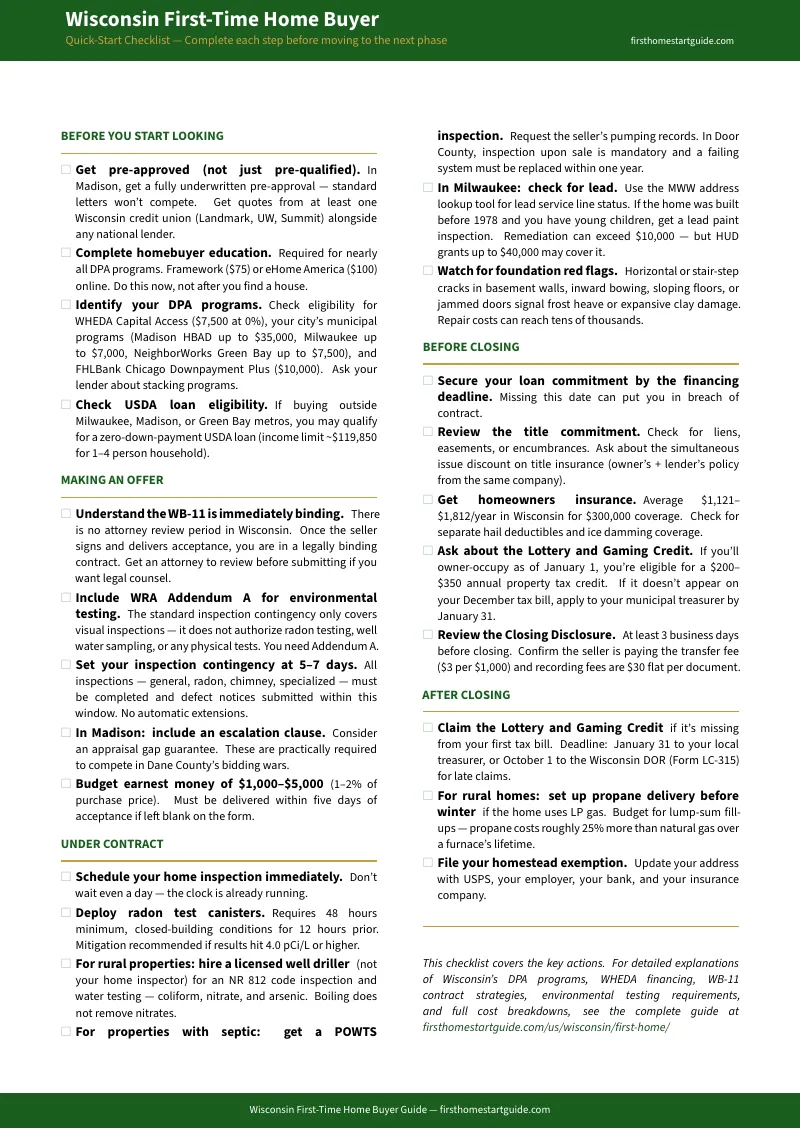
Download the free Wisconsin Quick-Start Home Buying Checklist to see the framework covering WB-11 contract essentials, WHEDA program eligibility, environmental testing priorities, and closing cost requirements. When you are ready for the complete guide with full chapter breakdowns, DPA program comparison worksheets, regional market analysis, environmental testing protocols, and printable tools for every meeting, get the complete Wisconsin First-Time Home Buyer Guide.
Wisconsin rewards buyers who understand the rules before they sign. This guide makes sure you do.
Frequently Asked Questions
What if the rules change after I buy?
We update the guide when the rules change. Email us any time, even years later, and we'll send you the current edition free.