You Have Read About Wisconsin's Stable Cap Rates and No Rent Control. You Still Do Not Know That a Single Clause in Your Lease Can Void the Entire Agreement and Force You to Refund Every Dollar of Rent You Have Ever Collected.
You have run the numbers on a Milwaukee duplex in the 53206 zip code. You have browsed Madison student housing listings on BiggerPockets and calculated the cash-on-cash return on a cabin near Wisconsin Dells. You may have seen the Reddit thread about a landlord who included a standard attorney's fees clause in a Wisconsin lease — a provision explicitly prohibited by ATCP 134.08 and Wis. Stat. 704.44. The Wisconsin Supreme Court ruled in Baierl v. McTaggart that the entire lease was void. The tenant had broken the lease by vacating early, but the landlord could not collect a dime. Recent appellate rulings in Koble Investments and Hoffman went further: the landlord must refund all rent previously paid over the entire tenancy, with no offset for the value of housing provided.
Or the investor who bought a cash-flowing pre-1950 duplex in Milwaukee without knowing that the city health department can order certified lead abatement, bill the entire cost to your property tax roll, and placard the building as unfit for habitation — all triggered by a single child's blood test. Or the Chicago buyer who underwrote a Door County vacation rental at full calendar-year occupancy, then discovered post-acquisition that Liberty Grove caps rental days at 180 per year, instantly cutting projected revenue in half.
The problem is not a lack of data. BiggerPockets has Milwaukee market threads. The Tenant Resource Center publishes landlord-tenant summaries. The DNR has pier regulations. But no single resource integrates Wisconsin's lease compliance traps (the Ten Deadly Sins, the Non-Standard Rental Provisions requirement, the 21-day security deposit clock), Milwaukee's lead paint enforcement regime (ATCP 163, DHS 163, abatement subsidies), Door County's fragmented STR permitting (septic occupancy caps, $1,500 license fees, resident agent rules), shoreland zoning (75-foot setbacks, impervious surface limits, pier dimensional standards), and the judicial foreclosure timeline (12-18 months of carrying costs with no access to the property) into one reference an investor can use to underwrite a deal correctly before signing.
The Wisconsin Investment Property Guide is a Wisconsin Investor Compliance System — a single, structured reference that maps regulatory compliance to deal underwriting across every major Wisconsin submarket. It replaces weeks of cross-referencing state statutes, administrative codes, forum posts, and municipal ordinances with a reference that tells you exactly what clauses void your lease, exactly what lead compliance costs, exactly what your septic system limits your guest count to, and exactly how long your capital sits locked in a judicial foreclosure.
What's Inside the Wisconsin Investor Compliance System
A comprehensive guide, a quick-start checklist, and 8 standalone worksheets and reference cards (10 PDFs) — covering every stage from acquisition through operations, built specifically for the statutes, codes, and local ordinances that make investing in Wisconsin different from every other Midwest state:
The Ten Deadly Sins and NSRP Lease Compliance
Wisconsin Statutes Section 704.44 lists ten prohibited lease provisions. Include even one — an attorney's fees clause, a rent acceleration provision, a confession of judgment, a missing domestic abuse disclosure — and the entire lease is void. Not the clause. The entire agreement. The guide maps every prohibited provision with the specific statute reference, explains how boilerplate language about "illegal activity" or "disturbing other tenants" can inadvertently trigger the 9th and 10th prohibitions, and walks through the Non-Standard Rental Provisions (NSRP) requirement under ATCP 134.09 — the separate, tenant-initialed document you must use for late fees, custom deposit deductions, and modified entry rights. Without it, your late fee is not just unenforceable; charging it exposes you to double damages and up to $10,000 per violation under Wis. Stat. 100.20.
Milwaukee Lead Paint Compliance — ATCP 163, DHS 163, and Abatement Subsidies
Pre-1978 properties in Milwaukee face the most aggressive lead enforcement in the Midwest. A child's blood test triggers a mandatory environmental investigation. If deteriorated paint is found, the city issues corrective orders. Fail to comply, and the Milwaukee Health Department can withhold your rent into escrow, placard the building as unfit for habitation, execute abatement at your expense, and levy the cost — up to 40% of assessed value — directly onto your tax roll. The guide covers DHS 163 renovation rules (the 6 sq ft interior / 20 sq ft exterior thresholds that require certified lead-safe renovators), target zip codes (53206, 53208, 53209, 53210, 53212, 53216 on the North Side; 53215 on the South Side), and the state and city subsidy programs that can offset abatement costs — turning a compliance liability into a capital improvement play.
Short-Term Rental Permitting — Dells, Door County, and Lake Country
Wisconsin's STR landscape is fragmented across municipalities. The state prohibits outright bans on rentals of 7+ days but allows local governments to cap rental days, impose licensing fees, and restrict occupancy. Sister Bay charges $1,500 per year for an STR license, requires a local agent within 30 miles available 24/7, and mails your property rules to every neighbor within 300 feet. Liberty Grove caps total rental days at 180 per calendar year. Across Door County, maximum guest occupancy is capped by your septic system's rated design capacity — not your bedroom count. The guide covers the Tourist Rooming House license requirements under ATCP 72 (effective January 2026), Wisconsin Dells' Conditional Use Permit process, and the municipality-by-municipality rules you must verify before underwriting any STR acquisition.
Lakefront Investment — Shoreland Zoning, Pier Rules, and Riparian Rights
Wisconsin has over 15,000 lakes. Every lakefront investment is governed by DNR shoreland zoning under NR 115: 75-foot building setbacks from the ordinary high-water mark, 15% impervious surface limits (expandable to 20% with a mitigation plan), vegetation removal restrictions within 35 feet of the shoreline, and pier dimensional standards (6-foot width, 200 sq ft loading platform, 2 boat slips per 50 feet of frontage). The guide explains the 2021 statutory presumption of riparian rights under Wis. Stat. 30.132, the DNR Pier Planner compliance checklist, and how properties with 3+ dwelling units trigger a formal Individual Permit requirement that can delay or block your dock installation entirely.
The Wisconsin Eviction Process — Notice to Writ of Restitution
Every eviction in Wisconsin goes through small claims court under Chapter 799. Self-help eviction is illegal and triggers double damages. The guide walks through the complete process step by step: the correct notice type for your situation (5-day pay or vacate, 5-day cure or quit, 14-day vacate, 30-day comply, or 5-day unconditional quit), filing the SC-500 complaint, service requirements (at least 5 days before the hearing), the initial hearing timeline (within 25 days of filing), the Writ of Restitution (valid for 30 days, sheriff must execute within 10 business days), and realistic timelines — 6-10 weeks uncontested, 3-4 months contested.
Judicial Foreclosure and Distressed Property Acquisition
Wisconsin is strictly a judicial foreclosure state. There is no non-judicial pathway. The total timeline from default to confirmation of sale runs 12-18 months. During the redemption period (3 months if the lender waives deficiency, 6 months if pursued, 5 weeks for abandoned property), the owner retains possession and the right to redeem. For investors targeting sheriff's sales, this means modeling a minimum 12-18 months of carrying costs — property taxes, insurance, interest — with no access to the property and no rental income. The guide explains the receivership strategy under Wis. Stat. 813.16 that lets you petition the court to appoint a receiver to collect rents and offset carrying costs during the redemption period.
Market Analysis by Region and Financial Analysis Frameworks
Submarket data across Madison (student housing cap rates, pre-leasing velocity, municipal late fee caps), Milwaukee (submarket-by-submarket median prices, cap rate ranges, Section 8 dynamics), Green Bay and Fox Cities (cash-on-cash yield profiles, manufacturing base stability), Waukesha County (collar market dynamics), Wisconsin Dells (seasonal STR revenue curves), and Door County (ADR profiles, licensing costs). Plus the financial analysis chapter: cap rate and cash-on-cash calculations with seven Wisconsin-specific adjustments — Lottery and Gaming Credit removal, lead compliance budgets, radon mitigation costs, POWTS maintenance, judicial foreclosure carrying costs, STR seasonality modeling, and the effective 5.36% state capital gains rate after the 30% exclusion.
Who This Guide Is For
- Out-of-state investors targeting Milwaukee duplexes or small multifamily who need to understand lead compliance costs, the NSRP requirement, and why their boilerplate lease from another state will void on contact with Wisconsin law
- Madison-area investors acquiring student housing near UW-Madison who need to navigate the compressed August turnover window, municipal late fee caps stricter than state law, and the tenant prepayment trap that reclassifies "last month's rent" as a security deposit
- Chicago or Milwaukee buyers evaluating vacation rentals in Door County or Wisconsin Dells who need the municipality-by-municipality STR rules, septic occupancy caps, and licensing costs before underwriting projected revenue
- Investors targeting lakefront cabins for STR or personal use who need to verify pier compliance, shoreland zoning setbacks, and impervious surface limits before making an offer
- Investors acquiring distressed properties, foreclosures, or sheriff's sale assets who need to model Wisconsin's 12-18 month judicial foreclosure timeline and understand the receivership strategy for preserving asset value
- First-time Wisconsin landlords who need the complete lease compliance framework — the Ten Deadly Sins audit, the NSRP document structure, the 21-day security deposit clock, and the step-by-step eviction process — before collecting their first rent check
Why Not Free Resources?
- BiggerPockets has active Milwaukee and Madison forums where investors crowdsource advice on lease language, tenant screening, and lead paint. But the advice is fragmented across hundreds of threads, mixes Wisconsin-specific rules with generic landlord guidance, and does not connect NSRP compliance to lease enforceability in the way that Baierl v. McTaggart demands. A thread recommending "standard late fee language" does not mention that writing the late fee into the lease body instead of a separate NSRP document makes it illegal and exposes you to double damages.
- The Tenant Resource Center publishes security deposit rules and eviction summaries — written from the tenant's perspective, for the tenant's benefit. It does not cover investor-side lease structuring, NSRP formatting requirements, or the operational implications of the 21-day security deposit return clock for properties with high turnover.
- State agency websites (DATCP, DHS, DNR) publish the statutes and administrative codes. They do not translate those codes into investor underwriting decisions — they do not tell you how to calculate the actual cost of lead compliance for a Milwaukee duplex, how to verify septic capacity before underwriting a Door County STR, or how to factor 18 months of carrying costs into a sheriff's sale bid.
- Reddit and landlord forums contain real experiences, but advice predating the January 2026 ATCP 72 revisions, the Koble Investments ruling, or the latest MHD enforcement priorities is worse than no advice — it creates false confidence in lease language and compliance practices that are now actionable violations.
This guide fills the Wisconsin-specific gap — the space between knowing the state has good cap rates and knowing how to structure a deal that does not blow up when a tenant refuses a late fee, the health department orders a lead inspection, or the town clerk tells you your septic system caps occupancy at four guests.
— Less Than a Single Late Fee You Cannot Legally Collect Without It
A single prohibited lease clause can force a full refund of every dollar of rent collected over the entire tenancy. A Milwaukee lead abatement order can cost $5,000 to $15,000 in certified window replacement — or up to 40% of assessed value if the city executes it and levies your tax roll. A Door County STR underwritten at full-year occupancy loses half its projected revenue when the 180-day cap applies. Eighteen months of carrying costs on a judicial foreclosure can consume the entire discount you thought you captured at a sheriff's sale.
This guide does not replace your attorney. But it gives you the lease compliance audit, the lead cost framework, the STR permitting matrix, the shoreland zoning checklist, and the foreclosure carrying cost model that ensure you identify every Wisconsin-specific risk before you sign an offer — not when the tenant files a complaint, the health department issues an order, or the court calendar stretches your foreclosure to month fourteen.
If it saves you from a single void lease, a single lead abatement levy, or a single STR underwritten without the municipal rental cap, it pays for itself before you finish reading it.
Money-back guarantee, no time limit. If the guide does not sharpen your underwriting and protect your investment in Wisconsin's regulatory environment, you pay nothing.
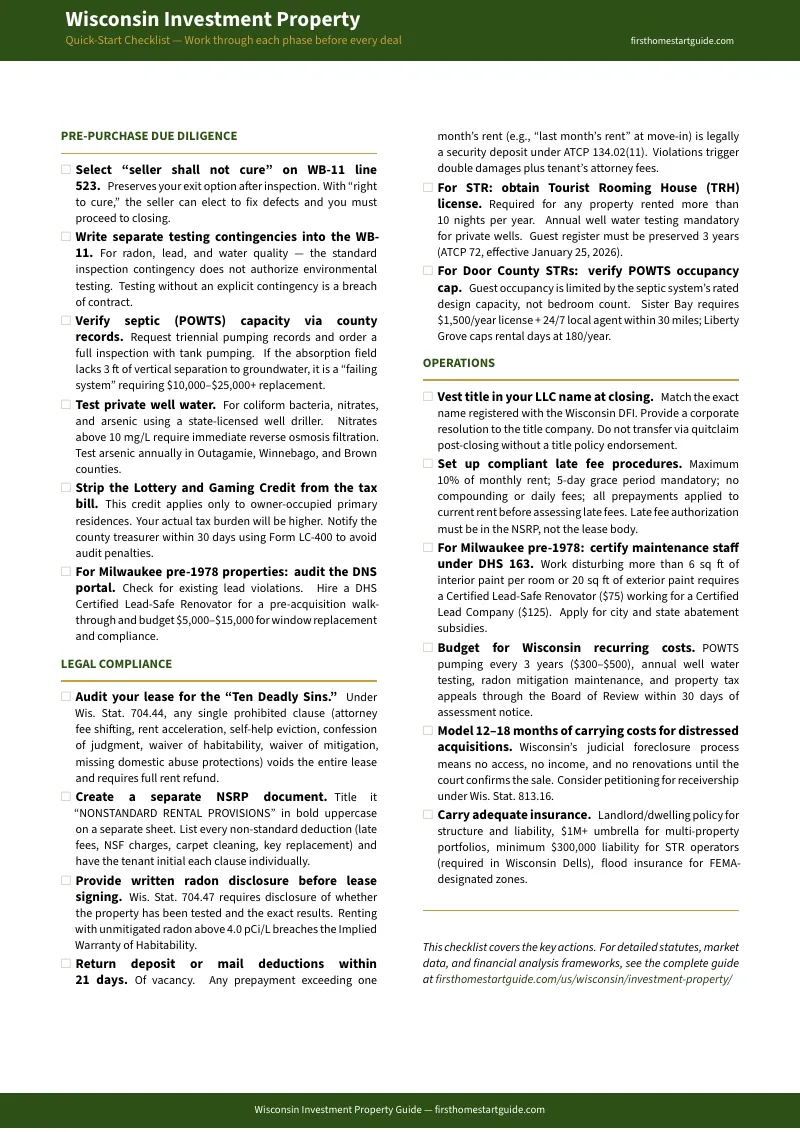
Download the free Wisconsin Quick-Start Checklist to see the step-by-step compliance framework covering pre-acquisition due diligence, lease structuring, and operations. When you are ready for the full lease audit, lead compliance system, STR permitting matrix, and financial analysis frameworks, the complete guide is here.
Wisconsin's yields are real. Its compliance traps are real. This guide makes sure you capture the first without being destroyed by the second.