
The Numbers Work Until Wyoming's 15-Day Deposit Deadline, Mineral Rights Financing Maze, and Energy Market Crash Rewrite Them
You found a duplex in Cheyenne throwing off 8% cap rates with military tenants paying on time every month via BAH. Or a four-unit in Casper at $317,000 with projected 10% yields while oil sits at $75. Or a 320-acre ranch outside Gillette with unsevered mineral rights and a coal royalty stream that could dwarf the surface rental income by a factor of ten. You formed a single-member Wyoming LLC because the internet told you it's "the best state for asset protection." The spreadsheet looks bulletproof. You're ready to wire earnest money.
Then Wyoming shows up. The Cheyenne tenant moves out, and you process the security deposit return in 25 days because that's what you're used to from Colorado's 60-day window. Wyoming's baseline is 30 days, but you missed the 15-day conditional trigger: when the tenant provided their forwarding address, you had exactly 15 days from that date, not 30. You're now in small claims court, and the penalty is automatic — the court doesn't consider honest mistakes. The Casper four-unit loses two tenants in a single month when WTI crude drops to $45 and the drilling crews leave town. Vacancy spikes to 15% across Natrona County. You underwrote at 5% vacancy. The ranch? Your mortgage lender assigned zero value to the mineral rights because standard residential appraisals exclude subsurface minerals entirely. You need a specialized mineral appraisal from a qualified energy appraiser, and the only banks that will underwrite mineral-inclusive properties are regional lenders like First Interstate and Jonah Bank. National lenders won't touch it. And your single-member LLC? Wyoming's charging order protection is ironclad — inside Wyoming. But you live in California, and when you're sued there, the California court can apply its own laws, bypassing Wyoming's exclusive remedy entirely and foreclosing on your membership interest.
Here's the problem: Wyoming combines zero state income tax on all income sources with a split-estate mineral rights system where 60-70% of private land has at least partially severed subsurface rights, an energy-dependent macroeconomy that subjects Casper and Gillette to 15-20% vacancy spikes when commodity prices crash, one of the tightest security deposit return windows in the country (15 days conditional, 30 days standard, 60 days with itemized deductions under Wyo. Stat. Ann. § 1-21-1208), LLC charging order protection that evaporates for single-member entities when litigation occurs outside Wyoming, a wind energy lease opportunity worth $4,000-$12,000 per turbine annually that requires transmission infrastructure analysis most investors skip entirely, and Teton County STR restrictions that limit residential properties to three short-term rental stays per calendar year with a five-year ban on permit issuance for violations. Each of these has cost real investors thousands — in small claims penalties, in negative cash flow during energy busts, in deal collapse from financing rejection, in asset protection that failed when it mattered — because the information existed but was scattered across the WOGCC well database, county clerk title records, BiggerPockets threads, and the Wyoming Secretary of State's LLC statutes.
The Wyoming Investment Property Guide is a Wyoming Investor Due Diligence System — not a motivational overview of tax-free investing, but a structured underwriting and compliance framework that maps every Wyoming-specific mineral rights trap, energy cycle risk, LLC structuring vulnerability, and landlord-tenant deadline into a process you work through before you wire earnest money. It replaces months of cross-referencing county clerk mineral records, WOGCC well databases, Wyoming LLC statutes, and energy market vacancy data with a single reference that tells you exactly what to verify, exactly what the numbers should look like at $40 oil and $80 oil, and exactly where deals go wrong in this state.
What's Inside the Wyoming Investor Due Diligence System
A 10-chapter guide, a 20-item due diligence checklist, and 8 standalone printable tools — covering every stage from market selection through mineral monetization and exit strategy, built specifically for the split-estate complexities, energy cycle correlations, and asset protection nuances that make Wyoming different from every other state:
Six Investment Zone Analysis with Energy Stress-Test Framework
Wyoming is not one market — it is six fundamentally different investment environments, each driven by a distinct economic engine. Cheyenne (7-9% cap rates) is anchored by state government, healthcare, and F.E. Warren Air Force Base where BAH-backed military tenants produce near-zero collection risk. Casper (8-11% cap rates) is symbiotically linked to WTI crude prices — when oil dropped below $50 in the 2015-2016 bust, vacancy surged above 8% and home prices compressed 15-20%. Laramie (7-10% cap rates) offers university-anchored demand from 13,000+ students but requires 12-month August-to-August leases with parent guarantor co-signatures to survive summer vacancy. Gillette (10-15%+ cap rates) offers the highest gross yields in the state from Powder River Basin coal, but long-term coal decline means the play is pure cash flow extraction, not appreciation. Sheridan (6-8% cap rates) attracts retirees and remote workers with stable demand. And Jackson (2-4% cap rates) is a capital preservation play with entry prices exceeding $3 million. The guide includes the stress-test framework that Casper and Gillette investors need: what does your pro forma look like at $40 oil, $60 oil, and $80 oil, and how many months of reserve capital do you need to survive a full cycle trough?
Mineral Rights and the Split Estate System
This is what makes Wyoming fundamentally different from any coastal or urban market. Roughly 60-70% of Wyoming's private land has at least partially severed mineral rights — meaning someone else may own the oil, gas, and coal beneath the property you're buying. Discovering whether you're acquiring fee simple absolute (minerals bundled) or a severed surface estate requires independent title chain analysis at the county clerk's office, cross-referenced against the WOGCC well database. If minerals are unsevered, the potential royalty stream at 12.5-20% of gross production can increase the property's intrinsic value by a factor of 5 to 20 during active production cycles. But standard residential appraisals assign zero value to subsurface minerals, and national lenders like Wells Fargo, Chase, and Rocket Mortgage will not underwrite mineral value. The guide covers WOGCC database verification, mineral appraisal requirements, regional lender options (First Interstate Bank, Jonah Bank, Wyoming Community Bank), the Surface Owner Accommodation Act (W.S. 30-5-401) that protects surface owners when third-party developers arrive, and the Contract for Deed financing mechanism that bypasses traditional banking entirely.
Wind Energy Lease Opportunity and Transmission Analysis
Wyoming's Class 7 wind resources — particularly in Albany, Carbon, and Laramie counties — are among the most productive in North America. Under the Wyoming Wind Energy Rights Act (WERA), wind rights are permanently appurtenant to the surface estate and cannot be severed, guaranteeing the landowner perpetual control over this revenue stream. Development agreements progress through structured phases: feasibility payments of $5-$40 per acre per year for meteorological tower placement, followed by operational royalties of 4-10% of gross electricity revenue per turbine — historically generating $4,000 to $12,000+ per turbine annually. But here's what most investors miss: Wyoming produces far more wind energy potential than its existing transmission grid can export. The TransWest Express and Gateway West transmission lines have been in permitting for over a decade. Investors who buy rangeland without near-term transmission access may hold the asset for years before any development occurs. The guide covers transmission proximity evaluation, BLM right-of-way status, utility interconnection queue position, and Landowner Wind Association (LWA) cooperative bargaining structures.
Wyoming LLC Asset Protection and the Single-Member Vulnerability
Wyoming was the first state to enact LLC legislation in 1977 and maintains some of the strongest corporate privacy and asset protection laws in the country. Under Wyo. Stat. Ann. § 17-29-503, a charging order is the exclusive remedy by which a judgment creditor can reach a member's interest — creditors cannot foreclose on the membership interest, force a liquidation, or exercise management rights. The manager controls distributions, meaning they can retain all rental earnings and distribute nothing, leaving the creditor with a charging order that yields zero cash. Under IRS Revenue Ruling 77-137, the creditor may even owe income taxes on the debtor's allocable share of LLC profits — money they never received. This "phantom income" deterrent is devastating for predatory litigants. But here is the critical nuance that generic LLC formation guides never mention: while Wyoming extends charging order exclusivity to single-member entities within its borders, out-of-state courts may apply their own laws when the single member resides elsewhere. The fix is simple — admit a second member (spouse, trust, or business partner) to create a multi-member LLC — and the guide explains exactly how, for $100 formation and $60/year.
The 15-Day Security Deposit Trap and Landlord-Tenant Compliance
Wyoming's security deposit return timeline under Wyo. Stat. Ann. § 1-21-1208 is one of the tightest in the United States, and it is the single most common compliance failure among out-of-state investors. The baseline is 30 days for a full refund. But the 15-day conditional window — triggered when a tenant provides their forwarding address — creates operational complexity that catches Colorado investors (accustomed to 60-day windows) every time. If you're withholding for damages, you get a maximum of 60 days to deliver an itemized deduction list plus the remaining balance. Miss any of these deadlines and the tenant can sue for the full deposit plus court costs — and the penalty is automatic. The guide also covers the full eviction process: 3-day notice to quit for nonpayment, Forcible Entry and Detainer filing in Circuit Court, and the Writ of Restitution that gives the tenant just 2 days to vacate. For Cheyenne landlords, the Servicemembers Civil Relief Act (SCRA) allows F.E. Warren military tenants to break leases upon receiving deployment or PCS orders — a reality entirely foreign to civilian-market investors.
Short-Term Rental Rules and the Teton County Trap
Investors who purchase residential property near Jackson expecting to operate Airbnb or Vrbo rentals discover Teton County's regulations only after closing. Properties outside designated Lodging Overlay or Planned Resort zones are limited to three separate short-term rental stays per calendar year under a Basic Use Permit (BUP). Violations trigger a five-year ban on BUP issuance — on a $2-5 million asset. The disconnect between Jackson's tourism-driven economy and its residential STR restrictions catches even sophisticated investors off guard. Meanwhile, Cody (Park County) offers a relatively accessible STR environment: non-owner-occupied STRs are permitted in commercial districts (D-1, D-2) and higher-density residential zones (R-3, R-4). The guide maps every jurisdiction, from Teton County's BUP limits to Cody's zoning-based approach, plus the Wyoming-wide tax compliance requirements: 4% state sales tax and 5% state lodging tax on stays under 30 days, filed with the Wyoming Department of Revenue.
Tax Architecture, Due Diligence, and Exit Strategies
Wyoming's zero income tax on all sources — rental income, capital gains, business income, mineral royalties, wind energy lease payments — is the primary draw for tax-motivated investors. Property is assessed at 9.5% of fair market value with effective rates of 0.53-0.70%, and there is no real estate transfer tax. The guide covers the complete tax framework plus domicile establishment strategy for high-income relocators from California, New York, and New Jersey — including the documentary trail needed to survive a Franchise Tax Board or Department of Taxation audit. The due diligence chapter goes beyond standard inspections: title insurance with specific mineral rights endorsements, WOGCC well database verification, DEQ contamination records, wildlife migration corridor analysis (Executive Order 2020-01), and hail/wind insurance with replacement cost vs. ACV coverage verification. Exit strategies include 1031 exchanges with zero state-level friction, installment sales, and mineral-inclusive exit considerations for properties with active royalty streams.
Who This Guide Is For
This guide is for real estate investors targeting Wyoming markets who:
- Are analyzing a Wyoming property and need to determine whether the deal works once you account for mineral rights status (unsevered vs. severed), energy market vacancy risk, the 15-day security deposit return deadline, and LLC structuring nuances — not the generic underwriting assumptions that work in states without split-estate complexities and commodity-correlated rental markets
- Are a Colorado investor acquiring your first Cheyenne property and need to understand that Wyoming's security deposit timelines are tighter than Colorado's, that BAH rate cycles matter for military tenant pricing, and that the landlord-tenant procedures you're used to do not apply here
- Are targeting Casper or Gillette and need an energy stress-test framework that models your pro forma at $40, $60, and $80 oil — because Wyoming's energy markets are commodity-driven, not demographically driven, and generic vacancy assumptions will destroy your cash flow when the cycle turns
- Are evaluating a property with unsevered mineral rights and need to understand how to verify ownership through county clerk records and the WOGCC database, why national lenders will not finance mineral value, which regional banks will, and how to structure the acquisition when standard appraisals exclude the most valuable component of the asset
- Are acquiring Wyoming rangeland with wind energy potential and need to evaluate transmission proximity, BLM right-of-way status, fair lease terms, and whether the TransWest Express or Gateway West lines will reach your parcel within a timeline that makes the holding cost worthwhile
- Have formed a single-member Wyoming LLC and believe your assets are protected — without realizing that the protection only holds if litigation occurs inside Wyoming, and that an out-of-state court can apply its own laws to bypass charging order exclusivity entirely
- Want every Wyoming-specific statute, tax rate, mineral rights procedure, and compliance deadline in one reference — instead of assembling it from the WOGCC database, county clerk records, BiggerPockets threads, and Secretary of State filings that may already be outdated
Why Not Free Tools and Forums?
Free information on Wyoming real estate investing exists across dozens of sources. Here's what it actually delivers:
- BiggerPockets forums contain useful war stories from Wyoming investors — mixed with LLC structuring advice that's national (not Wyoming-specific), mineral rights discussion from investors in other states, and energy market vacancy estimates based on years when oil was $70+ and Casper was booming. The consistently highest-engagement topic on BiggerPockets is Wyoming LLC vs. Nevada LLC vs. Delaware LLC — a debate that completely misses the single-member vulnerability that actually determines whether your asset protection holds. Sorting current from outdated across a dozen threads takes longer than reading a guide that has verified every statute and citation.
- Wyoming Secretary of State provides LLC formation mechanics — filing fees, annual reports, registered agent requirements. It does not explain the charging order exclusivity nuance for single-member entities, the phantom income deterrent, the multi-member structuring fix, or how an out-of-state court might apply its own laws to bypass Wyoming's protections entirely.
- Roofstock, Mashvisor, and national investment platforms provide market data and cap rate estimates for Cheyenne and Casper. They offer zero coverage of mineral rights valuation, wind energy lease mechanics, energy cycle correlation risk, or the split-estate title chain analysis that determines whether you're buying the most valuable component of a Wyoming property or leaving it on the table.
- National investing courses ($997 to $5,000+) teach cap rate analysis, DSCR calculations, and 1031 exchange mechanics that apply everywhere. They don't cover Wyoming's split-estate mineral system, wind energy lease terms, the 15-day security deposit trigger, energy market stress-testing, or the LLC charging order vulnerability that strips asset protection from single-member entities when litigation occurs out of state. Applying national frameworks to Wyoming's resource-driven market is how investors miss the subsurface value, underestimate the energy correlation risk, and form entities that fail when tested.
This guide fills the Wyoming-specific gap — the space between knowing how to analyze a rental property in general and knowing how to underwrite one in a state where the mineral estate beneath the land can be worth 5-20 times the surface improvements, where rental vacancy is driven by WTI crude prices rather than demographics, where security deposit deadlines are 15 days instead of the 60 you're used to, and where the LLC asset protection you set up fails the moment you're sued outside Wyoming's borders. It's the analysis that would take a Wyoming mineral rights attorney, an energy appraiser, a regional lender, and a real estate compliance specialist to assemble — structured as a reference you own permanently.
— Less Than One Hour of a Mineral Rights Attorney
A single mineral rights title chain error costs you a royalty stream worth tens of thousands annually. A single missed 15-day security deposit deadline puts you in small claims court with an automatic penalty. A single-member LLC you formed believing it was bulletproof fails when you're sued in your home state. A Casper property you underwrote at 5% vacancy hits 15-20% when oil drops to $45. A Jackson vacation rental you purchased for $3 million is limited to three bookings per year — and a violation triggers a five-year ban.
This guide doesn't replace your Wyoming real estate attorney, your mineral appraiser, or your regional lender. But it gives you the mineral rights verification framework, energy stress-test model, LLC structuring analysis, landlord-tenant compliance system, and market-by-market breakdowns that ensure you identify every Wyoming-specific risk before you're contractually committed — instead of discovering them in small claims court, during an energy bust, or when your asset protection structure collapses in an out-of-state courtroom.
If it catches a single mineral rights omission, prevents a single deposit deadline violation, or reveals that your single-member LLC needs a second member before it actually protects you, it pays for itself before you've finished reading it.
Money-back guarantee, no time limit. If the guide doesn't sharpen your underwriting and protect your capital in Wyoming's resource-driven market, you pay nothing.
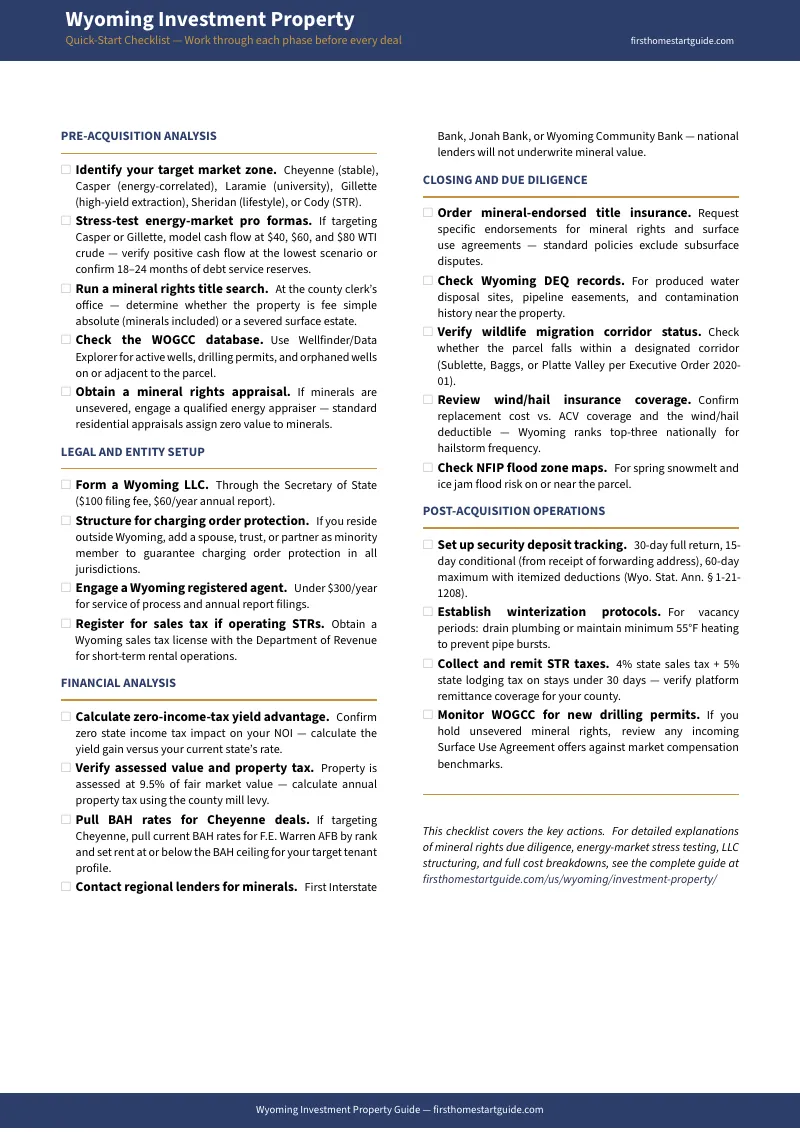
Download the free Wyoming Quick-Start Checklist to see the due diligence framework covering pre-acquisition mineral rights verification, LLC entity setup, energy stress-testing, closing procedures, and post-acquisition security deposit compliance. When you're ready for the full mineral rights system, energy cycle analysis, LLC structuring guide, landlord-tenant compliance framework, and 10-chapter investment guide, the complete guide is here.
The spreadsheet works in any state. This guide tells you whether it works in Wyoming.
Frequently Asked Questions
What if the rules change after I buy?
We update the guide when the rules change. Email us any time, even years later, and we'll send you the current edition free.