You Found a Condo in Vietnam. The State Owns the Land Under It, and the Developer May Have Already Mortgaged It to a Bank.
You've found a two-bedroom apartment in District 2 with a rooftop pool, a gym, and a view of the Saigon River. The developer's brochure says "permanent ownership." The agent says foreigners can buy freely. The price per square meter is a fraction of what you'd pay in Singapore, Hong Kong, or Sydney. You start picturing yourself on the balcony watching the sunset over Thu Duc City. Within a week you've learned that no one in Vietnam owns land — not foreigners, not Vietnamese citizens, not the developer. The Constitution declares all land the property of the entire people, administered by the state. What you're actually buying is a 50-year leasehold on the apartment structure, sitting on state-owned soil, inside a building where foreigners are capped at 30% of units, in a project where the developer may have already pledged the master land certificate to a commercial bank to fund construction. And the brochure that said "permanent ownership" — that phrase doesn't appear anywhere in the Housing Law 2023, the Land Law 2024, or the Real Estate Business Law 2023 that govern your transaction.
You search online for help. Savills and CBRE publish polished quarterly reports on Vietnam's residential market — written for institutional investors analyzing yield compression across asset classes, not for an individual buyer trying to figure out whether the building they want has already hit the 30% foreign quota. Local agencies publish blog posts with titles like "Complete Guide to Buying Property in Vietnam as a Foreigner" that walk you through the steps in upbeat English, gloss over developer mortgage risks entirely, and never mention Khang Gia Tan Huong or the 219 apartments in Phu Thanh that a bank tried to foreclose on despite being fully paid for and occupied. Law firm websites publish technically precise articles on the Housing Law 2023 — in dense legal prose that requires a Vietnamese law degree to parse, covers one provision in isolation, and functions as a lead-generation page for billable consultations. Reddit threads contain real experiences — alongside advice that confuses Pink Books with Red Books, confidently states that buying through a Vietnamese spouse gives you freehold, and recommends condotels in Da Nang based on a developer's promised 12% yield that collapsed two years ago.
Here's the problem no free resource solves: Vietnam's property system runs on a constitutional framework where land is collectively owned by the people and administered by the state, where your "ownership" is a time-limited Land Use Right recorded on a Pink Book that expires in 50 years, where the renewal requires a formal application to the provincial People's Committee at least 3 months before expiry and can be denied, where developers routinely mortgage the master Red Book to banks while selling you units against it, where the 30% foreign ownership cap is now enforced per block rather than per project, where condotel buyers have no formal residential protections, and where buying through a Vietnamese spouse under the Marriage and Family Law creates common marital property that can leave you disinherited on divorce or death. The system has structural protections for buyers — the 5% deposit cap, mandatory bank guarantees on off-plan sales, the right to withhold the final 5% until the Pink Book is delivered — but only if you know they exist, understand the statute that creates them, and activate them before you sign.
The Buying Property in Vietnam — Foreigner's Guide is the Vietnam Foreign Buyer Due Diligence System. Not a market overview from a brokerage earning listing fees. Not a lifestyle article about living in Da Nang. It's a structured verification framework that decodes every stage of the Vietnamese property purchase — from the constitutional basis of land ownership through the deposit agreement, the Sale and Purchase Agreement, fund routing via the State Bank's capital controls, notarization, tax settlement, and Pink Book issuance — so you make each decision understanding the legal mechanism behind it, the statute that governs it, and the financial consequence of getting it wrong.
What's Inside the Vietnam Foreign Buyer Due Diligence System
The complete guide, a quick-start checklist, and 6 standalone printable tools — 8 PDFs covering every stage from understanding state land ownership through Pink Book issuance, with the Vietnamese legal terms, statutory references, tax rates, and deadlines that determine whether your transaction succeeds or collapses:
Developer Mortgage Audit Protocol
The single most dangerous trap in Vietnamese property buying, and the one no agency guide or developer brochure will ever mention. Developers routinely mortgage the master Land Use Rights Certificate — the project's collective Red Book — to commercial banks to fund construction. Vietnamese law requires them to release these mortgages before selling units, but weak enforcement means developers collect up to 95% of your purchase price without clearing the underlying debt. Real cases: Khang Gia Tan Huong in HCMC — developer obtained the master certificate in April 2012, mortgaged it to BIDV Bank two months later, sold completed apartments, and residents discovered in 2020 that they were blocked from obtaining Pink Books. Phu Thanh — developer mortgaged 219 individually sold, fully paid, owner-occupied apartments to Viet A Bank for corporate debt. In June 2024, the bank initiated foreclosure on those occupied units. The guide covers how to request and verify the mortgage status of a project's master land certificate at the Land Registration Office before you pay a single dong, what documents the developer must produce to prove the mortgage has been released on your specific unit, and the legal mechanism under the Real Estate Business Law 2023 that entitles you to withhold the final 5% of the purchase price until the Pink Book is delivered.
50-Year Leasehold Decoder
Every English-language developer brochure uses phrases like "permanent ownership" or "exclusive property rights." None of these phrases appear in the Housing Law 2023. What you actually receive is a 50-year Land Use Right recorded on a Pink Book, starting from the date of issuance. The Housing Law 2023 clarifies the renewal: one extension of up to 50 additional years, creating a maximum potential holding period of 100 years. But the renewal is not automatic. You must submit a formal application dossier to the provincial People's Committee at least 3 months before your initial term expires. The Committee has 30 days to approve or reject. If you fail to apply, or if the application is denied, or if no legal transfer occurs before the expiry date, the ownership rights terminate and the property reverts to state ownership without compensation. The guide explains the exact renewal mechanics, the documentation requirements, the conditions that could trigger a rejection, and the exit strategies you should prepare years before the 50-year clock runs out.
30% Quota Verification System
Under the Housing Law 2023, foreigners collectively cannot own more than 30% of units in a single condominium building. The implementing guidance under Decree 95/2024/ND-CP closes the developer loophole: in multi-block developments sharing a common podium or basement, the cap applies per block, not across the aggregate project. For landed properties — detached houses, townhouses, villas — the cap is 250 homes per ward. Properties in national defense and security zones are excluded entirely. The guide covers the exact steps to verify a building's current foreign ownership count through the provincial Department of Construction before you sign the deposit agreement, what happens if you sign an SPA for a unit that exceeds the remaining allocation, and the practical implications of the block-by-block calculation for mixed-use mega-projects.
Marital Property Trap Navigator
Buying through a Vietnamese spouse seems like the obvious workaround: married to a Vietnamese citizen, you get indefinite ownership rights equivalent to a domestic buyer. The legal reality is more dangerous. Under the Marriage and Family Law, property acquired during a marriage is classified as common marital property. In practice, municipal land registration offices (DONRE) frequently refuse to register a foreign national's name on a land use right deed for landed properties. The foreign spouse signs a notarized affidavit of separate property — a document stating that the purchase funds belonged solely to the Vietnamese spouse and that the foreign spouse waives all future claims to the land. On divorce, or upon the death of the Vietnamese spouse, the foreign partner can be legally disinherited. If the deceased spouse leaves no will, the property defaults to Vietnamese family members. The guide covers how to structure the purchase to protect both parties, the specific provisions of the Marriage and Family Law that govern asset division, and the inheritance planning steps that must happen before the property closes — not after.
Viet Kieu Classification Guide
The Land Law 2024 created a two-tiered legal status for overseas Vietnamese that most diaspora buyers don't fully understand. Class 1 — Vietnamese citizens who hold a valid Vietnamese passport or Citizen Identification Card — enjoy full legal parity with domestic residents. They can buy raw land plots, agricultural land, individual street-front houses, and are exempt from the 30% condominium cap and the 250-home ward limit. Class 2 — persons of Vietnamese origin who hold foreign passports without Vietnamese nationality — are restricted to purchasing residential units within approved commercial housing projects, the same restriction that applies to regular foreigners. They verify their status through a Certificate of Vietnamese Origin issued by a Vietnamese embassy or the Ministry of Justice. The difference between these two classes determines whether you can buy a family plot in your ancestral province or are limited to a developer condo in a commercial project. The guide maps the exact documentation requirements for each class, the process for obtaining a Certificate of Vietnamese Origin, and the legal boundaries of each classification under Decree 95/2024/ND-CP.
Fund Routing and Capital Controls Decoder
Vietnam's State Bank (SBV) maintains strict controls over foreign capital entering the real estate market. Every payment must flow through a licensed credit institution — cash payments are prohibited and will result in the denial of your Pink Book registration. You must open either a VND payment account or an Indirect Investment Capital Account (IICA) at a licensed Vietnamese bank. Your international wire transfer must reference the specific project code, unit number, and SPA agreement number in the transfer memo. The receiving bank cross-checks the transfer amount against the values declared in your signed contract. Any discrepancy or failure to prove the legal origin of funds triggers an AML/CTF rejection. All transactions inside Vietnam must be denominated in Vietnamese Dong — your foreign currency is converted at the bank's prevailing spot rate at execution. The guide covers the complete fund routing sequence, the documentation you need to prove capital origin (tax returns, property sale deeds, employment contracts), the SWIFT memo format requirements, and the capital repatriation process when you eventually sell.
Condotel Risk Assessment
The Cocobay Da Nang collapse is the defining cautionary tale of Vietnamese real estate. The Empire Group marketed a 51-hectare hospitality complex with guaranteed annual yields of 10-12.5% for the first eight years. Buyers took bank loans under three-way agreements where the developer's guaranteed yields were paid directly to the bank to service the buyer's mortgage. In late 2019, the developer defaulted on all guaranteed payments. The banks demanded direct debt service from individual buyers. Over 450 buyers filed formal complaints. The developer attempted to unilaterally convert condotel units into residential apartments, demanding an additional 15% conversion fee without obtaining municipal zoning approvals. As of 2026, the project remains stalled. The guide covers the legal classification of condotels under the Real Estate Business Law 2023, the difference between residential and commercial zoning that determines your Pink Book type, the sustainable yield benchmarks (4-6% versus the 10-12% promises), and the specific contract clauses to scrutinize if you're considering any hospitality-linked property.
Transaction Cost Calculator and Tax Guide
The guide includes a worked cost model for a primary apartment purchase — registration fee (0.5% of the government-assessed value, not the market price), 10% VAT, the mandatory 2% sinking fund, notarization fees, and the 2% PIT the seller owes on secondary market sales (which is frequently negotiated onto the buyer). It covers the critical distinction between the government-assessed land price table and the actual market price — the assessed value is typically only 20-40% of the commercial price, which significantly reduces your registration fee. Plus the off-plan payment schedule limits: 5% maximum deposit, 50% cumulative pre-handover cap for foreign-invested developers, and the legal right to withhold the final 5% until the Pink Book is delivered.
Who This Guide Is For
This guide is for foreign buyers and expats purchasing property in Vietnam who:
- Are buying their first Vietnamese property and need the entire transaction mapped — from understanding the constitutional basis of state land ownership through the deposit agreement, SPA execution, fund routing, notarization, tax settlement, and Pink Book issuance — so they understand what happens at each stage, what it costs, and what can go wrong
- Have found a condo or villa they want to buy and need to verify, before they sign anything, whether the building has hit the 30% foreign quota, whether the developer has mortgaged the master land certificate, and whether the project sits in a national defense exclusion zone
- Are an expat who has lived in Vietnam for 2-3 years, watched rents increase 10-15% annually, and want to evaluate whether buying makes financial sense — with the real tax costs, the leasehold depreciation, and the capital repatriation constraints factored in
- Are Viet Kieu returning to Vietnam and need to determine whether they qualify as Class 1 (full citizen parity, can buy land directly) or Class 2 (restricted to commercial residential projects), and what documentation they need to prove their status
- Are married to a Vietnamese citizen and need to understand why buying through a spouse creates common marital property under the Marriage and Family Law — and how to structure the purchase to protect both parties from disinheritance on divorce or death
- Are considering a condotel or tourism property and need the objective risk assessment — the Cocobay case study, the legal classification gap, the sustainable yield benchmarks, and the contract clauses that determine whether you're buying a residential asset or inheriting a developer's debt
Why Not Free Resources?
Free information on buying property in Vietnam as a foreigner is abundant. Here's what each source actually delivers:
- Savills and CBRE Vietnam publish highly detailed quarterly market reports with pricing data, yield analysis, and supply-demand forecasts — written for institutional investors evaluating portfolio allocation across asset classes. What they don't provide: a step-by-step transaction guide for individual buyers, developer mortgage audit procedures, quota verification steps, or the practical mechanics of routing funds through the State Bank's capital controls. The macroeconomic analysis is excellent. The information that protects your deposit is absent.
- Local real estate agencies publish blog posts and "Complete Foreigner's Guides" in polished English — maintained by firms earning commission on every sale they close. They walk you through the basic steps, use terms like "simple process" and "safe investment," and systematically omit developer mortgage risks, the Khang Gia and Phu Thanh cases, the Cocobay condotel collapse, and the Marriage and Family Law provisions that can disinherit a foreign spouse. The optimism is calibrated to close sales, not to protect buyers.
- Vietnamese law firms publish technically precise articles on individual provisions of the Housing Law 2023 and Land Law 2024 — each article covering one concept in isolation, written in dense legal terminology that requires a Vietnamese legal background to interpret, and functioning as an SEO lead-generation page for consultations. You get fragments of expertise designed to demonstrate competence at billable rates, not an integrated roadmap that connects the legal, financial, tax, and administrative tracks into one sequence.
- Reddit and expat forums (r/Vietnam, r/expats, Facebook buying groups) contain genuine experiences from foreign buyers — alongside confidently stated advice that confuses Pink Books with Red Books, recommends condotels based on developer-promised yields that have already defaulted, claims buying through a spouse gives you freehold, and warns you never to buy anything in Vietnam without explaining the specific risks that can be mitigated with proper due diligence. Both the horror stories and the success stories are real. Neither tells you which outcome applies to your transaction.
This guide fills the structural gap — the space between knowing that foreigners can buy property in Vietnam and understanding exactly how the state land ownership system works, what the 50-year leasehold actually means for your money, how to verify whether a developer has mortgaged the project, how to confirm quota availability, how to route funds through the SBV's capital controls, and what the Marriage and Family Law says about property you buy through a Vietnamese spouse. It's the analysis an independent advisor with no commission to earn would give you, structured as a permanent reference you own.
— Less Than One Hour of a Vietnamese Property Lawyer's Time
An independent Vietnamese property lawyer charges $150-$300 per hour for a consultation that covers one aspect of your transaction. A notarization session runs $500-$1,000. The deposit you're protecting under the SPA is 5% of a property that costs $100,000-$300,000 — that's $5,000-$15,000 at risk before you've even confirmed whether the building has hit its foreign quota or the developer has cleared the master mortgage. A single condotel purchase based on a guaranteed yield promise can lock you into a three-way bank agreement that turns the developer's default into your personal debt.
This guide doesn't replace your lawyer or your notary. But it gives you the developer mortgage audit protocol, the quota verification system, the leasehold renewal decoder, the spousal property trap navigator, the fund routing sequence, and the transaction cost calculator that ensure you walk into every viewing, every developer meeting, and every notarization session understanding the mechanism behind each step — instead of discovering how Vietnamese property law works by losing money to it.
If it prevents a single deposit payment on a unit that exceeds the 30% foreign quota, catches a single developer mortgage that would block your Pink Book for years, or identifies the Viet Kieu classification that determines whether you can buy land or are restricted to commercial condos, it pays for itself before you've finished reading it.
Money-back guarantee, no time limit. If the guide doesn't make the Vietnamese property transaction clearer and your financial position stronger, you pay nothing.
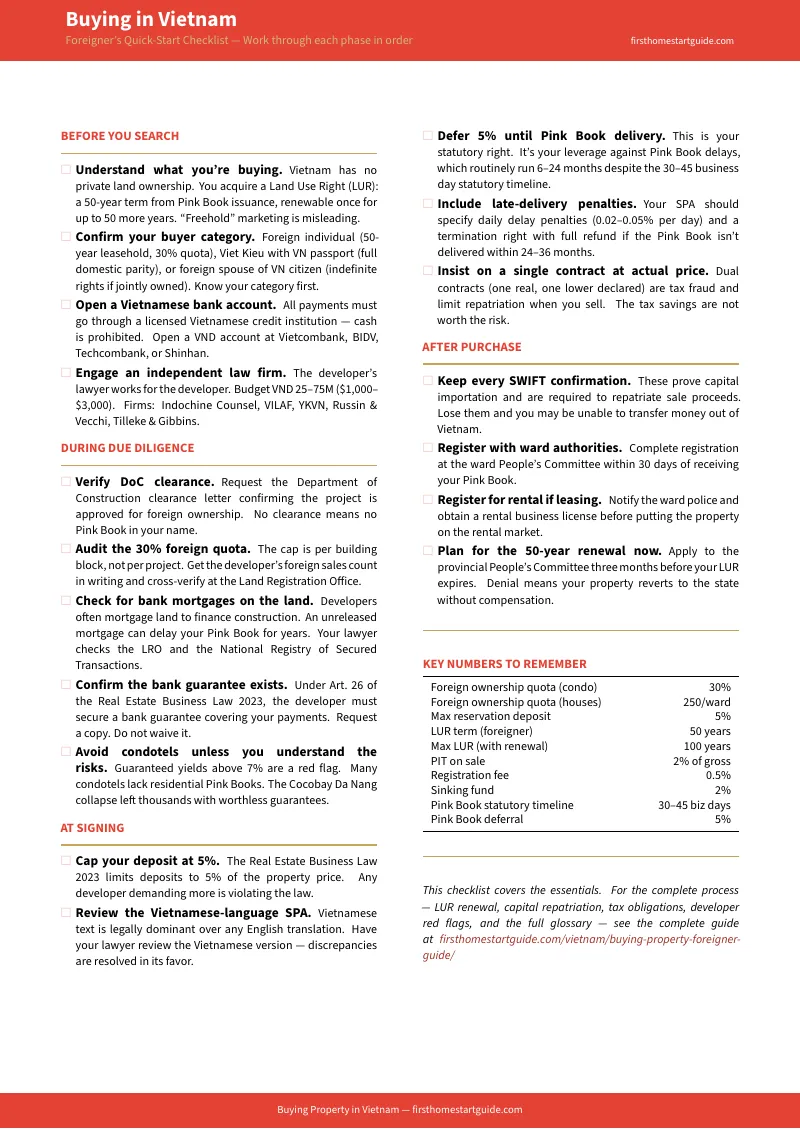
Download the free Quick Checklist to see the step-by-step action plan covering quota verification, developer mortgage checks, the 50-year leasehold renewal timeline, fund routing requirements, and the deposit-to-Pink-Book transaction sequence. When you're ready for the full Due Diligence System — complete with the developer mortgage audit protocol, marital property trap navigator, Viet Kieu classification guide, condotel risk assessment, and transaction cost calculator — the complete guide is here.
You've found the property. Now verify the system that stands between you and the Pink Book.