Your Agent Says "Strong Yield." Your First Tax Bill Says HKD 110,000.
You have seen the headlines: cooling measures abolished, mortgage rates falling, mainland capital surging. Every agent, every developer showflat, and every bank seminar tells you Hong Kong property is back. What none of them mention is the provisional property tax system that doubles your first-year tax bill, the criminal penalties for renting your unit on Airbnb, or the management fees that quietly eat 12% to 16% of your gross rent before you collect a dollar.
Consider a straightforward scenario. You purchase a HKD 10 million one-bedroom unit in Tseung Kwan O. You rent it for HKD 25,000 per month. Your gross yield looks respectable at 3%. Then the Inland Revenue Department sends your first assessment: HKD 55,200 in property tax plus HKD 55,200 in provisional property tax for the following year. That is HKD 110,400 in your first tax bill alone -- before rates, government rent, and management fees. Your "3% yield" is now closer to 1.8%.
Nobody in the transaction chain has a structural incentive to walk you through this arithmetic. The agent earns commission on the sale. The bank earns interest on the mortgage. The developer needs to move units. Centaline and Midland publish gross yield tables and transaction indices, not the net yield calculation that accounts for progressive rates, the 20% statutory deduction, management fee drag, and vacancy provisions. The analysis that might change your buying decision is the analysis that does not get published.
The Net Yield Navigator exists because running these numbers should not require a HKD 40,000 consultation with a tax advisory firm. The Hong Kong Investment Property Guide is an objective, regulation-heavy playbook covering stamp duty mechanics (Scale 2 AVD, the 6.5% surcharge on properties above HKD 100 million), the HKMA financing framework (70% LTV caps, 50% DSR limits), property tax optimisation (standard rate versus Personal Assessment), the Cap. 648 lease extension system, short-term rental prohibitions under Cap. 349, the full Lands Tribunal eviction process, and district-by-district yield analysis. Every rate, threshold, and worked example uses 2026 figures.
What's Inside the Net Yield Navigator
A 13-chapter guide, a due diligence checklist, 5 standalone printable tools, and the worked calculations that no commission-driven source will publish. Each chapter addresses a specific structural problem that Hong Kong property investors face -- not generic investment theory, but current regulations, real numbers, and scenarios you can apply to your situation this week. The standalone printables include a net yield worksheet, district yield reference card, stamp duty reference, eviction timeline flowchart, and a quick-reference card you can bring to every property viewing.
The Complete Stamp Duty Landscape After the 2024 Reset
Every cooling measure was removed on 28 February 2024. No more Buyer's Stamp Duty, no more New Residential Stamp Duty, no more Special Stamp Duty. But the government replaced blanket restrictions with targeted interventions: the February 2026 AVD surcharge raised the rate to 6.5% on properties above HKD 100 million. This chapter maps every Scale 2 AVD band from HKD 100 to 4.25%, the conditions that trigger the higher rates, and worked duty calculations at common price points so you know your exact tax liability before signing the Provisional S&P Agreement.
HKMA Financing Rules: The 70% LTV Cap and the DSR Ceiling
Investment properties are capped at 70% loan-to-value with no access to the Mortgage Insurance Programme. The 50% DSR ceiling applies at current rates (the stress test is suspended), but banks haircut rental income by 20% to 40% depending on whether the tenancy is stamped. This chapter models the maximum borrowing capacity at different income and existing-debt levels, explains what "approved panel solicitor" actually means for your mortgage, and covers the 30-year maximum tenor restriction that tightens repayments on higher-value properties.
Property Tax: The Provisional Tax Trap That Doubles Your First Bill
Every landlord pays 15% of Net Assessable Value. The NAV formula deducts rates paid and applies a flat 20% statutory allowance for repairs -- regardless of actual expenses. But the trap is the provisional tax system: your first assessment includes both the current year's tax and a prepayment for the following year. On a HKD 40,000/month rental, that is HKD 110,400 in year one. This chapter walks through the full calculation, explains when Personal Assessment (aggregating rental income with salary at progressive rates of 2% to 17%) saves money, and identifies who cannot use it -- non-residents and corporate investors are locked into the flat 15% rate.
Why Airbnb Will Get You Arrested
The Hotel and Guesthouse Accommodation Ordinance (Cap. 349) makes it a criminal offence to offer sleeping accommodation for fewer than 28 consecutive days without a guesthouse licence. Obtaining a licence for a standard residential unit is practically impossible due to fire safety and commercial zoning requirements. The Home Affairs Department's Office of the Licensing Authority runs coordinated sweeps under operations like "Solar Flare," using internet intelligence teams to identify unlicensed listings. First-offence penalties include fines up to HKD 500,000 and 3 years' imprisonment. This chapter explains the law, the enforcement reality, and why short-term rental strategies that work in other cities will destroy your investment in Hong Kong.
Cap. 648 and the 2047 Question
Most New Territories and Kowloon land leases expire on 30 June 2047. The Extension of Government Leases Ordinance (Cap. 648), enacted July 2024, introduced automatic 50-year extensions at 3% of rateable value as annual government rent -- no additional premium. But the system requires checking: the Lands Department publishes Extension Notices and Non-Extension Lists six years before lease expiry. Properties with unresolved building breaches can be excluded. This chapter explains how to verify your property's extension status using Land Registry records and Gazette Notices, and flags the foreign entity restriction requiring prior written approval from the Commissioner of China's Ministry of Foreign Affairs in Hong Kong.
The Full Eviction Process Under Cap. 7
When a tenant stops paying, you cannot change the locks, cut utilities, or intimidate them out. Self-help eviction is a criminal offence under the Landlord and Tenant (Consolidation) Ordinance carrying fines up to HKD 500,000 and 12 months' imprisonment. Instead, you wait 15 days, then file Form 22 with the Lands Tribunal. This chapter maps the complete four-step legal process -- demand letter, Form 22 filing, service and affixing, default judgment -- with realistic timelines, cost estimates, and an explanation of the court's power to grant tenants "relief against forfeiture" even when they have clearly defaulted.
District-by-District Yield Analysis
Gross yields range from 3.95% in Tuen Mun to 3.38% in Tsim Sha Tsui. But gross yields are misleading. This chapter calculates net yields for 12 major investment districts after deducting property tax, government rates, government rent, management fees, and vacancy provisions. The typical gross-to-net compression is 40% to 45%. A district advertising 3.8% gross may deliver 2.1% net. Every district analysis includes the primary tenant profile, MTR connectivity, and the risk factors that could shift yields.
Who This Guide Is For
- Local HKPRs buying a second or third property who need to model the true cost of expanding their portfolio after Scale 2 AVD, the DSR ceiling, and the LTV haircut on subsequent mortgages
- Mainland Chinese buyers and talent scheme arrivals navigating a market where BSD has been abolished but the regulatory landscape -- property tax, tenancy registration, lease verification -- remains complex and predominantly Cantonese-language
- International expatriates and foreign investors who need plain-English guidance on Hong Kong's territorial tax system, the leasehold framework, and the operational realities of managing a rental property in a jurisdiction where most advisory resources are in Chinese
- Existing landlords dealing with tenant defaults, tax optimisation between Property Tax and Personal Assessment, or uncertainty about their property's lease extension status under Cap. 648
This guide is not for:
- First-time home buyers looking for owner-occupier guidance (see our Hong Kong First Home Guide)
- Anyone looking for speculative "hot tips" or developer marketing angles -- this is a regulatory and financial reference, not a sales pitch
Why Free Resources Are Not Enough
Centaline, Midland, and JLL publish transaction data and market reports. None of them publish the net yield calculation. They will tell you gross yields by district. They will not show you the full cost stack that compresses a 3.8% gross yield to 2.1% net after property tax, progressive rates, government rent, management fees, and vacancy. Their revenue depends on transaction volume. The analysis that reveals whether a specific purchase actually makes financial sense is the analysis that does not appear in their reports.
Government portals are bilingual but technical. The IRD explains Property Tax computation. The Lands Department publishes Cap. 648 Extension Notices. The RVD publishes the Hong Kong Property Review. But navigating these sources requires cross-referencing multiple ordinances, understanding statutory formulae, and interpreting Gazette Notices. No single government resource connects the dots between stamp duty, financing, taxation, and tenant management in a way that lets you make an investment decision.
Solicitors and tax advisors provide expert guidance at expert fees. A conveyancing firm charges HKD 8,000 to HKD 30,000 for a standard transaction. A tax advisory consultation runs HKD 20,000 to HKD 50,000. This guide delivers the same regulatory analysis at a fraction of that cost -- not to replace professional advice on your specific transaction, but to ensure you understand the framework before you engage professionals.
Satisfaction Guarantee
If the guide does not help you make a better-informed investment decision, email us and we will refund your purchase. No complicated process.
Start with the Free Checklist
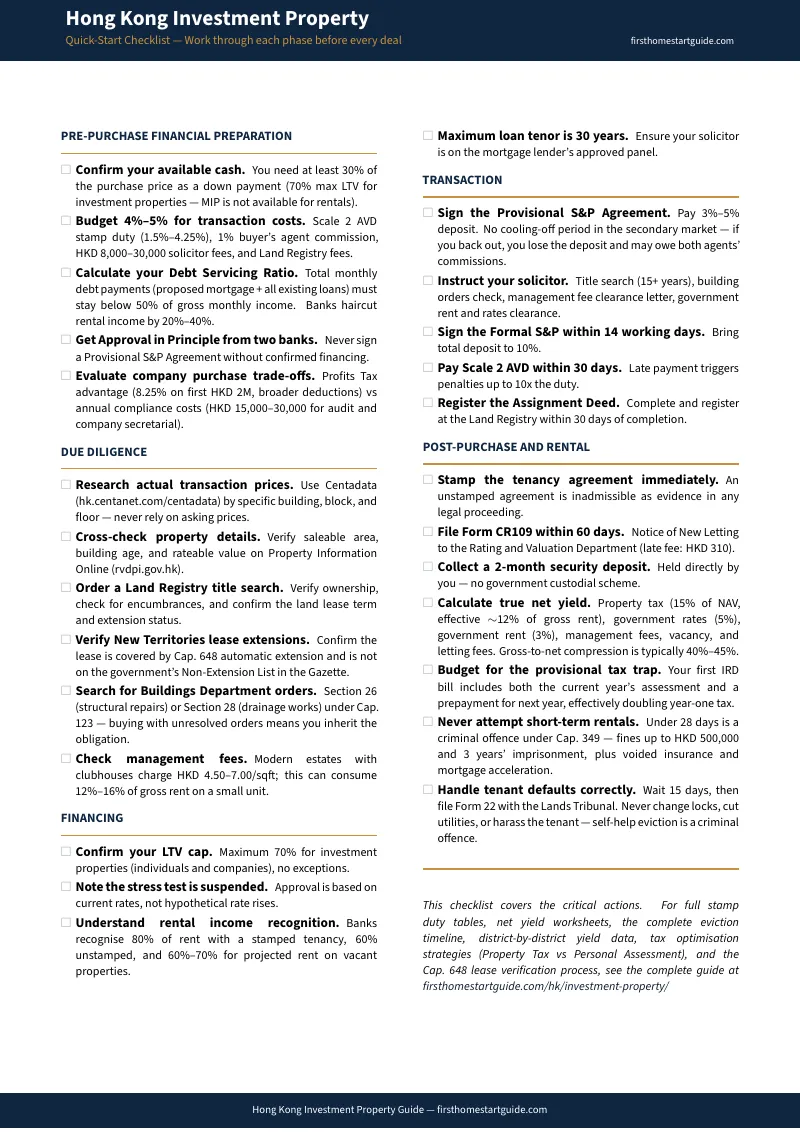
Download the Hong Kong Investment Property Quick-Start Checklist free -- a step-by-step verification list covering stamp duty calculations, LTV and DSR checks, legal due diligence, lease verification, tenancy registration, and net yield validation. Print it and bring it to every property viewing.
Or get the full guide -- 13 chapters of stamp duty mechanics, financing frameworks, property tax optimisation, short-term rental law, Cap. 648 lease extensions, eviction procedures, and district yield analysis -- all for .