
You Modelled 6% Gross Yield on a Two-Bed in Galway. But You Didn't Know That Revenue Takes 52.35% of Every Euro of Profit, That Evicting a Non-Paying Tenant Takes 19 Weeks Through the RTB, or That the Nationwide 2% Rent Cap Means Your Revenue Growth Will Never Keep Pace With Your Costs.
You found a two-bedroom apartment in Salthill projecting 7.7% gross yield. Or a three-bed terraced house in Limerick where the agent's brochure promises 8.4% returns. Or an ex-council house in Dublin's commuter belt where the BRRRR maths look solid at a 5.8% cap rate. You talked to your mortgage broker. You lined up the 30% deposit. You're ready to make an offer.
Then Ireland happens. Your accountant runs the numbers and reveals that your EUR 20,000 rental profit generates EUR 10,470 in combined Income Tax, USC, and PRSI -- leaving you EUR 9,470 after the RPRIR credit. You close on the Galway apartment and a tenant stops paying rent. You file with the RTB, where adjudication takes an average of 17 to 19 weeks -- during which you receive no rent but must continue servicing your buy-to-let mortgage at 5.3%. You claim the EUR 1,000 RPRIR tax credit to soften the blow, then sell the property two years later and Revenue claws back every cent of relief you ever claimed under the four-year retention rule. And when you try to raise the rent to cover your rising insurance and management costs, you discover the nationwide Rent Pressure Zone cap limits you to 2% per annum -- while your operating costs are inflating at 5% or more.
Here is what no single free resource explains: Ireland layers a 52.35% marginal tax rate on every euro of rental profit against a nationwide 2% rent cap that structurally compresses your margins every year against RTB dispute timelines of 7 to 19 weeks where you receive zero income but must service your mortgage against March 2026 Tenancy of Minimum Duration reforms that give tenants a six-year statutory right to stay and strip landlords with four or more properties of the right to evict for sale or family use against a December 2026 Failte Ireland short-term letting registry that effectively blocks the Airbnb escape route against Central Bank rules demanding 30% deposits and BTL interest rates of 3.75% to 7.55% against a Capital Gains Tax rate of 33% with no indexation relief for properties acquired after 2002. Each of these has cost real Irish investors tens of thousands because the information existed -- scattered across Revenue.ie, RTB.ie, Reddit r/IrishPersonalFinance, mortgage broker brochures, and EUR 300-per-hour accountant consultations -- but nobody had assembled it into a single investment framework calibrated to how Ireland actually works in 2026.
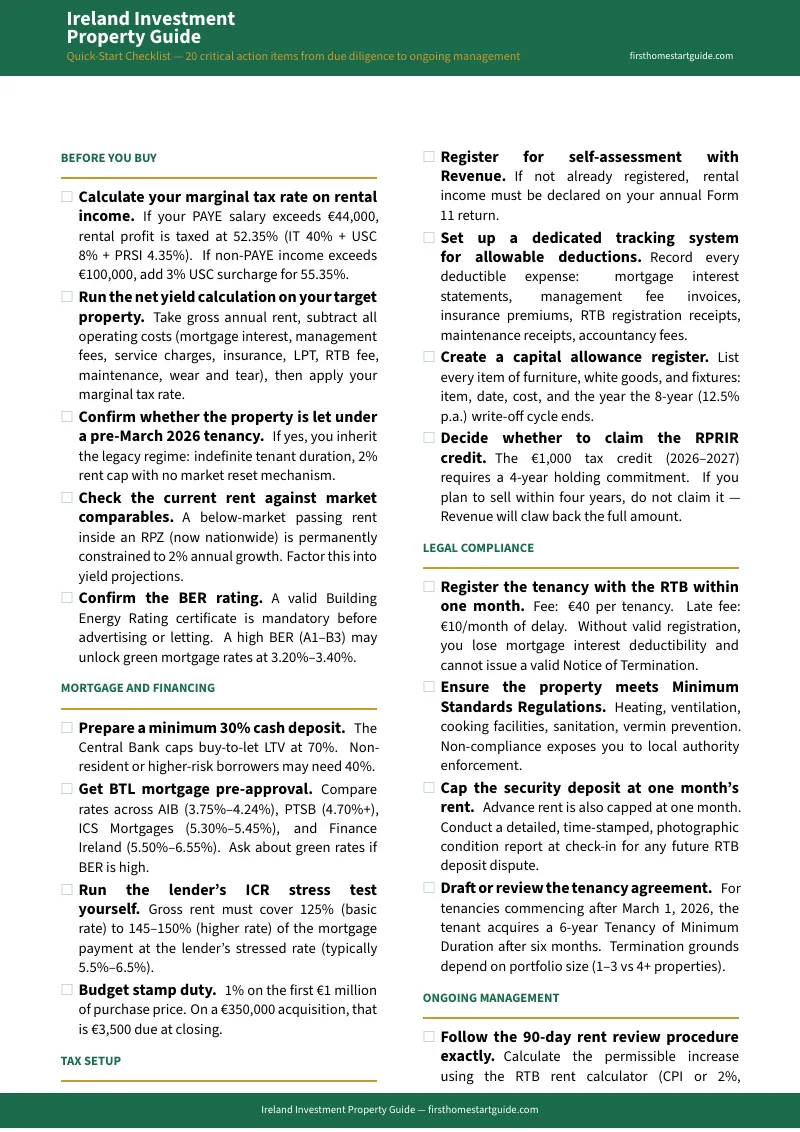
The Ireland Investment Property Guide is a Case V Financial Defence System -- not a motivational overview of Irish property, but a structured reference that maps every Irish-specific tax mechanism, regulatory constraint, ownership structure, and regional market into a process you work through before your deposit is committed. It replaces months of cross-referencing Revenue.ie technical notes, RTB procedural guides, Central Bank macro-prudential rules, and r/IrishPersonalFinance threads with a single guide that tells you exactly what the numbers should look like, exactly what to verify, and exactly where Irish property deals go wrong.
What's Inside the Case V Financial Defence System
A comprehensive guide, a quick-start checklist, and 3 standalone printable worksheets -- covering every stage from initial viability assessment through capital gains disposal, built specifically for the taxation, regulations, and market dynamics that make Ireland one of Europe's most hostile environments for private landlords:
The 52.35% Tax Stack -- Worked Examples, Not Theory
Revenue taxes rental income under Case V of Schedule D, and it is not ring-fenced -- it sits on top of your PAYE salary and is taxed at your highest marginal rate. The guide breaks down how 40% Income Tax, 8% USC, and 4.35% PRSI (from October 2026) combine into the 52.35% marginal rate that applies to every higher-rate taxpayer. It includes a full worked example showing how an investor on an EUR 80,000 salary retains just EUR 10,530 from EUR 20,000 of rental profit after tax -- and the gross-to-net waterfall showing how EUR 24,000 in gross rent becomes EUR 6,718 in your pocket after deductions and the three-layer tax stack. If your non-PAYE income exceeds EUR 100,000, the 3% USC surcharge pushes the effective rate to 55.35%.
Every Allowable Case V Deduction
You cannot control the 52.35% rate. What you can control is the quantum of taxable profit. The guide provides the complete checklist of deductions under Section 97(2) of the Taxes Consolidation Act 1997: 100% mortgage interest deductibility (conditional on RTB registration -- let it lapse and you lose your single largest deduction), capital allowances at 12.5% straight-line over eight years for furniture and white goods, management fees, insurance premiums, RTB registration fees, advertising, accountancy costs, and ground rent. It covers what is explicitly not deductible -- Local Property Tax, your own labour, capital principal repayments, and the critical distinction between repairs (deductible) and improvements (capital expenditure). It details the EUR 10,000 pre-letting expense cap under Section 97A for properties vacant six months or more, extended through December 2027 -- a provision most investors either miss entirely or misapply.
The RPRIR Credit and the 4-Year Clawback Trap
The Residential Premises Rental Income Relief provides a non-refundable tax credit against Income Tax only -- not USC, not PRSI. For 2026 and 2027, the maximum credit is EUR 1,000 (20% of Case V profit up to EUR 5,000). The guide explains how to claim it correctly and, more importantly, when not to claim it. If you sell, cease letting, transfer ownership, or change use within four years of first claiming the relief, Revenue claws back every cent from every prior year. The lost EUR 1,000 per year becomes a liability plus interest. For investors considering a sale within three years, the guide demonstrates why skipping the credit preserves future flexibility at minimal cost.
RPZ Mechanics -- The Nationwide 2% Rent Cap
As of March 2026, Rent Pressure Zones apply to every private residential tenancy in Ireland. Annual rent increases are capped at CPI or 2%, whichever is lower. The guide covers the full procedural chain: using the RTB's specific rent calculator, issuing a formal 90-day written notice, and simultaneously notifying the RTB on the same day (failure invalidates the notice with no cure -- you restart the 90-day clock). It maps the narrow exemptions that allow a market-rate reset: new-build apartments with a commencement notice on or after June 10, 2025; properties vacant and unlet for 24 continuous months; and properties where renovations improved the BER by seven full levels. It explains the compounding margin squeeze -- your revenue capped at 2% while insurance, maintenance labour, and variable mortgage rates rise unconstrained -- and how to model cash flows under the cap assumption before committing capital.
RTB Compliance and Dispute Timelines
The guide covers the full operational framework: annual registration at EUR 40 per tenancy (late fees compound at EUR 10 per month), security deposit rules (capped at one month's rent, no centralised protection scheme as of 2026), minimum property standards under the Housing Regulations, and the statutory rent arrears eviction sequence -- 28-day warning notice to tenant and RTB, 28-day waiting period, formal notice of termination. When a tenant contests, you enter RTB dispute resolution: mediation averages 7 weeks, tribunal 15 weeks, adjudication 17 to 19 weeks. If the tenant ignores the Determination Order, you enforce through the District Court -- adding further months. The guide instructs you to budget for 6 to 18 months of zero income during any contested eviction, and to model that carrying cost into your cash flow projections as a core operational risk.
March 2026 TMD Reforms -- The Biggest Change in Two Decades
The Residential Tenancies (Miscellaneous Provisions) Act 2026 replaced indefinite Part 4 security of tenure with six-year Tenancies of Minimum Duration. The guide covers the new framework: landlords can terminate without reason during the first six months (with 90 days' notice to tenant and RTB), but after six months the tenant acquires an absolute right to remain for the full six-year cycle. Notice periods escalate from 152 days (6-12 months of tenancy) to 224 days (8+ years). Landlords with four or more properties can only terminate for tenant breach or property unsuitability -- no eviction for sale, family use, or refurbishment. The critical commercial feature: at the end of each six-year TMD cycle, landlords can reset rent to the current open market rate, escaping the 2% RPZ cap entirely. The guide covers how this reset works, what happens with pre-March 2026 tenancies (legacy rules, no reset, 2% cap until the tenant leaves), and why checking when a tenancy commenced is essential before purchasing any tenanted property.
BTL Mortgage Rates and the 30% Deposit Reality
The Central Bank caps buy-to-let LTV at 70% -- a 30% deposit is non-negotiable. The guide provides current rate comparisons across every active BTL lender: AIB (3.75% to 4.24% variable, 3.10% to 4.19% fixed), PTSB (4.70% to 5.85%), ICS Mortgages (5.30% to 5.45%), Finance Ireland (5.50% to 6.55%), and EBS (up to 7.55% on specialist terms). It covers green mortgage discounts of 3.20% to 3.40% for high-BER properties, the Interest Coverage Ratio stress test (125% to 150% of stressed mortgage payment at 5.5% to 6.5%), top slicing mechanics for investors whose personal income can bridge the ICR gap, and age-related term constraints that compress cash flow for investors purchasing at 50 or older.
Stamp Duty Tiers and the 15% Bulk Surcharge
Residential stamp duty operates on a tiered basis: 1% on the first EUR 1 million, 2% on EUR 1 million to EUR 1.5 million, and 6% above EUR 1.5 million. For the typical investor purchasing in the EUR 200,000 to EUR 600,000 range, the rate is a straightforward 1%. The guide covers the retroactive 15% bulk purchase surcharge under Section 31E -- triggered when 10 or more residential houses are acquired within a rolling 12-month period -- and the apartment block exemption that shields multi-storey acquisitions. It explains commercial property stamp duty at 7.5% for value-add residential conversion strategies.
Capital Gains Tax at 33% -- Worked Calculation
The guide walks through a complete disposal calculation: gross sale price less disposal costs, acquisition cost, stamp duty and legal fees at purchase, qualifying enhancement expenditure, and the EUR 1,270 annual personal exemption. It covers Principal Private Residence relief apportionment for investors who originally purchased as owner-occupiers, the abolition of indexation relief for properties acquired after 2002, and the non-standard payment schedule -- CGT on disposals between January and November is due December 15, not at year-end. Missing the payment deadline triggers interest and surcharges before the CG1 return is even filed.
Personal Name vs SPV vs Pension -- Side-by-Side
The guide provides a detailed comparison table across seven factors: tax on rental profit (52.35% personal vs 25% corporate vs 0% in a pension), close company surcharge (the hidden 20% levy on undistributed SPV income after 18 months that can push the effective corporate rate to 40%), extraction tax on dividends and salary, mortgage interest deductibility, CGT treatment, inheritance mechanics, and RPRIR eligibility. It explains when an SPV works (4+ properties, profits reinvested, no cash extraction for personal use), when personal ownership is optimal (1 to 3 properties, income-focused), and when the pension route is viable (large mature SSAP/ARF, outright purchase required due to the IORP II borrowing ban, strict arm's length rules prohibiting personal use or connected-party transactions). The message throughout: choosing the wrong structure costs tens of thousands -- get specialist tax advice before committing.
Regional Yield Comparison
Data-driven profiles of Dublin (EUR 2,828 average rent, 6.8% one-bed yield, highest capital security but lowest percentage returns), Galway (EUR 2,309, 7.7% one-bed yield, constrained supply, tech and student demand), Cork (EUR 2,103, growing regional hub), Limerick (EUR 1,900, best gross yields at 8.4% for one-beds, lower capital appreciation), and Waterford (EUR 1,490, smaller market). The guide includes a side-by-side net return comparison showing how a Limerick three-bed house delivers 32% more net cash flow than a Dublin one-bed apartment on identical capital -- primarily because it avoids EUR 2,500 in annual service charges. It covers the gross-to-net compression: a 7.0% gross yield in Galway compresses to approximately 2.5% to 3.5% true net yield after management fees, LPT, insurance, maintenance, and the 52.35% tax stack.
Airbnb and Short-Term Letting Restrictions
The guide covers why the short-term letting escape route is effectively blocked for investment properties. Since RPZs now cover the entire country, using a dedicated investment property for short-term letting requires change-of-use planning permission from the local authority -- and Dublin, Cork, and Galway routinely deny these applications. The national Failte Ireland short-term letting register opens December 1, 2026, with mandatory registration by December 31, 2026. The guide explains the tax classification distinction between Case I (trading income) and Case IV (miscellaneous income), the DAC7 directive requiring platforms to report host income directly to Revenue, and why acquiring property with the assumption that you can "just put it on Airbnb" is a strategy that no longer exists in urban Ireland.
Common Investment Mistakes
Ten specific traps that cost real Irish investors real money: underestimating the effective tax rate by ignoring USC and PRSI; purchasing a property with a historically low passing rent inside an RPZ with no market reset mechanism; the Airbnb planning permission trap; assuming eviction for non-payment is swift; service charge erosion on Dublin city centre apartments; failing to register with the RTB (a EUR 40 fee that protects thousands in mortgage interest deductions); claiming RPRIR without understanding the four-year clawback; choosing the wrong ownership structure; buying based on gross yield alone; and purchasing a tenanted property without checking whether the tenancy pre-dates March 2026.
Who This Guide Is For
This guide is for property investors targeting Irish residential rental property who:
- Are earning EUR 60,000 or more and need to understand exactly how the 52.35% marginal tax stack erodes their rental profit -- including every allowable deduction under Section 97(2) that reduces the taxable quantum
- Need to model cash flows under the nationwide 2% RPZ rent cap and determine whether their target property generates a viable post-tax return when revenue growth is permanently constrained
- Are evaluating whether to hold property in their personal name, a limited company (SPV), or a pension fund -- and need the side-by-side comparison that shows when each structure saves money and when it costs more than it saves
- Want to understand the March 2026 TMD reforms before purchasing a tenanted property -- including the six-year minimum duration, the restricted termination grounds for larger landlords, and the market rent reset mechanism that only applies to post-March 2026 tenancies
- Are comparing regional markets and need data-driven yield comparisons that account for service charges, LPT, management fees, and the 52.35% tax stack -- not just gross yield percentages from estate agent brochures
- Previously considered short-term letting as a strategy to bypass RPZ rent caps and need to understand why the December 2026 Failte Ireland registry and planning permission requirements make this route impractical for investment properties in urban centres
- Want every Ireland-specific tax rate, regulatory deadline, RTB procedure, and financing constraint in one reference -- instead of assembling it from Revenue.ie technical notes, RTB procedural guides, Central Bank rules, and r/IrishPersonalFinance threads from landlords who already made the expensive mistakes
Why Not Free Tools and Forums?
Free information on Irish property investment exists. Here is what it actually delivers:
- Revenue.ie publishes comprehensive, legally accurate guidance on Case V taxation, allowable deductions, the RPRIR credit, and CGT calculations. It is written in dense statutory language designed to enforce compliance, not to provide strategic financial advice. Revenue will tell you the mechanics of the four-year RPRIR clawback, but it will not advise you on whether it makes mathematical sense to claim the credit if you plan to sell in three years. You get the rules without the strategy.
- RTB.ie outlines the 90-day rent review notice procedure, the dispute resolution process, and the grounds for termination. It does not explain how to financially model the 19-week adjudication timeline into your cash reserves, does not quantify the carrying cost of a contested eviction, and does not walk you through which TMD termination grounds are available based on your portfolio size. You get the procedure without the financial impact analysis.
- Reddit r/IrishPersonalFinance contains genuine operational frustration -- landlords posting about the 52.35% marginal rate shock, RTB dispute nightmares, tenants who stopped paying, and the margin squeeze from 2% rent caps against rising costs. The experiences are real, but the advice is fragmented, frequently legally inaccurate, and heavily biased by personal grievance. Sorting current 2026 law from pre-reform advice takes longer than reading a guide that has already done it.
- Mortgage broker and estate agent guides highlight Ireland's supply shortage and strong rental demand. They rarely quantify the 52.35% tax burden, do not model the RPZ margin squeeze, and never explain why a below-market passing rent inherited from a pre-March 2026 tenancy permanently depresses both your yield and the property's resale value. The content is designed to generate buyer leads, not to identify reasons to adjust your underwriting.
- Accountants and tax advisors provide bespoke, highly accurate financial structuring advice at EUR 150 to EUR 300 per hour. An accountant advises on tax frameworks but rarely covers RTB dispute timelines, BTL mortgage rate comparisons, regional yield analysis, or the operational mechanics of the March 2026 TMD reforms. For an investor at the research stage, paying EUR 900 for three hours of advice before knowing whether the investment is even viable is capital deployed against the wrong problem.
This guide fills the Ireland-specific gap -- the space between knowing how to invest in property generally and knowing how to invest in a country where rental profit is taxed at 52.35%, rent increases are capped at 2%, tenants acquire a six-year statutory right to stay after six months, eviction disputes average 19 weeks, short-term letting is effectively blocked, and every refinance requires a 30% deposit. It is the analysis that would take an Irish tax advisor, an RTB compliance specialist, and a property finance broker to assemble -- structured as a reference you own permanently.
-- Less Than One Hour of an Irish Tax Advisor
An Irish tax advisor charges EUR 150 to EUR 300 per hour. A single accountant consultation to review your Case V position costs EUR 450 to EUR 900. Discovering the four-year RPRIR clawback after selling a property turns every year's EUR 1,000 credit into a liability plus interest. Failing to register with the RTB -- a EUR 40 annual fee -- costs you the mortgage interest deduction worth thousands. Purchasing a property with a pre-March 2026 tenancy and a below-market passing rent locks you into the 2% RPZ cap permanently with no market reset mechanism. A contested eviction through RTB adjudication at 19 weeks costs 5 months of mortgage payments, insurance, and LPT with zero rental income.
This guide does not replace your tax advisor or your solicitor. But it gives you the Case V tax calculation framework, every allowable deduction under Section 97(2), the RPRIR clawback analysis, the RPZ procedural requirements, the RTB dispute timeline model, the March 2026 TMD rules, the BTL financing comparison, the stamp duty and CGT calculations, the personal-name-vs-SPV-vs-pension framework, and the regional yield data that ensure you identify every Ireland-specific risk before your deposit is committed -- instead of discovering them on your first tax return, your first RTB filing, or your first rent review.
If it prevents a single RPRIR clawback, catches a single pre-March 2026 tenancy with no market reset, or shows you that the gross yield your broker quoted compresses to 2.8% after the 52.35% tax stack, it pays for itself before you have finished reading it.
Money-back guarantee, no time limit. If the guide does not sharpen your underwriting and protect your investment in Ireland's unique tax and regulatory environment, you pay nothing.
Download the free Ireland Quick-Start Home Buying Checklist to see the action plan covering pre-purchase research, due diligence, and post-purchase compliance. When you are ready for the full Case V tax analysis, RPZ strategy, TMD reform framework, and regional market data, the complete guide is here.
The deal pencils out on the spreadsheet. This guide tells you whether Revenue, the RTB, and the 2% cap agree.