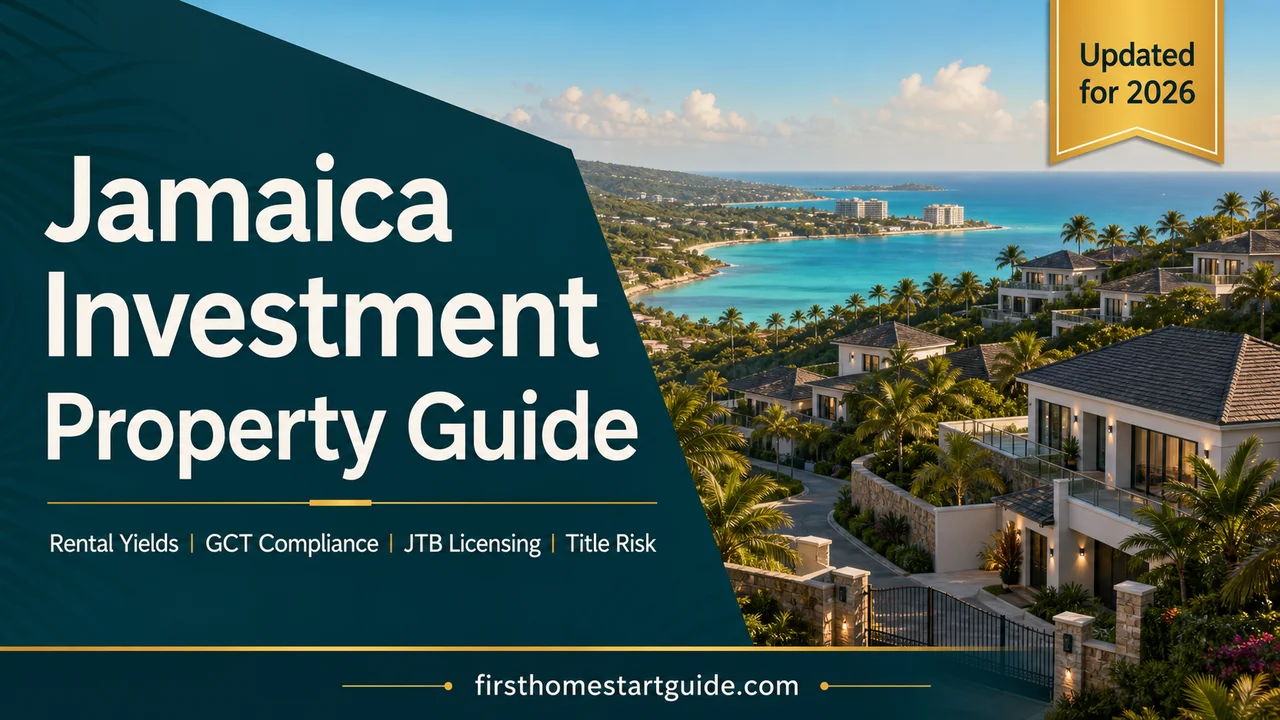
You Found a Villa in Montego Bay. You Cannot Calculate Whether It Will Actually Make Money After GCT, Management Fees, and the Licensing Process Nobody Warned You About.
You have seen the Airbnb listings. You know a two-bedroom in Drax Hall pulls USD $296 per night. You may have read the Jamaica Observer article about the government applying GCT to short-term rentals starting April 2027 — a 15% tax that did not exist before — and wondered what that does to the margins everyone is quoting. Or you heard about the investor who purchased a beachfront property in Negril, listed it on Airbnb within a week, and received a TPDCo enforcement notice because they did not know that every vacation rental in Jamaica requires a commercial license from the Jamaica Tourist Board — a process involving fire brigade inspections, police records, public health certificates, and parish council approval that takes months to complete.
The problem is not a lack of data. AirDNA publishes occupancy rates. JAMPRO publishes investment brochures. TAJ publishes tax brackets. But no single resource explains how the new 15% GCT on short-term rentals interacts with your income tax obligations and what you can actually deduct, why a property with a Common Law Title instead of a Registered Title can void your entire purchase when the bank refuses to finance it, how the difference between a co-hosting arrangement at 10% and full management at 25% changes your net yield by more than the fee itself, or why Kingston corporate rentals earning J$868,000 per month with 36% occupancy might outperform a Montego Bay villa earning USD $1,620 per month at 34% occupancy once you account for seasonality and management overhead.
The Jamaica Investment Property Guide is a Jamaica Rental Yield and Compliance System — a single reference that maps every tax obligation, licensing requirement, geographic yield reality, title risk, and management cost structure into a step-by-step process you work through before you commit capital. It replaces weeks of cross-referencing government portals, real estate forums, and scattered news articles with a reference that tells you exactly what your net yield looks like after every cost, exactly what compliance steps you must complete before your first guest arrives, and exactly where Jamaica-specific transactions fall apart for investors who skip the due diligence.
What's Inside the Jamaica Rental Yield and Compliance System
A comprehensive 14-chapter guide, a quick-start checklist, and 7 standalone printable worksheets — covering every stage from choosing your investment model through to collecting your first rental income, built specifically for the taxation rules, licensing requirements, and yield dynamics that make investing in Jamaica different from anywhere else in the Caribbean:
Regional Yield Analysis — Kingston vs. Montego Bay vs. Ocho Rios vs. Negril
Average gross yields of 5% to 8% mean nothing without geographic context. Kingston maintains 1,610 active listings with the highest consistent occupancy on the island at 36% — driven by corporate expatriates and diplomats, not seasonal tourism. Montego Bay's 930 listings command a USD $223 average daily rate. Drax Hall in St. Ann generates a staggering USD $296 ADR from purpose-built gated communities. The guide provides parish-by-parish yield data — active listings, average daily rates, monthly revenues, occupancy rates, and top-tier performer benchmarks — so you allocate capital to the corridor that matches your risk tolerance, not the one with the best marketing.
The GCT Shock — What the 2027 Tax Change Actually Means for Your Net Yield
Effective April 1, 2027, every short-term rental operator in Jamaica generating above J$15 million in gross revenue must register for GCT, collect 15% from guests, and remit monthly to TAJ. The tourism GCT rate simultaneously rises from the legacy 10% to the standard 15%. This is not theoretical — the legislation passed in the House of Representatives in April 2026. The guide breaks down the registration threshold, collection mechanics, input tax credit eligibility, and the specific deductions that offset GCT impact — so you model your net yield under the new regime, not the old one that no longer applies.
Income Tax — What You Owe and What You Can Legally Deduct
Net rental income is taxed at 25% up to J$6 million, then 30% above that threshold. Individual residents get a J$1.5 million tax-free threshold. Corporate entities face a flat 25%. The guide maps every allowable deduction — mortgage interest, insurance premiums, property management fees, platform commissions, utilities, structural repairs, and capital allowances on improvements — because investors who do not claim these deductions artificially inflate their tax burden by tens of thousands of dollars annually.
JTB/TPDCo Vacation Rental Licensing — The Compliance Roadmap
Operating a short-term rental in Jamaica without a JTB license exposes you to forced closure, financial penalties, and disqualification from GCT input tax credits. The licensing process requires fire safety certification from the Jamaica Fire Brigade, a public health certificate from the Ministry of Health, a police record for the operator, up-to-date property tax receipts, public liability insurance, and a TPDCo inspection. The guide provides the full documentary checklist, inspection preparation requirements, timeline expectations, and the exact sequence for remote operators who cannot attend inspections in person.
Registered Title vs. Common Law Title — The Risk That Can Void Your Purchase
Jamaica's land registration system operates two parallel frameworks. A Registered Title is a state-guaranteed Certificate of Title — indefeasible, with all encumbrances noted on the face of the document. A Common Law Title is a Deed of Conveyance that provides no state guarantee. A single missing deed in the historical chain can invalidate the seller's right to sell. Converting a Common Law Title to a Registered Title at the National Land Agency costs J$400,000 to 3% of property value in attorney fees alone, takes 6 to 18 months, and requires surveyor diagrams, statutory declarations, and public advertisement against objections. The guide explains what to verify, what to reject, and how to budget for conversion if the property justifies the risk.
Property Management — Co-Hosting vs. Full Management vs. Premium
A 20% management fee sounds expensive until you calculate what it buys. Professional managers using dynamic pricing and maintaining high review scores routinely increase gross bookings by 30% to 50% — more than offsetting their fee while eliminating the operational impossibility of managing guest turnovers from Toronto, London, or New York. The guide maps three management tiers (co-hosting at 10-15%, full management at 15-25%, premium at 20-30%), what each tier includes, how to vet managers in your specific parish, and the contract terms that protect absentee owners from maintenance fraud and revenue underreporting.
The Diaspora Playbook — Buying and Managing Property Remotely
Diaspora investors face specific friction: remote documentation, power-of-attorney requirements, foreign-currency mortgage structures, contractor trust, and cross-border tax obligations. The guide covers the entire remote investment process — from engaging a local attorney and vetting property managers to structuring your holding entity and managing currency risk between USD income and JMD expenses.
Financing — Domestic and Foreign Options
Domestic mortgage rates range from 5.5% to 8.5% in JMD and 4% to 7% in USD. Non-resident borrowers face stricter loan-to-value ratios — typically 60% to 70% maximum. The guide covers JN Bank, VM Building Society, and commercial bank products, plus the mechanics of all-cash transactions, international financing, and the critical rule of matching your debt currency to your income currency to avoid exchange rate margin compression.
Transaction Costs — The Cash You Need Beyond the Purchase Price
Total closing costs average 3% to 4% for cash transactions and 9% to 12% for financed purchases. The guide itemises every cost: the 2% Transfer Tax (paid by the seller), the flat J$5,000 stamp duty, the 0.5% NLA registration fee, attorney fees at 2% to 4% plus GCT, valuation reports, surveyor's identification reports, and lender processing fees. For a USD $300,000 investment property, buyer closing costs can exceed $10,000 in cash above the deposit.
Capital Repatriation and Exit Strategy
Jamaica has no capital gains tax on property dispositions — but it has a 2% Transfer Tax, real estate agent commissions of 5%, and attorney fees on both sides. The guide covers the full exit cost structure, capital repatriation procedures through BOJ-authorized dealers, and the critical distinction between investment sales and business activity that determines whether TAJ treats your profit as tax-free appreciation or taxable trading income.
Long-Term Rentals and the Rent Restriction Act
Not every investment property is a vacation rental. Kingston corporate rentals offer stable, year-round JMD yields without tourism seasonality or JTB licensing requirements. But long-term landlords face a different regulatory framework — the Rent Restriction Act, security of tenure provisions, and the Rent Assessment Board. The guide covers the rent-setting rules, tenant rights, eviction procedures, and the practical differences between corporate and residential tenancies that determine whether long-term leasing fits your investment model.
Standalone Printable Worksheets
Seven standalone PDFs you print and use at each stage of your investment — at your attorney's office, during management interviews, and at tax filing time:
- Regional Yield Reference Card — one-page parish-by-parish comparison of ADR, occupancy, revenue, and top-performer benchmarks
- Closing Cost Calculator — fillable worksheet for calculating total buyer costs at any purchase price, cash and financed
- Title Verification Checklist — Registered Title verification steps, Common Law red flags, and First Registration cost estimator
- Tax Deduction Tracker — annual fillable worksheet tracking every allowable deduction against gross rental income, with the tax calculation built in
- JTB/TPDCo Licensing Checklist — every documentary and inspection requirement tracked from business registration through final approval
- Property Management Scorecard — side-by-side comparison matrix for evaluating management companies against the vetting criteria
- 90-Day Action Plan — dated timeline tracker from Day 1 through your first booking, with target dates and key contacts
Who This Guide Is For
- Diaspora Jamaicans in the US, Canada, or UK who want to invest in property back home but cannot navigate the JTB licensing process, property management selection, or title verification from overseas — and who need a framework for vetting contractors and managers they cannot supervise in person
- Foreign investors attracted by Jamaica's USD-denominated rental market who need to understand the full compliance stack — GCT registration, JTB licensing, income tax obligations, and the difference between Registered and Common Law Titles — before committing capital
- Local Jamaican professionals and business owners seeking to diversify into rental income and needing clarity on whether Kingston corporate rentals or coastal vacation rentals better match their capital range, management capacity, and risk tolerance
- Anyone considering a short-term rental in Jamaica who needs to model their net yield after the 2027 GCT implementation, management fees, income tax, and the operational costs that marketing brochures never include
- Investors looking at properties with Common Law Titles who need to understand the financing restrictions, adverse possession risk, and the conversion process and costs before signing an Agreement for Sale
Why Not Free Resources?
Free information on investing in Jamaican real estate exists across government portals, news outlets, and social media groups. Here is what it actually delivers:
- JAMPRO investment guides provide macroeconomic overviews and general market health indicators. They do not explain how the 2027 GCT on short-term rentals changes your net yield calculations, what you can legally deduct from rental income, or how to navigate the JTB licensing process step by step. They are designed to attract foreign direct investment, not to help individual investors model returns.
- The Jamaica Observer and the Gleaner publish timely reporting on legislative changes like the GCT expansion. They report on events — they do not provide compliance roadmaps, deduction strategies, or financial models that show what the tax change means for a two-bedroom in Drax Hall versus a studio in Kingston.
- AirDNA and rental analytics platforms publish gross revenue figures. They do not account for the 15% GCT, the 20-25% management fee, the income tax on net rental proceeds, or the JTB licensing costs that turn a headline figure of USD $1,620 per month into a substantially different net number.
- Facebook groups and WhatsApp threads contain real investor experiences mixed with outdated information. A 2024 post about rental tax does not reflect the 2027 GCT legislation. Advice about management fees in Montego Bay does not apply to Kingston corporate rentals. Sorting current from outdated information takes longer than reading a guide that has already done it.
This guide fills the Jamaica-specific gap — the space between knowing you want to invest in Jamaican property and knowing how to calculate the actual net yield after every tax, fee, and compliance cost that marketing materials leave out.
— Less Than One Night's Management Fee
A single night's property management fee on a Montego Bay villa runs USD $45 to $75. Attorney fees for conveyancing cost 2% to 4% of the purchase price plus GCT. Operating without a JTB license exposes you to forced closure and penalties that dwarf any compliance cost. Purchasing a property with a Common Law Title that your bank will not accept as collateral can derail your entire investment. Failing to register for GCT before the April 2027 deadline exposes you to retroactive penalties on revenue you already collected.
This guide does not replace your attorney or your property manager. But it gives you the geographic yield comparisons, GCT compliance roadmap, income tax deduction framework, JTB licensing checklist, title risk assessment, and management cost analysis that ensure you model every cost and satisfy every regulatory requirement before you commit capital — not when the TPDCo inspection notice arrives, the bank rejects your title, or TAJ sends an assessment for GCT you did not collect.
If it saves you from a single licensing violation, a single title risk, or a single year of unclaimed tax deductions, it pays for itself before you finish reading it.
Money-back guarantee, no time limit. If the guide does not sharpen your investment due diligence and protect your capital in Jamaica's property market, you pay nothing.
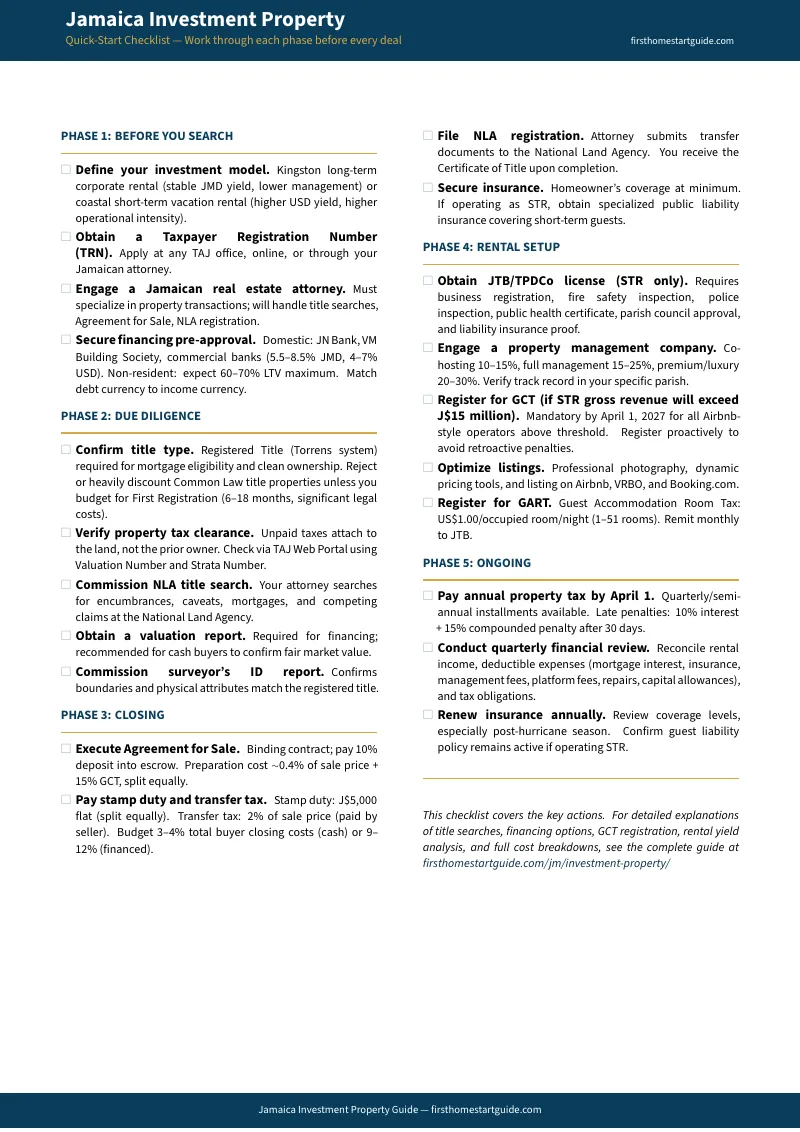
Download the free Jamaica Quick-Start Home Buying Checklist to see the step-by-step framework covering pre-search planning, due diligence, closing, rental setup, and ongoing operations. When you are ready for the full yield analysis, GCT compliance roadmap, licensing checklist, and management cost framework, the complete guide is here.
Jamaica's rental market rewards investors who do the compliance work. This guide makes sure you do it right the first time.
Frequently Asked Questions
What if the rules change after I buy?
We update the guide when the rules change. Email us any time, even years later, and we'll send you the current edition free.