
You Can Buy a Warsaw Apartment in Three Weeks. The Same Apartment in Gdansk Takes a Government Permit and Ten Months.
You've found a bright two-bedroom in Mokotow, a renovated flat near Krakow's Kazimierz, or a modern development overlooking the Odra in Wroclaw. You've done the mental currency conversion, confirmed the price-per-square-metre looks remarkably reasonable compared to London or Berlin, and started imagining the life beyond the rental treadmill that's been eating PLN 4,000 a month for the past three years. Then you learn that the flat listed as "full ownership" is actually a cooperative proprietary right — a legacy of the communist era that means the housing cooperative owns the building and you own a usage right that may not have a land register, can't be mortgaged, and sits on land with an unregulated legal status. The deposit you're about to pay isn't a refundable advance — it's an earnest money payment under Article 394 of the Civil Code that you forfeit entirely if you pull out, while the seller pays you double if they back out. And the property your agent describes as "no permit needed" triggers a full Ministry of the Interior permit application because there's a parking space on a separate plot bundled into the sale — one fractional land share that flips the entire legal framework.
You search online for help. ATL Law publishes a clean overview of the MSWiA permit rules that covers the basics in five paragraphs — written by an international law firm that charges PLN 200-500 per hour for the consultation they want you to book. FindingPoland runs an "Advice Guide" on buying as a foreigner that stops precisely where the complexity begins: no mention of border zones, cooperative ownership traps, the zadatek-versus-zaliczka deposit distinction, or the first-time buyer PCC exemption. MortgageBlog.pl explains mortgage eligibility clearly but doesn't tell you that earning USD, EUR, or GBP locks you out of PLN financing entirely. Reddit's r/poland threads contain real experiences from real buyers — alongside confidently stated advice that conflates EU and non-EU rules, recommends against buying because "the housing market is shit enough without foreigners," and cites the defunct Bezpieczny Kredyt 2% program as current information.
Here's the problem no free resource solves: Poland's property system runs on a 1920 statute that creates invisible geographic tripwires, a dual ownership framework where one type looks like ownership but structurally isn't, a deposit mechanism that can cost you tens of thousands of zloty if you sign the wrong word, a government permit process that takes six to ten months and costs PLN 1,570 just to apply, and a currency matching law that eliminates mortgage access for anyone earning in a foreign currency. The system has genuine protections — the Developer Guarantee Fund, the first-time buyer PCC exemption, negotiable notary fees, the five-year capital gains elimination — but only if you know they exist, understand when they apply, and activate them before you sign. Miss one, and you pay the price a Polish buyer never would.
The Buying Property in Poland — Expat Guide is The Foreign Buyer's Compliance System. Not a lifestyle blog about cheap Warsaw apartments. It's a structured decision framework that decodes every stage of the Polish property purchase — from Ksiega Wieczysta verification through the MSWiA permit, cooperative ownership analysis, the preliminary agreement, and the final notarial deed — so you make each decision understanding the legal mechanism behind it, the statute that governs it, and the financial consequence of getting it wrong.
What's Inside The Foreign Buyer's Compliance System
The complete guide, a standalone printable checklist, and 7 printable tools — covering every stage from determining your permit status through key collection, with the Polish legal terms, statutory references, tax rates, and deadlines that determine whether your transaction succeeds or collapses. Includes standalone worksheets and reference cards you can bring to viewings, notary appointments, and bank consultations:
MSWiA Permit Decoder and Border Zone Map
The single most dangerous trap for non-EU buyers in Poland. The apartment exemption that lets Americans, British, and other non-EU citizens buy residential apartments without a government permit is completely voided if the property falls inside a designated border zone — and those zones include the entire Tri-City agglomeration (Gdansk, Sopot, Gdynia) and Szczecin. A US tech worker can buy an apartment in Warsaw in three weeks. The exact same person buying the exact same type of apartment in Gdansk triggers a full MSWiA permit requiring proof of ties to Poland, Ministry of National Defense clearance, Internal Security Agency (ABW) vetting, PLN 1,570 in fees, and a realistic timeline of six to ten months. Without the permit, the notary will refuse to execute the deed, and any contract signed in violation is legally void. The guide maps which cities are inside the border zone, explains the Promesa (advance promise) shortcut that lets you complete security vetting before you find a property, and walks through the exact documentation package — residence card, KRS extract, cadastral map, ZUS certificate, proof of financial resources — so you don't lose a property to bureaucratic delay.
Cooperative Ownership Decoder
Poland has two fundamentally different apartment ownership types, and the wrong one can trap you in a cash-only purchase with no mortgage options and no ability to convert. Full ownership (odrebna wlasnosc) gives you a dedicated land register, a proportional land share, and unrestricted access to financing. Cooperative proprietary right (spoldzielcze wlasnosciowe prawo do lokalu, or SWPDL) is a communist-era relic where the housing cooperative owns the building and you own a transferable usage right. The structural risks are severe: many SWPDL apartments sit on land with an unregulated legal status, meaning no Ksiega Wieczysta can be established, no mortgage is possible, and resale liquidity plummets. Non-EU buyers in border zones can use SWPDL as a loophole to bypass the MSWiA permit — because it's classified as a limited real right, not real estate — but the loophole has three traps. A bundled parking space on a separate plot triggers the full permit requirement. Converting SWPDL to full ownership itself constitutes acquiring real estate, immediately invoking the permit. And unregulated land blocks conversion permanently regardless of permits. The guide explains how to identify which type you're buying, what questions to ask the agent, and when the SWPDL loophole is strategically viable versus when it's a structural prison.
Ksiega Wieczysta Verification System
The Land and Mortgage Register is the absolute foundation of property security in Poland — and Polish law places the burden of verification squarely on the buyer. There is no title insurance. The guide translates all four sections of the register: Dzial I-O (property description and area), Dzial I-Sp (associated rights and land shares), Dzial II (legal ownership — the name here must exactly match the seller), Dzial III (the danger section — easements, bailiff proceedings, life-tenancy rights that are nearly impossible to evict), and Dzial IV (mortgages and financial encumbrances). It explains how to navigate the Polish-language Ministry of Justice portal at ekw.ms.gov.pl, what a wzmianka (pending application warning) means and why it should halt your transaction, the Sunday morning maintenance downtime quirk, and how to use the register to defend against the most common property scam in Poland: fake listings where fraudsters impersonate owners to extract reservation deposits.
True Cost Calculator
Transaction costs in Poland typically range from 3% to 6% of the purchase price on the secondary market — and cannot be rolled into a standard mortgage. On a PLN 1,000,000 apartment, closing costs can reach PLN 54,000. The guide breaks down every line item: the 2% PCC tax on secondary market purchases (with the first-time buyer 0% exemption that saves PLN 10,000-20,000 and applies to foreigners, not just Polish citizens — but only if you proactively ensure the notary applies it), the 8% residential VAT on primary market purchases versus 23% on surplus area and commercial spaces, the statutory notary fee sliding scale (which is the maximum — fees are negotiable downward by 30-50%), the 23% VAT on agency commissions that agents never mention upfront, the PLN 400 KW registration fees, and the PLN 400-800 sworn translator requirement if you don't speak Polish. Worked examples for PLN 500,000 and PLN 1,000,000 properties show exactly what you need in cash beyond the purchase price.
Deposit Strategy — Zadatek vs. Zaliczka
The single word in your preliminary agreement that determines whether you lose your 10-20% deposit or double it if the deal collapses. Under zadatek (Article 394 of the Civil Code), if you default you forfeit the entire deposit; if the seller defaults, they pay you double. Under zaliczka, the money is simply refundable to both sides with no penalty mechanism. Most expats sign without knowing which one they've agreed to. The guide also explains the two forms of preliminary agreement — standard civil contract (you can only sue for damages if the seller backs out) versus notarial deed (you can force the sale through court) — and when the stronger form justifies the additional notary cost.
Foreign Buyer Mortgage Navigator
The currency matching law is the single rule that eliminates more foreign mortgage applicants than any other. Following the Swiss Franc mortgage crisis, Polish banking law mandates that a mortgage can only be issued in the currency of the borrower's primary income. If you earn GBP, USD, or EUR from a foreign employer, you cannot access a PLN mortgage — period. The guide covers the three ways around this (restructure to PLN income, buy with cash, or find the rare EUR-denominated product), the residency documentation requirements (EU registration certificate or Karta Pobytu with 6-12 months remaining validity), the PESEL requirement, why non-EU buyers face 30-40% down payment requirements versus 10-20% for domestic buyers, which banks have established track records with foreign applicants (PKO BP, Pekao, ING, mBank), and why a licensed mortgage broker costs you nothing and navigates the internal policy differences between banks.
Developer Protection Decoder
Poland's 2021 Developer Law provides some of the strongest new-build buyer protections in Europe. Your money flows through a housing trust escrow account — not to the developer directly — and the Developer Guarantee Fund (DFG) guarantees 100% of your funds if the developer goes bankrupt, the escrow bank fails, or the developer misses the contractual transfer deadline. The guide explains the difference between open and closed escrow accounts, the technical handover inspection process (hire your own building inspector — it costs a few hundred zloty and can identify defects you'd miss), the strict 14-day acknowledgment and 30-day repair deadlines, your right to hire third-party contractors and back-charge the developer if they miss deadlines, and the statutory withdrawal rights under Article 43 that let you exit the contract entirely and receive a full refund. These protections apply regardless of what the developer's contract says — any clause attempting to waive them is void.
Exit Strategy and Capital Gains Eliminator
Profit from selling property in Poland is subject to a 19% flat income tax — unless you know how to eliminate it. The five-year rule completely erases the liability if you sell after five full tax years from the end of the calendar year of purchase. If you need to sell earlier, the housing relief exemption (Ulga Mieszkaniowa) lets you avoid the 19% tax by reinvesting proceeds into a new residential property within three years — and the reinvestment doesn't have to be in Poland. EU, EEA, and Swiss residents can reinvest anywhere in the bloc: sell your Warsaw apartment, buy a house in Berlin, and pay zero capital gains. The guide includes the exact timeline calculations and documentation you need to preserve.
Who This Guide Is For
This guide is for foreign buyers and expats purchasing property in Poland who:
- Are buying their first Polish property and need the entire transaction mapped — from determining permit status through the preliminary agreement, Ksiega Wieczysta verification, and final notarial deed — so they understand what happens at each stage, what it costs, and what can go wrong
- Are EU or EEA citizens who enjoy full legal parity with Polish buyers but need the process decoded — notarial acts, ownership types, deposit mechanics, fee structures, and tax exemptions that work differently from their home countries
- Are American, British (post-Brexit), Australian, Indian, or any other non-EU nationality and need to know exactly when the MSWiA permit applies, how long it takes, and how the Promesa shortcut can save months of waiting
- Are targeting the Baltic coast (Gdansk, Sopot, Gdynia) or Szczecin and need to understand how the border zone regulation transforms an apartment purchase from a three-week process into a ten-month bureaucratic procedure
- Are considering a cooperative ownership apartment (SWPDL) and need to know whether it can be mortgaged, whether the land status is regulated, and whether the border zone loophole applies to their specific situation
- Are digital nomads or remote workers earning in USD, EUR, or GBP and need to understand why the currency matching law blocks their mortgage application and what their alternatives are
- Are returning Polish diaspora from the UK, Ireland, or Germany who hold Polish citizenship but haven't navigated the domestic property market in a decade and need the modern legal framework explained from scratch
- Want every transaction cost, every legal deadline, every ownership type, and every procedural requirement in one document — so they walk into notary appointments, bank consultations, and contract signings with the same structural understanding as a Polish buyer
Why Not Free Resources?
Free information on buying property in Poland as a foreigner exists. Here's what each source actually delivers:
- ATL Law and international firm blogs publish technically sound overviews of the MSWiA permit and foreign buyer rules in polished English — written and maintained by law firms that charge PLN 200-500 per hour for the consultation they want you to book. The articles cover the permit requirement in broad strokes. What they don't cover: border zone geography, the SWPDL loophole and its three traps, the zadatek-versus-zaliczka deposit distinction, or the first-time buyer PCC exemption. The information is accurate. The structural risks that cost buyers real money are systematically absent.
- FindingPoland and MortgageBlog.pl offer accessible English-language guides that walk you through the basics of buying as a foreigner and obtaining a mortgage. Both stop precisely where the complexity begins. FindingPoland's guide doesn't mention border zones, cooperative ownership risks, or the currency matching law. MortgageBlog.pl covers eligibility clearly but doesn't explain what happens when your income currency doesn't match the loan currency — the rule that disqualifies more expat applicants than any other. You get a confident overview designed to make the process seem manageable, not to prepare you for where it actually breaks down.
- Reddit and expat forums (r/poland, r/warsaw, Facebook groups, Internations) contain genuine experiences from foreign buyers — alongside advice that conflates EU and non-EU rules, recommends against buying with xenophobic hostility, confidently cites the cancelled Bezpieczny Kredyt 2% and Kredyt na Start programs as current policy, and fails to mention the Tri-City border zone trap. One thread has a poster who closed smoothly on a Warsaw apartment. Another has someone who discovered their "ownership" was a cooperative right on unregulated land with no mortgage options. Both stories are true. Neither tells you which outcome applies to your property.
- Government portals (Biznes.gov.pl, gov.pl/web/mswia-en) have improved significantly, offering translated MSWiA permit procedures. They are written in dense administrative prose, lack any practical context about market dynamics, scams, or negotiation, and provide zero strategic advice. They tell you the permit exists. They don't tell you that your Gdansk apartment triggers it, that your parking space voids the SWPDL loophole, or that the statutory timeline of two months is fiction.
This guide fills the structural gap — the space between knowing that Poland has a notarial system and understanding exactly how that system works at each stage, what the 1920 Act actually says about your nationality and your target city, what your ownership type means for your mortgage and resale options, and what happens to your deposit if you sign the wrong word. It's the analysis an independent advisor with no commission to earn would give you, structured as a permanent reference you own.
— Less Than One Hour of a Polish Lawyer's Consultation
An English-speaking Polish real estate lawyer charges PLN 200-500 per hour. The MSWiA permit application alone costs PLN 1,570. A real estate agent commission on a PLN 500,000 property runs PLN 15,000 including VAT. The PCC tax exemption you might not know you qualify for saves PLN 10,000-20,000. The closing costs you didn't budget for reach PLN 27,000-54,000.
This guide doesn't replace your notary or your lawyer. But it gives you the MSWiA permit decoder, the cooperative ownership analysis, the Ksiega Wieczysta verification system, the deposit strategy, the true cost calculator, and 7 standalone printable tools — an MSWiA permit document checklist, a Ksiega Wieczysta verification card, a closing cost calculator worksheet, a due diligence checklist, a deposit decision reference card, a city comparison card, and a developer handover checklist — that ensure you walk into every appointment, every viewing, and every contract signing understanding the mechanism behind each step, with the right reference sheet in hand.
If it prevents a single deposit forfeiture from the wrong deposit type, catches a single cooperative ownership trap before you commit to a cash-only purchase, identifies the first-time buyer PCC exemption that saves you PLN 10,000-20,000, or warns you about the border zone before you sign a void contract in Gdansk, it pays for itself before you've finished reading it.
Money-back guarantee, no time limit. If the guide doesn't make the Polish property transaction clearer and your financial position stronger, you pay nothing.
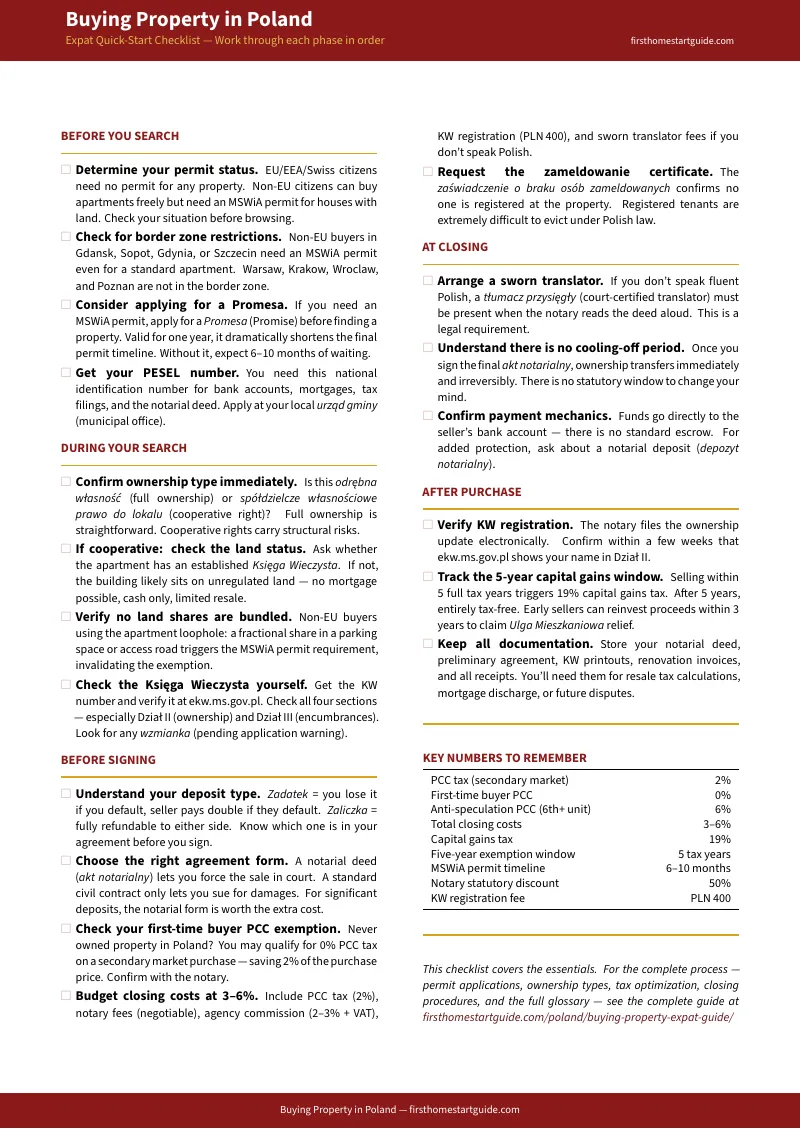
Download the free Quick Checklist to see the step-by-step action plan covering permit status, border zone verification, ownership type checks, Ksiega Wieczysta verification, deposit strategy, and the PCC exemption. When you're ready for the full Foreign Buyer's Compliance System — complete with the MSWiA Permit Decoder, Cooperative Ownership Decoder, True Cost Calculator, Foreign Buyer Mortgage Navigator, Developer Protection Decoder, and Exit Strategy — the complete guide is here.
You've found the property. Now decode the legal system that stands between you and the keys.