
You Got Bond Approval. Nobody Told You About the R76,000 Bill That Comes Next.
Your bank said yes. You celebrated. Then your transferring attorney sent an invoice for transfer duty, conveyancing fees, Deeds Office registration, bank initiation charges, and bond attorney costs — and the number was larger than anything you budgeted for. Because every calculator you used online showed the monthly repayment. None of them showed the cash you need to hand over before the property is even yours.
Then you discovered the timeline. Eight to twelve weeks. Three separate sets of attorneys — the transferring attorney (paid by you but appointed by the seller), the bond registration attorney (appointed by your bank), and the bond cancellation attorney (appointed by the seller's bank). A Deeds Office queue where your documents sit for 7 to 10 working days before a five-day registration window even opens. And your landlord wants 30 days' notice on your lease — but your attorney can't confirm a registration date until week nine.
Meanwhile, your colleague at work mentions she got R121,000 from the government toward her deposit — a non-repayable cash grant called First Home Finance that you had never heard of. She earned R18,000 a month, applied through her bond originator before transfer, and the NHFC paid the grant directly into her bond. You earn R16,000. You would have qualified too. But you already registered at the Deeds Office last month, and in Gauteng, retrospective applications are rejected outright.
The South Africa First-Time Home Buyer Guide is a Transfer-Ready Buyer System — a structured walkthrough that takes you from credit score preparation through Deeds Office registration with every cost calculated, every deadline mapped, and every subsidy claimed before it's too late. Not a summary of what to expect. A process that prevents the exact mistakes that cost first-time buyers tens of thousands of rands every month across Gauteng, the Western Cape, and KwaZulu-Natal.
What's Inside the Transfer-Ready Buyer System
Fourteen chapters plus three printable worksheets — following the buying process in order, with the real 2025/2026 numbers, not generic advice that could apply to any country:
The First Home Finance Timing Engine
The government offers a non-repayable cash grant of R38,911 to R169,265 for households earning R3,501 to R22,000 per month — but only if you apply at exactly the right moment. In Gauteng, the NHFC generally rejects retrospective applications after transfer. In the Western Cape, you have up to two years post-transfer. In KZN, twelve months. The guide maps the full sliding scale, shows how to use the grant strategically as a deposit (which lowers your interest rate and monthly repayment, not just the purchase price), and gives you the exact application sequence so you never lose eligibility through bad timing.
The Transfer Cost Calculator (Printable Worksheet)
Transfer duty at the 2025/2026 SARS brackets (0% below R1,210,000, then 3%, 6%, 8%, 11%, 13% on progressive bands). LSSA-guideline conveyancing fees. Deeds Office lodgement fees at the April 2026 rate of R52 per lodgement. Bank initiation fees. Bond registration attorney costs. Worked examples at R800,000, R1,200,000, and R2,000,000 purchase prices. One worksheet that replaces every calculator that only shows you the monthly repayment and hides the upfront cash requirement.
The Bond Originator Strategy
Applying directly to your bank gets you one offer at one interest rate. Using ooba or BetterBond submits the identical application to up to eight banks simultaneously — ABSA, FNB, Standard Bank, Nedbank, and more. The banks know they're competing on an open platform, so they offer rate concessions below prime. The service costs you nothing — the bank pays the originator's commission. The guide shows exactly how a 0.25% rate reduction on a R1,500,000 bond over 20 years saves approximately R85,000 in total interest. Skipping this step is one of the most expensive mistakes a first-time buyer can make.
The Three-Attorney Conveyancing Timeline
Week by week from OTP signing through Deeds Office registration. FICA verification in weeks one to four. Rates clearance, compliance certificates, and document signing in weeks five to eight. Lodgement, examination, and the five-day registration window in weeks nine to twelve. The guide explains what triggers each phase, where municipal delays cause backlogs (Gauteng rates clearance can stretch to 30-60 days), and why you must not terminate your lease or commit to a moving date until your transferring attorney confirms lodgement.
The "Big 5" Compliance Certificate Negotiation Guide
Electrical, electric fence, gas, beetle (coastal), and plumbing (Cape Town only). The seller is legally obligated to provide these certificates — but if the property fails inspection, the cost of remedial work can run into tens of thousands of rands. The guide shows how sellers try to shift this cost to buyers through small price reductions that don't cover the actual repair, and how to negotiate from a position of knowledge rather than desperation to close the deal.
The Sectional Title Health Check (Printable Worksheet)
The three financial documents every buyer must demand before making an offer on an apartment or townhouse: the latest audited financial statements, the 10-year Maintenance, Repair and Replacement Plan (MRRP), and two years of AGM minutes. The guide explains the STSMA minimum reserve fund contribution rules — if the reserve fund is below 25% of the previous year's admin fund, the body corporate must contribute at least 15% of the new budget. If it's depleted, special levies are coming. The printable worksheet gives you a structured checklist for auditing any scheme's financial health at a glance, plus your legal right under PMR 26 to access these records.
Solar and Backup Power Budgeting
Load-shedding is a structural reality, not a temporary crisis. Entry-level inverter plus battery: R40,000 to R60,000. Grid-tied solar without battery: R55,000 to R70,000 (useless at night). Hybrid solar system with full backup: R120,000 to R150,000+. The guide covers each tier, what to check at every property viewing, and how to negotiate solar installation financing into your primary bond application so the cost doesn't wipe out your emergency savings in month one.
Regional Buying Strategies
Gauteng: municipal delays, outer suburb value (Roodepoort, East Rand, Centurion), 44.2% of national first-time buyer applications. Western Cape: the semigration premium, 1.07% vacancy rate, mandatory plumbing COC, entry-level suburbs shifting to Brackenfell, Kuils River, and Blouberg. KZN: coastal compliance requirements, 30-60 day rates clearance backlogs, growth in Umhlanga Ridge and Sibaya. Each market analysed with realistic price ranges and the specific traps that catch outsiders.
Who This Guide Is For
This guide is for first-time home buyers in South Africa who:
- Got bond pre-approval and assumed the hard part was over — then discovered a 12-week conveyancing process, three sets of attorneys, and upfront costs that nobody mentioned during the application
- Earn between R3,501 and R22,000 per month and might qualify for up to R169,265 in government grant money — but don't know the application timing rules or the provincial differences that determine whether they can still apply
- Are comparing sectional title units and have no idea how to audit a body corporate's financial health, what the reserve fund rules mean, or how to spot a scheme heading for special levies
- Applied to one bank for a bond, got one interest rate, and didn't know that a bond originator would have submitted the same application to eight banks and forced a competitive rate below prime — at no cost
- Are buying in Cape Town and don't know about the plumbing compliance certificate that no other city in South Africa requires, or the damp issues that come with buying in a winter-rainfall climate
- Need to know how much cash they actually need before registration — not just the monthly repayment, but the total transfer duty, attorney fees, Deeds Office costs, and bank charges at their specific price point
Why Not Free Resources?
Free information about buying property in South Africa is abundant. Here's what it actually delivers:
- Property24 and Private Property are excellent at showing you what's for sale. Their buyer guides cover the basics — get pre-approved, find an agent, sign the OTP. They never explain how to audit a body corporate's reserve fund, negotiate when a compliance certificate fails, or calculate the true transfer cost at your specific price point. They are listing portals. Their job is to show you properties, not to prepare you for what happens after you make an offer.
- Your bank's home loan centre provides a bond calculator, a pre-approval process, and a customer service line. What it will never provide: a recommendation to use a bond originator who submits to competing banks, a warning that their conveyancing attorney quote is negotiable by 10-20%, or advice on a government subsidy that reduces the amount you need to borrow from them.
- ooba and BetterBond offer excellent bond origination services and educational content about the financing process. But their content stops at bond registration. They don't cover compliance certificate negotiations, voetstoots risks, body corporate audits, or the post-purchase reality of budgeting R120,000+ for backup power.
- Reddit and Facebook groups (r/personalfinanceza, r/capetown, Property24 forums) contain genuinely useful lived experience mixed with advice that was accurate in 2023 before the transfer duty thresholds changed, the First Home Finance subsidy amounts were updated, and the Deeds Office fee schedule was revised. Sorting current from outdated takes longer than reading a guide that uses the actual 2025/2026 figures.
This guide fills the neutral advisory gap — the space between listing portals that show you properties and financial institutions that sell you their own products. It covers the complete process from credit preparation through post-registration settlement, using every current figure, in one structured resource that no single free tool, bank, or originator provides.
— Less Than One Hour of a Conveyancing Attorney's Time
A transferring attorney's professional fee starts at R6,640 plus VAT for a property under R100,000 and scales rapidly from there. A home inspection runs R3,000 to R5,000. Transfer duty on a R1,500,000 property is R13,614. The remedial electrical work needed to pass a compliance certificate on an older property can cost R15,000 to R40,000.
This guide doesn't replace your attorney or your bond originator. It ensures you walk into every attorney meeting, bank appointment, and property viewing knowing exactly what you should be paying, what you can negotiate, what the government will give you for free, and what the 12-week timeline actually looks like — instead of discovering each cost as an invoice arrives.
If it prevents a single missed First Home Finance application, catches a single body corporate with a depleted reserve fund, or saves a single unnecessary percentage point on your bond interest rate, it pays for itself before you've finished Chapter 4.
Money-back guarantee, no time limit. If the guide doesn't make your home buying process clearer and your financial position stronger, you pay nothing.
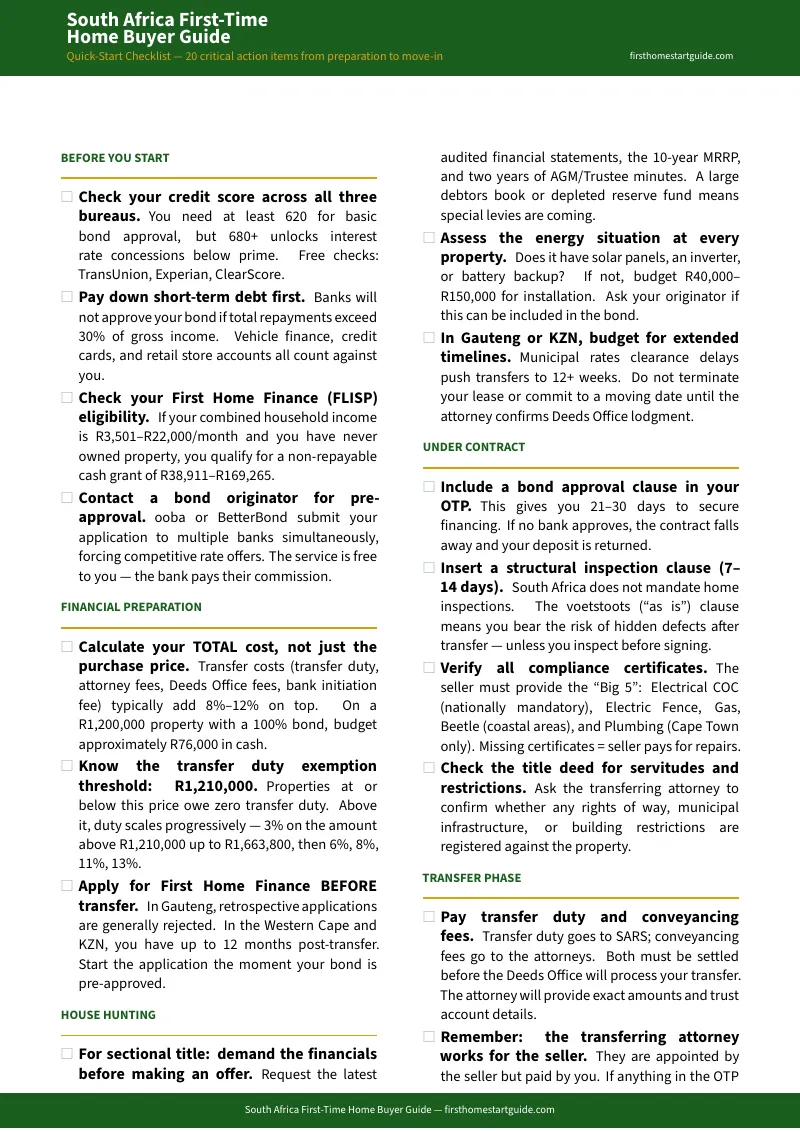
Download the free Quick-Start Checklist to see the 20-step action plan covering credit preparation, First Home Finance eligibility, and transfer cost awareness. When you're ready for the full Transfer-Ready Buyer System — with the subsidy timing engine, cost calculator worksheets, compliance certificate negotiation strategies, and regional buying analysis — the complete guide is here.
You've got the approval. Now build the system that gets you the keys without losing R100,000 along the way.
Frequently Asked Questions
What if the rules change after I buy?
We update the guide when the rules change. Email us any time, even years later, and we'll send you the current edition free.