
The Yield Looks Great on Property24. South African Law Will Decide Whether You Keep It.
You found a two-bedroom apartment in Randburg listing at R1,100,000 with tenants paying R9,500 a month. Or a student digs opportunity near Stellenbosch where NSFAS-accredited beds fill themselves. Or five new sectional title units from a developer brochure promising Section 13sex tax write-offs that offset your PAYE. The gross yield clears 8%. The numbers work.
Then reality shows up. The Randburg tenant stops paying rent and you change the locks — only to receive a letter from their attorney informing you that self-help eviction is a criminal offence under the PIE Act carrying up to two years imprisonment, and now you are the defendant. The Stellenbosch student property needs a shuttle service because it sits 3.2 km from campus, and your NSFAS accreditation inspection fails on ablution ratios — one shower for every seven students, not the five you built for. The developer's Section 13sex projections forget to mention that selling any of the five units triggers a Section 8(4)(a) recoupment that adds the entire depreciation claimed back to your taxable income in the year of disposal, at your marginal rate.
Here's what no single resource explains: South Africa layers constitutional tenant protections (the PIE Act makes court-ordered eviction the only legal path, and the process takes 3 to 12+ months), a tax system with powerful but trap-laden incentives (Section 13sex depreciation requires five new units held solely for trade, ring-fencing rules under Section 20A can lock away your rental losses, and recoupment provisions on disposal can eliminate years of tax savings in one assessment), sectional title financial risks (special levies transfer automatically to buyers on registration under the STSMA), mandatory compliance certificates (electrical, gas, plumbing, beetle, electric fence), and municipal-specific regulations (Cape Town's 50% room-night threshold reclassifies your property as commercial) into a regulatory environment that punishes investors who apply assumptions from other markets to South African problems. Every one of these has cost real investors real money — not because the information didn't exist, but because it was scattered across conveyancing attorney blogs, SARS interpretation notes, body corporate management circulars, and Reddit threads that may have been accurate before the latest legislative amendment.
The South Africa Investment Property Guide is a South African Investor Compliance and Yield System — not a motivational overview of property investing, but a structured due diligence framework that maps every South Africa-specific legal requirement, tax calculation, entity structuring decision, and regional yield profile into a process you work through before you sign the Offer to Purchase. It replaces months of cross-referencing conveyancing attorney advice, SARS tax guides, body corporate circulars, and municipal by-laws with a single reference that tells you exactly what to verify, exactly how the numbers should work, and exactly where deals go wrong.
What's Inside the South African Investor Compliance and Yield System
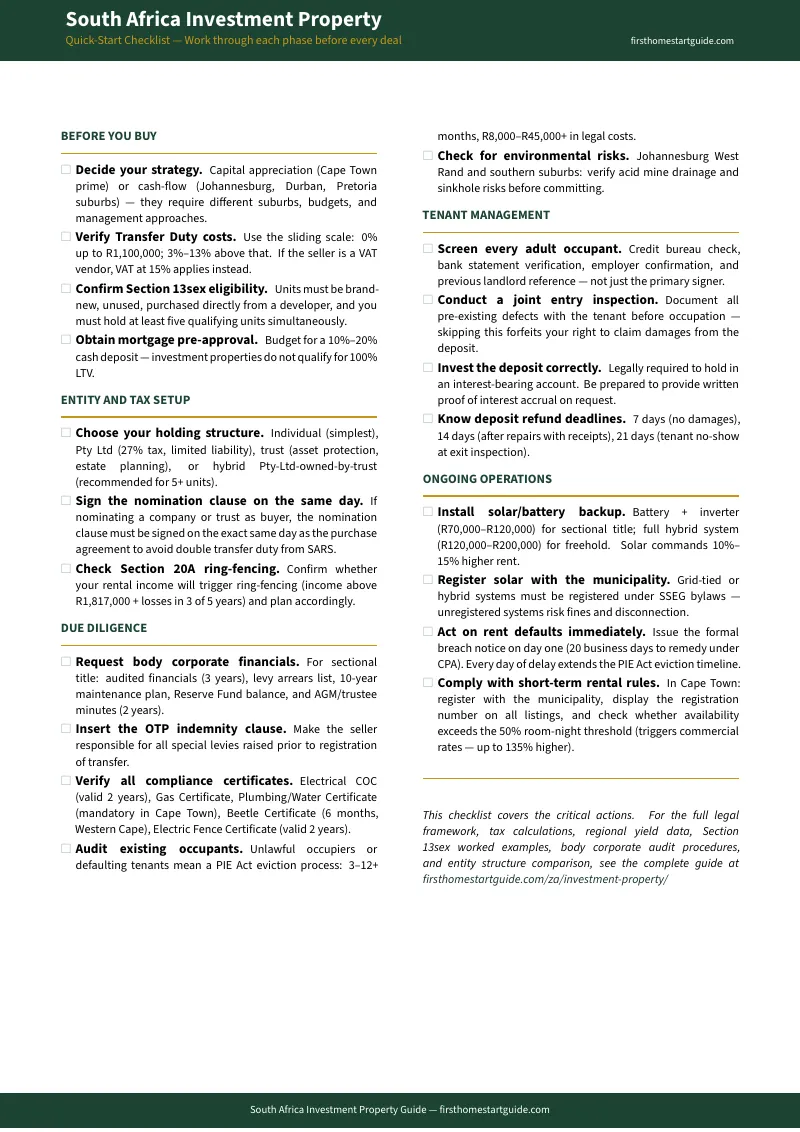
A 17-chapter guide, a standalone 20-item due diligence checklist, and 8 printable tools (Transfer Duty worksheet, entity comparison card, Section 13sex calculator, PIE Act eviction timeline, body corporate audit checklist, four-metro yield reference, compliance certificates tracker, and solar ROI worksheet) — covering every stage from entity structuring through post-purchase operations, built specifically for the legal and tax complexity that makes South Africa different from every other property market:
The PIE Act Eviction Framework
The single most dangerous legal trap for South African landlords. Self-help eviction — changing locks, disconnecting utilities, intimidating occupiers — is a criminal offence carrying fines or up to two years imprisonment. Every eviction must follow a six-stage court process from lease cancellation through sheriff-executed removal. Uncontested evictions take 3 to 6 months; contested cases routinely exceed 12 months. The court must assess whether eviction is "just and equitable," considering vulnerable household members and municipal housing availability. The guide maps the entire process, timeline, and cost structure (R8,000 to R45,000+) so you budget legal risk into every deal from day one — not after your first non-paying tenant files an opposition.
Section 13sex Tax Depreciation — The Full Calculation
South Africa's most powerful residential property tax incentive — and its most misunderstood. Section 13sex allows straight-line depreciation deductions on new residential rental stock, but only if you meet five strict statutory criteria simultaneously: the units must be brand-new and unused, you must hold legal title, they must be in South Africa, used solely for residential letting (no mixed-use, no personal occupation), and you must own a minimum of five qualifying units at all times. Drop below five, and the remaining properties lose their allowance from that tax year onward. The guide includes worked examples using deemed cost percentages for sectional title (55% of purchase price qualifies) and new improvements (30%), calculates the actual cash-flow impact at your marginal tax rate, and explains the Section 8(4)(a) recoupment trap that adds all previously claimed depreciation back to your taxable income when you sell.
Ring-Fencing and Loss Offset Analysis
When your rental property generates a loss — from mortgage interest, operating costs, and depreciation exceeding rental income — you want to offset that loss against your salary or other income. Section 20A of the Income Tax Act determines whether you can. The guide walks through the four-step ring-fencing sequence: marginal tax rate check, suspect trade classification, the "facts and circumstances" escape clause, and the six-out-of-ten-years permanent lock. High earners above R1,817,000 face mandatory assessment. The proposed removal of the income threshold means every individual investor may soon be subject to ring-fencing — the guide covers what this means for your portfolio's after-tax cash flow.
Sectional Title Body Corporate Due Diligence
Under the STSMA, special levies raised before registration of transfer automatically become the buyer's liability for any remaining instalments. One resolution by the body corporate trustees can impose tens of thousands of rands in unbudgeted costs — lift replacements, roof waterproofing, security upgrades — weeks after you take ownership. The guide provides the complete pre-acquisition audit checklist: Reserve Fund adequacy, arrear levy levels (high defaults mean paying owners subsidise non-payers), audited financial statements, and trustee meeting minutes. It includes the exact OTP indemnity clause that makes the seller responsible for all special levies raised prior to transfer — and explains why the old Sectional Titles Act protection no longer applies.
Compliance Certificate Requirements
No property transfer registers without mandatory compliance certificates. The guide covers each one: Electrical Certificate of Compliance (entire installation must comply), Gas Conformity Certificate, Plumbing/Water Certificate (mandatory in Cape Town — storm-water separation from sewerage), Beetle Certificate (critical in Western Cape), and Electric Fence Certificate. For distressed property purchases, where the bank or sheriff shifts certificate costs to the buyer, the guide explains how to incorporate compliance costs into your acquisition bid and budget for the renovation surprises that older properties consistently deliver.
Regional Market Analysis — Four Metros, Matched to Strategy
Cape Town (capital appreciation: 6.2-week average sale speed, Atlantic Seaboard prime to Northern Suburbs value plays), Johannesburg (cash-flow: Bedfordview, Midrand, Sunninghill, Sandton Central with gross yields up to 10.3%), Durban (highest gross yields in the country: Musgrave, Morningside), and Pretoria (Garsfontein, Arcadia — stable government and institutional demand). Each metro broken down by representative suburb, average price, average rent, gross yield, and net yield. Know which game you are playing — appreciation or cash flow — before you sign.
Solar and Utility Resilience Modelling
Municipal electricity tariffs have escalated 8% to 12% annually over five years, making solar PV a direct driver of net rental yields. Properties with hybrid solar and battery systems command 10% to 15% higher rent and suffer near-zero vacancy. The guide covers system sizing (inverter + battery for sectional title at R70,000–R120,000, full hybrid for freehold at R120,000–R200,000), SSEG registration requirements to avoid municipal fines, and the financial model that shows solar payback within a standard investment horizon.
Student Accommodation — NSFAS and Private Models
The NSFAS-accredited model offers guaranteed demand but requires strict DHET compliance: property within 5 km of campus (or provide a shuttle), minimum 7.5 m² single rooms, specific ablution ratios (1 shower per 7 students, 1 toilet per 5), kitchen equipment ratios, high-speed internet, and laundry facilities. Registration costs R5,000–R15,000 per bed. Monthly rents are capped by regional allowance. The luxury private digs model commands premium rents but faces three-month summer vacancy — the guide covers the hybrid student/tourism model that offsets the income gap.
Who This Guide Is For
This guide is for property investors targeting the South African market who:
- Are evaluating a South African rental property and need to understand whether the deal actually works once you account for Transfer Duty calculations, conveyancing attorney fees, body corporate levies, compliance certificate costs, and the PIE Act eviction timeline — not the simplified yield projections from the listing agent or developer brochure
- Are considering Section 13sex tax depreciation and need to verify whether your portfolio structure actually qualifies — the five-unit minimum, the new-and-unused requirement, the solely-for-trade restriction, and the recoupment liability on disposal — before your accountant structures a transaction based on incomplete information
- Are buying a sectional title unit and need the body corporate due diligence checklist and OTP indemnity clause that prevents inheriting special levies raised before you took ownership
- Have a non-paying tenant and need to understand the lawful eviction process under the PIE Act — timeline, costs, court requirements — before making the mistake of changing locks or disconnecting services
- Are evaluating student accommodation near a South African university and need to know the exact NSFAS accreditation requirements, DHET spatial standards, and rental caps before committing capital to a model where non-compliance means zero government-funded tenants
- Want every South Africa-specific regulation, tax calculation, entity structuring option, and regional yield profile in one reference — instead of assembling it from conveyancing attorney blogs, SARS interpretation notes, body corporate management circulars, and forum threads from before the latest legislative amendment
Why Not Free Tools and Forums?
Free information on South African property investing exists across dozens of sources. Here's what it actually delivers:
- Property24 and Private Property articles cover market trends and suburb profiles but don't explain how to calculate Transfer Duty on the sliding scale, how Section 13sex deemed cost percentages work for sectional title (55%) vs. new improvements (30%), or how Section 20A ring-fencing determines whether you can offset rental losses against your salary. You get market sentiment without the tax and legal analysis that determines whether a specific deal works.
- Reddit and Facebook investor groups (r/personalfinanceza, South African Property Investors) are where someone says Section 13sex applies to renovated stock (it doesn't — new and unused only), someone else says you can offset unlimited rental losses against PAYE (ring-fencing applies above the marginal rate threshold), and a third person recommends changing locks on a non-paying tenant (a criminal offence under the PIE Act). Genuine experience reports exist alongside advice that can trigger criminal prosecution or SARS audits.
- Estate agency buyer guides explain the general process of buying property in South Africa. They don't cover the nomination clause trap (nominate your entity on the same day or pay double Transfer Duty), the body corporate special levy liability shift under the STSMA, the three-attorney model that distinguishes transferring attorney from bond registration and cancellation attorneys, or the going concern VAT zero-rating that can save you 15% on a commercial acquisition.
- Financial advisor recommendations often suggest buying five units for Section 13sex without explaining the operational requirements: all five must be new, all must be used solely for trade, all must be held simultaneously, and disposal triggers full recoupment at your marginal tax rate. The strategy advice exists without the compliance detail that determines whether it works.
This guide fills the South Africa-specific gap — the space between knowing that property investing works in principle and knowing how to structure, evaluate, and operate a portfolio under the specific legal, tax, and regulatory framework that governs every rand you invest in South African residential real estate. It's the analysis that would take a conveyancing attorney, a property tax specialist, and a sectional title management expert to assemble — structured as a reference you own permanently.
— Less Than One Body Corporate Special Levy
A single special levy you didn't know about can cost tens of thousands of rands within months of taking ownership. A self-help eviction attempt on a non-paying tenant exposes you to criminal prosecution and legal costs of R8,000 to R45,000+. A Section 13sex portfolio that drops below five units loses the depreciation allowance going forward. An unregistered solar installation risks municipal fines and disconnection. A Cape Town short-term rental that exceeds the 50% room-night threshold gets reclassified to commercial rates — up to 135% higher.
This guide doesn't replace your conveyancing attorney or your tax advisor. But it gives you the PIE Act eviction framework, Section 13sex qualification checklist, body corporate due diligence process, compliance certificate requirements, and regional yield analysis that ensure you identify every South Africa-specific risk before you sign the Offer to Purchase — instead of discovering them on your first body corporate AGM, your first SARS assessment, or your first tenant dispute.
If it catches a single special levy liability, prevents a single unlawful eviction attempt, or saves you from a Section 13sex structure that doesn't qualify, it pays for itself before you've finished reading it.
Money-back guarantee, no time limit. If the guide doesn't sharpen your due diligence and protect your capital in South Africa's regulatory environment, you pay nothing.
Download the free South Africa Quick-Start Checklist to see the 20-item due diligence framework covering entity setup, pre-purchase research, compliance certificates, tenant management, and ongoing operations. When you're ready for the full PIE Act analysis, Section 13sex calculations, body corporate audit procedures, and 17-chapter investment system, the complete guide is here.
The yield looks good on the listing. This guide tells you whether South African law agrees.